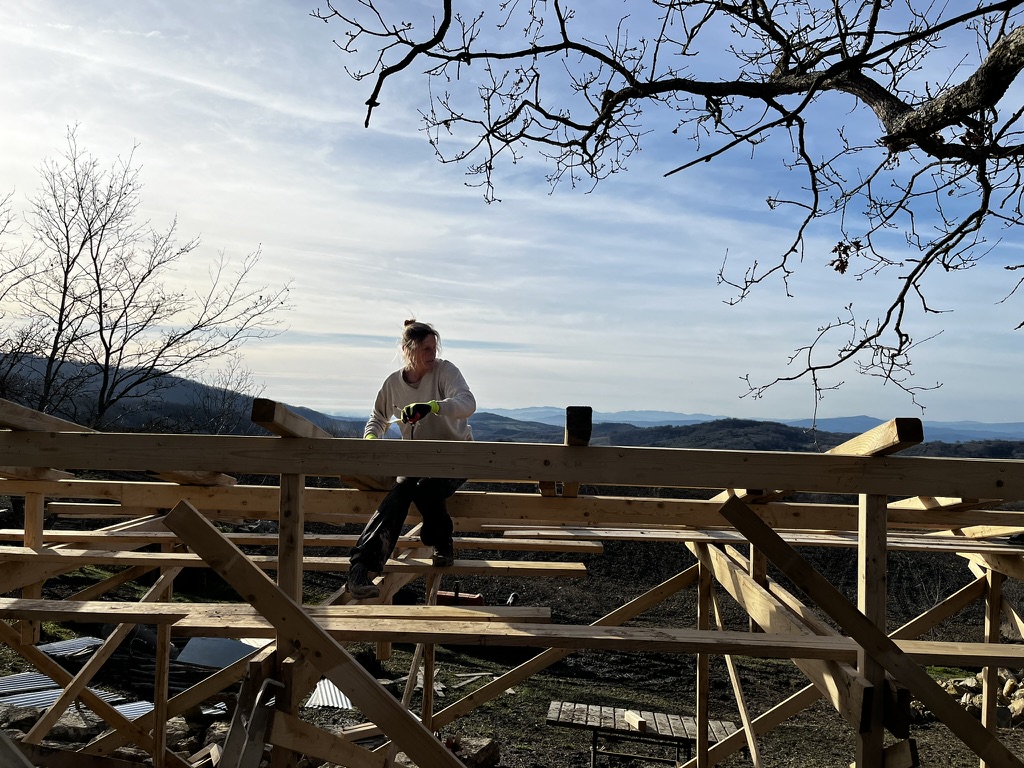
If you didn't have that kind of life, there wouldn't be a farm, right?
Everything is connected. I think a lot of people who have led similar lives end up seeking peace and nature. It just wears you out, tires you, and then you reach a point where you've had enough. And so, you take another leap into the unknown, a radical solution. So far, I'm really enjoying it here and I'm working really hard. We'll see if this is my final chapter.
What does it mean to live a similar life?
Most people stay in their field their whole lives. I can't do that. Even my dancing has been incredibly varied. When I look back, I feel like I've lived five different lives. And each one to the fullest, with all the ups and downs. (Author's note: Lenka Flory is referring to her professional career. She gradually moved between the roles of performer, choreographer, and teacher; with the creation of the Déjà Donné ensemble, she also took on managerial and production responsibilities. In addition, she initiated and directed an international festival and a number of community projects, devoted herself to creative and program dramaturgy, and also worked as a set and costume designer.)
How long have you had "nothing to do with" dancing?
Probably since I left Duncan. (Lenka Flory ran the Duncan Centre Conservatory, founded by her mother Eva Blažíčková in 1992, from 2013 to 2014, author's note.)
Already? But you collaborated on several projects after that.
I disconnected at that point. I didn't manage to achieve what I had set out to do at Duncan. The situation was complicated when I joined, and although I managed to at least partially restore the school's international spirit, I couldn't handle the pressure from the staff. I had good intentions, but I lacked patience. Perhaps I didn't know how to present and communicate my ideas well. At that time, I already knew that by leaving Duncan, I was ending my relationship with the world of dance. It was over.
So you see the work you did in the field afterwards more as a side job?
Yes, exactly. Because Duncan was the logical culmination of my previous work. By 2013, I already had fifteen years of experience with Déjà Donné, with festivals and grants, and I also had a lot of educational projects and international contacts under my belt. My collaboration with Simon (Sandroni, who was Lenka Flora's professional and life partner for many years; together they founded the Déjà Donné ensemble, which became one of Europe's leading ensembles and travelled all over the world, author's note) had come to an end, and Michal Záhora's offer to take over the school came at just the right moment. I finally felt the strength to give something back: to the students, the school, and the Czech Republic, so I jumped at the chance.
What was your primary goal at Duncan Centre?
I wanted to reconnect the school with the world. With Prague, the Czech Republic, Europe, and beyond. I wanted the students to leave the school with everything a professional dancer needs to know and be able to do these days. That's what I focused on.
What does a dancer need to know and be able to do?
I think they need to understand that they must be human beings first and foremost. Curious human beings. Curiosity automatically leads to experience, knowledge, and opinion. Only then their interpretation or choreography can gain depth and authenticity. Dance technique is a tool, and the more precise it is, the better the final product, but it is not enough on its own.
And what role does school play in this?
The task of the school is to awaken curiosity in students. Without it, it's impossible. Those who start actively searching on their own have a chance. Well, everyone has a chance, but I'm talking about the quality I've always sought. They learn a lot through music, movies, books, but most of all through discussion. They discuss things they have experienced, seen, heard, read... And when they talk to people from another city, it's great, from another country even better, and when from another continent, it starts to have real meaning. The content of the conversation logically expands when it loses its "homely" undertones. In my opinion, this is the breeding ground for quality work.
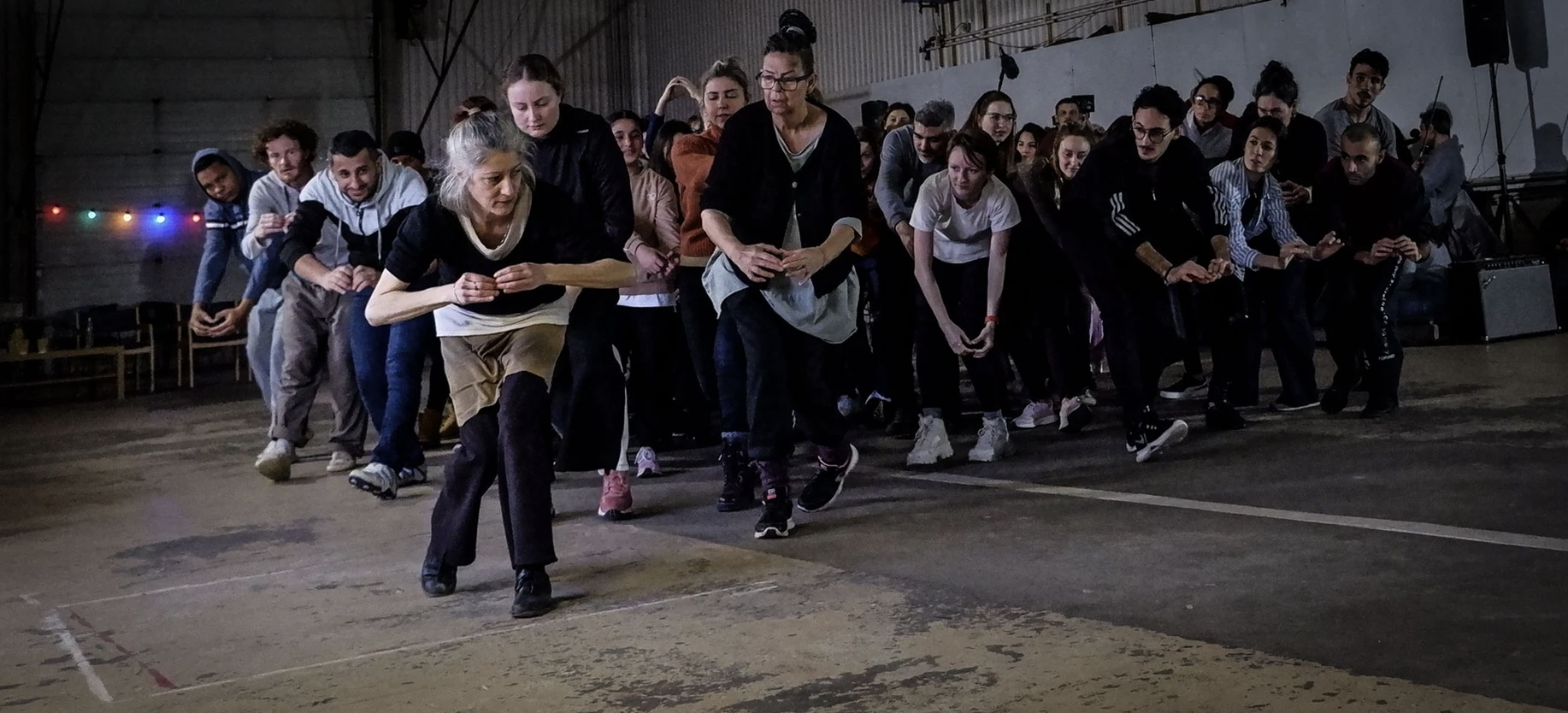
Has the Czech contemporary scene managed to catch up after the delay it suffered during totalitarianism?
In my opinion, no. There is a lack of personal input, courage to take risks, and a real need to communicate something. People create according to trends, grants, or friends. They go on stage because they can and because they like it, not out of a need to create and communicate something through their work. I sense complacency and self-satisfaction in this. No one wants to invest themselves fully, in the spirit of "either I die now or I do it." There is a lack of hunger.
Is the absence of "hunger" also evident in how the work in the studio looks?
When Simon and I had super successful days, we did a minute of choreography in eight hours. Coming up with and fixing a minute so that it makes sense is a terrible job. We worked on one piece for six months, eight hours a day, and after dinner we sat down to work on it again. Sandroni is a really good choreographer. Now everyone is done right away. Not only in Czechia. I have watched a lot of creations, but I have rarely seen anyone lock themselves in the studio for the whole day and work with concentration. Produce a half-hour work during a two-week residency? It's just not possible. Or it is, but the result is obvious. A Slovenian friend of my Hungarian girlfriend once said on an international platform: "There's a difference between cooking dinner for two hours and cooking dinner for ten minutes." That's a good comparison.
Isn't it also about money?
Yes, but it's also about the time you invest in everything, including earning money. And it's about courage. The courage to be different, the courage to throw yourself into something wholeheartedly, without any certainty that it will turn out well.
What parameters must a production have for you to consider it good and want it at your festival?
It's very important to distinguish between what I like and what is actually good.
The former can be very misleading. I have seen pieces that I personally did not find aesthetically pleasing, but I was nevertheless absolutely certain that they were excellent.
For example, the Italian company Societas Raffaello Sanzio. They travel all over the world and do terribly harsh things: they are cruel because they show humanity from only one side. But the way their productions are constructed and what and how they talk about is absolutely fantastic. When I watch it, I suffer, but at the same time I know that I am watching a top-notch performance.
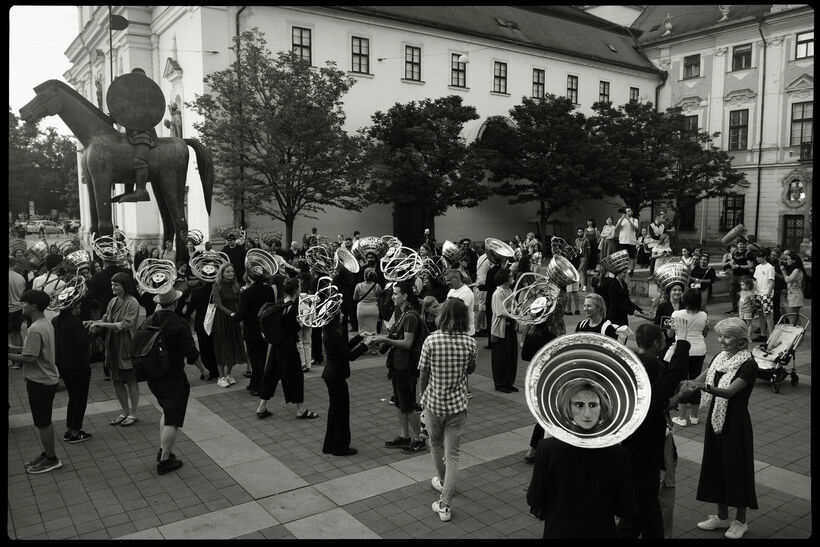
And when you're selecting for the festival?
I mainly look at the idea and how it's constructed. I hate deception. It's very easy to see when a performance is about nothing and is just a way to fill time and satisfy ambition. Then I just see if the idea is relevant for specific viewers and if my selection will be approachable to a specific audience. Because, of course, there's a big difference between looking for a program for Prague or for the region.
In Žďár, it was a different kind of work. (Since 2013, the outdoor festival KoresponDance, which was founded in Prague in 2009 and is organized by the SE.S.TA. Center for Choreographic Development, has been held in Žďár nad Sázavou on the initiative of Marie Kinsky, author's note.) There were many challenges: the performances had to be staged either outdoors or in the castle grounds, which have nothing to do with theatre. Another challenge was the audience itself. In Žďár, we did a lot of educational and social work. It wasn't just about the program, but about getting people who had nothing to do with dance to come to the festival in the first place.
Is there such a thing as a universally good production?
I think so. If we are talking about the very highest level. With excellent art, it doesn't matter whether you present it in New York, Prague, or Žďár: it will inspire everyone. You don't need any preparation to appreciate it, you don't need to know anything about dance, you don't need to read the program. A good performance is simply a good performance and will captivate everyone.
When did you start presenting foreign works in the Czech Republic?
When I was living in Brussels, I felt the need to bring home new information from abroad. Thanks to my collaboration with Wim (Vandekeybus in the Ultima Vez ensemble, where Lenka Flory worked in 1991–1992, author's note), I had an open door at the Vlaams Theater Instituut and was allowed to copy videos. I spent a month there and copied everything that seemed essential to me at the time and took it to Duncan Centre. It was one of the first attempts to introduce the world of authorial creation, which was unknown in Czechia at the time.
Was the effort to bring world-class dance here successful from the start?
Not at all. It took tremendous, almost insane courage. Imagine the year 1992, a country that had been closed off for decades. We started bringing in things that weren't Martha Graham or Merce Cunningham, but contemporary works.
We brought people who came only because of our friendship. The whole concept was based on a plea: "Come and help us show that it is possible to create quality even on a small scale." We wanted to encourage the Czech scene and tune it to a different note. It doesn't have to be a fifty-member ensemble that represents the only quality. People can simply create and perform.
It was very difficult at first. We presented everything at Duncan Centre, we had poor technical equipment, and above all, no audience. No one went to see names they didn't know. We had invited people from Belgium, there were ten people sitting in the hall, and I was looking out the window to see if anyone else was running from the next tram. It was awful. But within two years, we managed to build trust. People understood that even if they didn't know the name, it was worth traveling to Braník Prague district, to the end of the world. Towards the end of the project, we had to send audience members back home because the hall simply couldn't hold more than 140 people. After two years, the project turned into an international festival.
Is it possible today to keep track of everything that the current scene has to offer?
It's almost unthinkable. In the early 1990s, I worked in Brussels, where things were really buzzing at the time, and I naturally gained a huge overview and a comprehensive picture of the European scene at the time. What's more, we all knew each other, there was less going on, and program dramaturgy was different. If you wanted something, you had to see the work live. Today, the world is completely different. Everything is done mainly through a computer screen. Reading annotations, watching videos...
But there is a difference between seeing a work live and seeing it on video.
Of course. Video is deceiving. You learn to watch it and take it in, but still. It's also very important to have the chance to talk to choreographers in person. To find out what their work is really about, what kind of person they are. Then it's easier to really stand behind their work during the promotion phase. It always annoyed me when journalists asked me what my hit was at the festival. I regularly replied that they were all hits. That's why I chose them. We don't have fillers at the festival.
It seems to me that today the program is put together in a completely different way. Only few people really have an opinion. It doesn't matter what's good and what's not, they choose what's "hot" at the moment, what sells well, what has a famous name, what gets applause. Everything revolves around money, the work itself is only of secondary importance.
It's not that I despise applause and sold-out halls, on the contrary, but I want to present what I believe in and take a risk with audience reception.
In the Czech Republic, the allocation of grants is traditionally a big topic at this time of year. How should the money be distributed?
Based on previous work. It's very easy to fool people with a grant application; you can basically write anything you want.
But if you judge it based on results, new artists won't get a chance at all.
We'll talk about "artists" later; I would call them budding choreographers. How do they know they are choreographers when they haven't choreographed anything yet? It may sound like something from another world, but we had to do it without money at the beginning. Only when we put together our first full-length show could we say, "We did this." There were no European or national subsidies, so we had to make a living by simply selling performances. And we had to work very hard to do that.
And what did you live on before you made a breaktough?
It's an investment, like anything else. Investing time, energy, and attention in something I believe in. We put together our first production, ...and where is Marie?, in our free time; it was practically an amateur production. We took it to the first Czech Dance Platform, which was also held at Duncan Centre: if you had seen it, you would have laughed yourself silly. But there were also people from the American Dance Festival (ADF), The Turning World festival in London, and several festivals in Germany and France. Of course, we all performed for free and only then did we get our first paid engagements: in London, Germany, and six weeks at the ADF. It was great there: we performed Marie at the festival and I also got an offer to work with the festival students. The fee for all of this was about ten thousand dollars at the time. It was with this money that Déjà Donné (the production that subsequently gave its name to the emerging ensemble, author's note) was created, without a single co-production. And it was on the basis of Déjà Donné that we obtained our first real co-productions from four brilliant European theatres and our first subsidies in Czechia.
In today's world, where social security and the status of artists are being discussed, is it really right to expect emerging artists to have “to hassle” like this?
Support is obviously necessary, without it nothing works, and ultimately we are serving society. But I think it's right that everyone has to start on their own first. First you have to invest your own work to find out if you are capable and what the result of your efforts will be.
A lot of people think they are artists, but in reality they just want to be. This personal use of the status of artist generally annoys me terribly. About ten or fifteen years ago, things suddenly changed, and people stopped saying: I am a writer, violinist, dancer, actor, choreographer. When asked, "What do you do?", they answer, "I'm an artist." Oh, really? Who said you're an artist? Work and let others call you that. I also think I'm a model. It's just that no one wants to photograph me. That's weird...
So, a person has to do something first and only then ask for a grant.
Exactly. Before I start asking for money, I have to know that I can do it. I can't write a "nice" project, send it to the city hall, get a hundred thousand, and only then find out that I'm not very good at it. But I'm not going to return the hundred thousand. I'll "knock something up" and that's it. It'll go through anyway, my friends will come, applaud, and everything will be fine.
I'm terribly cynical, but I don't think everyone is entitled to everything right away. Everyone should have the right to work and to a dignified life, I agree, but that's not compatible with someone just deciding that from now on they're going to call themselves an artist. So first ride the tram and find out if you're an artist.
You have devoted a large part of your professional career to community projects. But it started with grants, right?
I first really got into it when I was working on My Name is King. That's when I discovered that I could communicate with people and draw them into the story. My original motivation was purely pragmatic: we wanted a grant from Creative Europe. I had everything arranged, including co-productions, and I just needed an "excuse" to base the project on. Connecting with schools seemed like the obvious choice. It was just an excuse until I actually started doing it and realized that I had discovered enormous potential.
What is the source of this power?
You see people transform. The initial distrust with which they listen to you. What we experienced together in the Be Part! project. At first, people laugh at you, distrust you, or feel that you want to take advantage of them. You have to find a way to reach them. "Recruiting" people for the project is incredibly exciting and fun for me.
And then you see the results. It was incredible with the children. Unruly, aggressive children, whom teachers claimed were incapable, became the best protagonists. On stage, these "brats" were absolutely divine. They were focused, active, and went the extra mile. I had the same experience in Munich, where I worked on the Anna tanzt project for the Bavarian State Ballet for five years. We brought together children from a prestigious high school with two classes from a vocational school, where most of the students were foreigners who hardly spoke any German. For a month, we spent five hours a day together instead of going to school, putting together a performance. And it was a blast. I saw how those kids changed.
Do you believe that even if you only show up for a few weeks and then disappear again, something will last?
It's about creating an atmosphere and enabling connections between people who would otherwise never meet. A 14-year-old boy from a wealthy Munich family meets a Turkish girl in a headscarf who at first refuses to lie down on the ground because it's against her culture. And it ends up with the girl lying on the ground, happy and talking to the boy who might have just shouted rude things at her before. You make that possible. I believe that at the very least, overcoming their fear will remain with them—they won't be so quick to judge others.
What you describe as an "excuse for a grant" happens quite often. At the European grant level, integration and the secondary impacts of art are highly sought after. Isn't that wrong?
It's a crazy interesting topic. You wonder why Europe puts it out there like that. They know that thousands of activities will be attached to it, stimulated only by money, not by an internal need. But I think they don't care, because these things are happening. And that's what matters. The conditions are strict, and they make sure that people really connect. Artistic quality is not the most important thing. Besides, who is going to judge it? The main thing is that people have met.
Don't you miss those ambitions today?
But I do have them, they've just shifted elsewhere. Now I'm putting them into the farm. It's the same excitement and I think I'm starting to get to know myself here. It sounds awful, but it's true...
I'm learning a lot of things: to accept the weather, not to exhaust myself on the first day of a new project, to work with a chainsaw, and hopefully one day with a tractor, but mainly that I can't force everything I want to happen. Sometimes things just don't work out, and that's okay. It's not necessarily my failure. I'm learning patience and not to push too hard. If I were to return to my profession after this experience in the mountains, I would do things differently. With more respect and more slowly. I would recommend the farm to everyone, especially people from the city. They should try a year of life on a farm on their own responsibility. The world would be a better place right away. Here, I've learned to almost like myself sometimes, and that's the biggest success for me. And what I do here with eight hectares of land is, in the end, scenography.
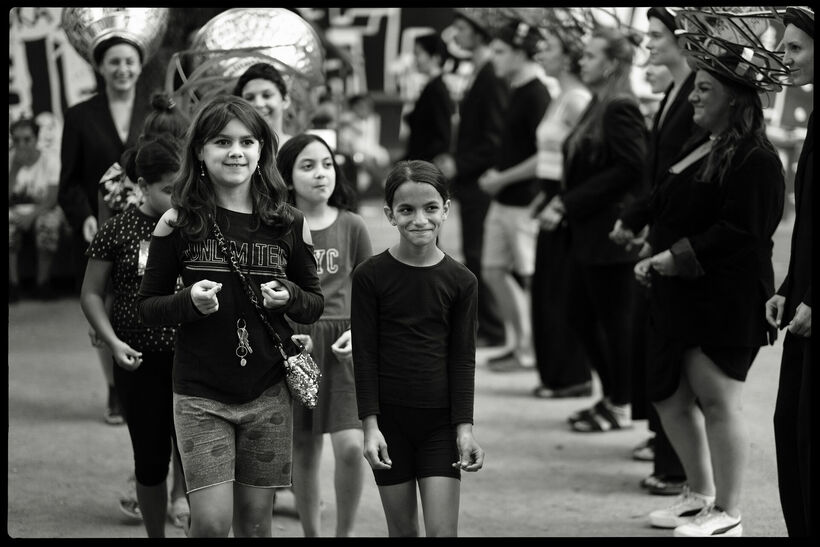
Lenka Flory is a choreographer, creative producer, and co-director of BPART. As a performer, she has collaborated with Studio Komorního Tance in Czechia, Czurda Tanztheater in Germany, and Ultima Vez in Belgium. From 1992 to 2004, she taught at the Duncan Centre Conservatory, founded and led the Project of Progressive Personalities of European Dance Theatre, and organized the international festival Konfrontace. From 1997 to 2013, she founded and, together with Simon Sandroni, led the international ensemble DEJA DONNE, whose work has been presented in 26 countries around the world. As a director, choreographer, tutor, teacher, set designer, and manager, Lenka Flory has participated in international projects around the world. She has collaborated with the National Theatres in Prague and Brno and with the Bavarian State Ballet. In 2013–2014, she directed the Duncan Centre Conservatory. Since 2015, she has been working as an independent manager and producer of international artistic and community projects.