
The painful fate of Frida Kahlo was revealed in published excerpts from her diaries and correspondence. She became the inspiration for several books and films, and theater artists repeatedly return to her story. Figuratively speaking, Frida sang in opera and danced in ballet. The Czech audience first encountered the dance interpretation of her life in 1998, when the Volksbühne Berlin brought the production Frida Kahlo to the Divadlo festival in Plzeň. In it, Johann Kresnik focused with a great deal of harsh expression on the theme of pain, which was present throughout the painter's adult life. Czech critics were divided in their reception of Kresnik's work at the time – some wrote about its superficial effect (e.g. Jan Kolář and Helena Kazárová), while others praised the bold power of its theatrical and artistic gestures (Vladimír Hulec and Nina Vangeli).
Frida Kahlo's life was full of pain, but in Liberec they see it as a romantic love story. It's a shame, but why not?
The life of Mexican painter Frida Kahlo was full of passion and pain, and above all, admirable strength. To a large extent, this was reflected in her original artistic style, which often mirrored her inner world in the form of self-portraits. It is no wonder that it has inspired and continues to inspire numerous artistic works, as evidenced by the latest ballet premiere in Liberec.


However, interest in Frida Kahlo among choreographers working in Czech Republic was largely sparked by the premiere of director Julie Taymor's successful film in 2002. In fact, everyone used Elliot Goldenthal's film soundtrack – Jan Kodet, Robert Balogh, and most recently Marika Mikanová. Kodet's choreography (originally created in 2004 for the Prague Dance Conservatory and restaged four years later at the National Theater Brno as part of the World of Desire program) was loosely inspired by the painter's life, working more with symbolism and motifs from her life than following her biography. Kodet's work already featured Death as a personified antagonist, or rather a companion to the title character. Robert Balogh prepared his first half-hour version of Frida in 2006 for the Divadelní Flora festival, and five years later he developed the theme into a full-length ballet at the Moravian Theater in Olomouc. In his production, the theme of pain and "lurking" death was very strongly present – whether in the symbolic figures of Death, Grim Reaper, and Pain, or in the large-scale allegory of death in the form of a dance of skeletons.
Marika Mikanová first focused on the Mexican painter in 2020 at the Ústí nad Labem ballet company, and this year she returned to the theme twice – in the spring in Banská Bystrica and now in her home town of Liberec. Incidentally, this is already the third Liberec adaptation (i.e., not a simple transfer) of her production, which was originally created for the Ústí ballet company (after The Snow Queen and The Taming of the Shrew). The Liberec production has a lot in common with the Banská Bystrica Frida (including almost identical sets and costumes by Aleš Valášek).
The life of Frida Kahlo offers a number of compelling themes on which to build the main framework of the production. Often, the main theme in artistic interpretations has been her struggle with permanent pain after a fatal traffic accident. Naturally, her complicated relationship with the painter Diego Rivera comes to mind, but also her strongly left-wing political preferences and her relationship with the exile Lev Trotsky. Last but not least, her characteristic artistic style with symbolic and surreal features, in which the main subject is often the painter herself, has great inspirational potential.
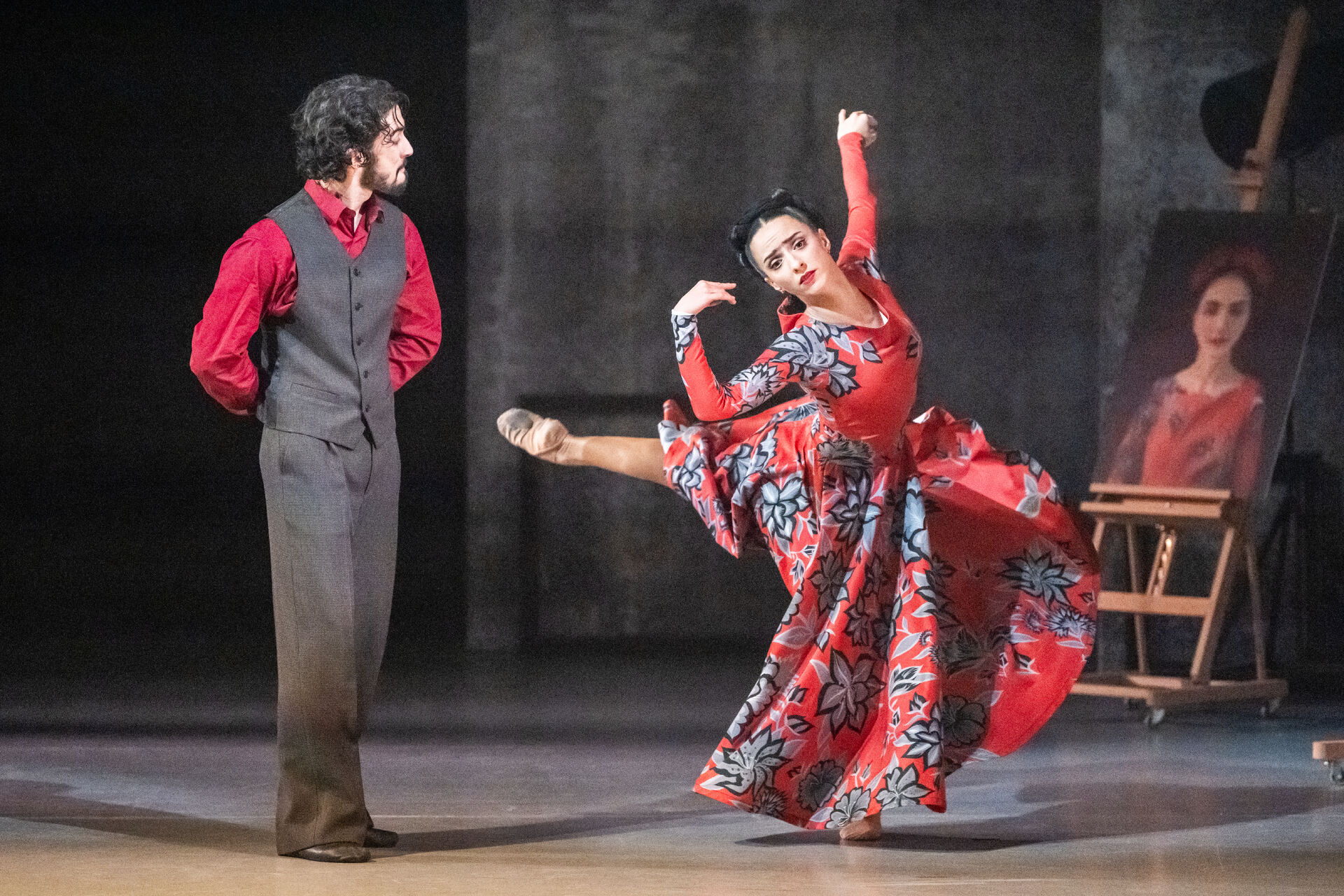
Marika Mikanová consistently followed the biographical line in Frida, choosing the form of dance theater with a series of short scenes and quick cuts. She has an undeniable flair for dance storytelling, which is understandable and yet balances quite well on the edge of tolerable descriptiveness. She focuses entirely on Frida's relationship with Diego Rivera – their romantic passion and the emotional wounds caused by infidelity. The vicissitudes of their life together are depicted in passionate duets performed with great emotional intensity by Nuria Cazorla García and guest performer František Vlček. Other motifs do appear in the production, but only marginally. The theme of physical pain is most strongly present in the scene of the traffic accident and subsequent convalescence and in the images of her death that frame the production. For the most part, however, we see Frida as a confident woman, unhindered by physical suffering. The premonition of death resonates strongly in the scene of the Mexican holiday Día de Muertos and the dance of the symbolic figure La Muerte.
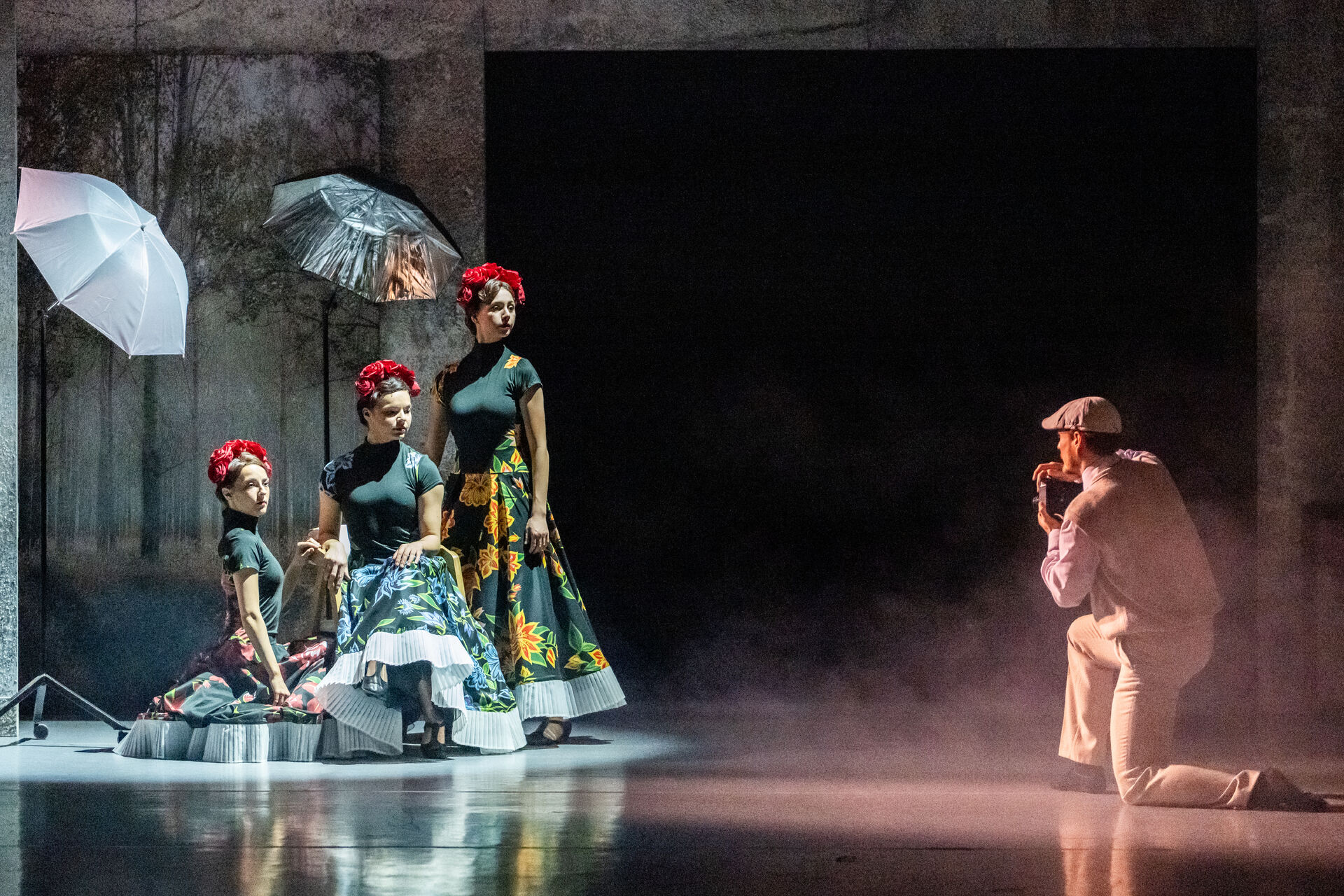
In a large-scale, revolutionary-themed performance, Frida's inclination towards communist ideas is shown. References to her artwork are also included. This is most strongly evident in the image of Two Fridas, which is embodied by the division of the title character between two dancers, expressing Frida's inner conflict (her alter ego is mostly danced by Maria Gornalova, dressed in black, and we can see in her the personification of the heroine's inner pain, the opposite of her defiant energy). In the finale, the two dancers, sitting next to each other and holding hands, stylize themselves into the form of the famous painting. Aleš Valášek's artistic solution follows the atmosphere of the individual scenes, whether they are carnival-like and colorful or, on the contrary, moderately conservative. Inspiration from Frida Kahlo's paintings can be seen in the frequent floral and other plant motifs on the dresses; the corset costume is reminiscent of the painter's self-reflection in the painting The Broken Column.
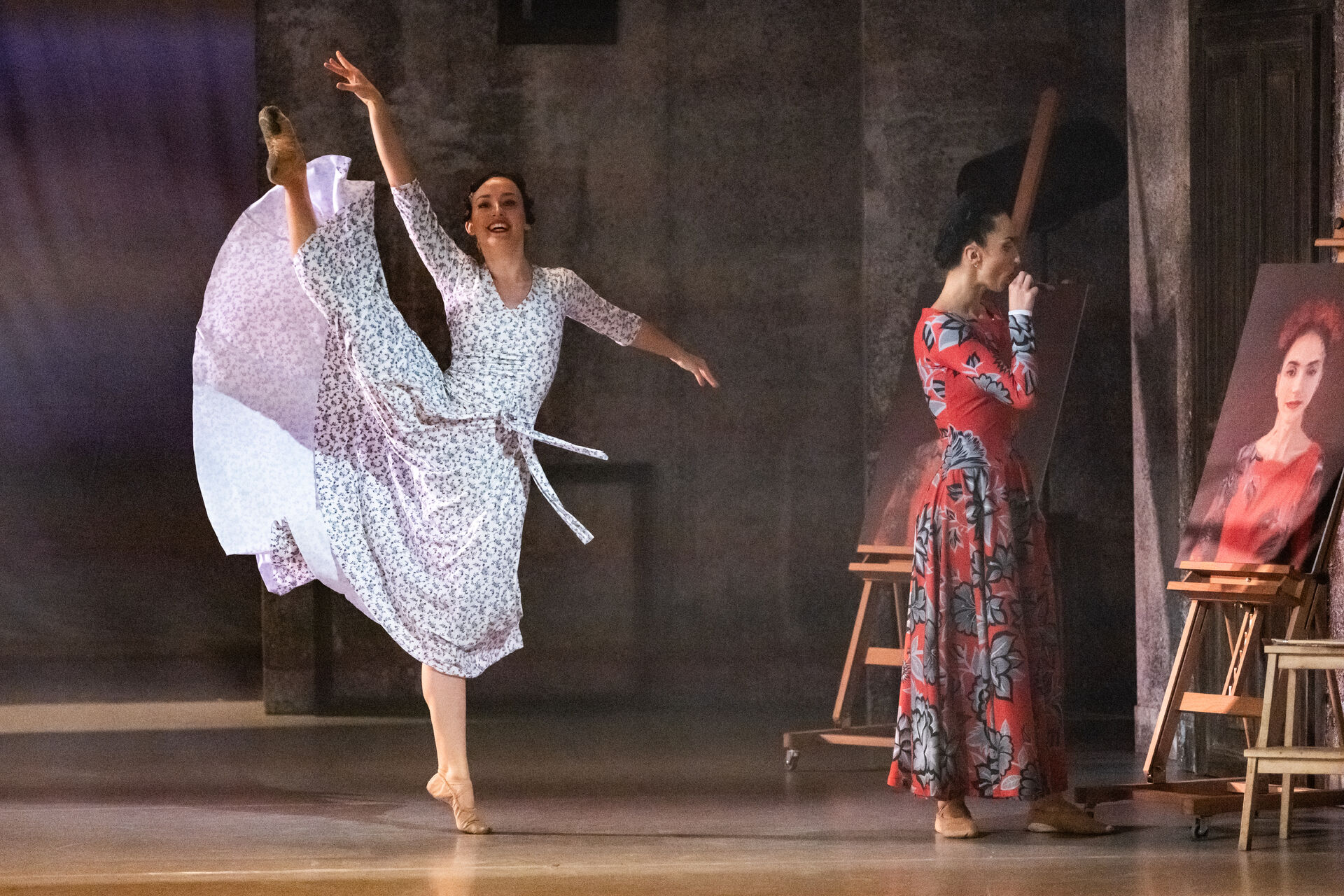
Marika Mikanová's Frida is danced at a fast pace with almost no significant slowdowns. It is clear that Hispanic culture and southern temperament in music and dance styles appeal to the choreographer. An example from the past is her The House of Bernarda Alba. The duets reveal neoclassical roots, while the group scenes feature elements of flamenco, stylized Mexican folklore, and references to American dance styles from the first half of the 20th century. This mix suits the Liberec ensemble perfectly. They dance with infectious enthusiasm. Marika Mikanová's Frida is not irritating or complicated. It focuses on a romantic story of passionate love. With narrative skill and knowledge of the local audience.
Written from the performance on November 13, 2025, at the F. X. Šalda Theater in Liberec.
Frida
Libretto, choreography, and direction: Marika Mikanová
Set and costumes: Aleš Valášek
Music: Elliot Goldenthal, Francisco Tárrega, Manuel de Falla, and others