
The emphasis on the third, often overlooked phase of a dancer's career is clearly articulated in the concept of the National Theatre Brno Ballet as part of the ensemble's new dramaturgy. The ensemble currently consists of the main ensemble, NdB 2 for young dancers just starting out, and the project-based NdB 3. In an international context, it builds on the philosophy of Jiří Kylián and Nederlands Dans Theater – i.e., the idea that a dancer's career does not have to end when their physical peak declines, but can develop into another, more mature dimension of artistic expression. NdB 3 puts this idea into practice by bringing together soloists whose careers have been linked to leading Czech and Slovak stages.
Masters from NdB 3 remained on the surface
The new project by the ballet company of National Theatre Brno, entitled NdB 3, represents a bold and welcome step, a platform designed specifically for performers of a more "mature" age who, even after the end of their professional careers, still possess acting, technical, and expressive skills that are worth presenting independently. The program, entitled Masters, features Janáček's miniatures in the original choreography by Mário Radačovský and Megumi Nakamura, which were originally created for EXPO 2025 in collaboration with the Brno Philharmonic and piano virtuoso Ivo Kahánek. For the Brno premiere, they were supplemented with a third part, Radačovský's choreography La Jolla with music by Bohuslav Martinů.

Masters. Ballet NdB 3. Photo: NdB archive.
Advertisement
Among the names associated with the project are a number of prominent figures from the Czech ballet scene – Nikola Márová, Klaudie Radačovská, Ivona Jeličová, Andrej Szabo, Martin Svobodník, Petr Hos, and the still-active dancer Ilja Mironov. In a sense, the art of dance is unfair. Young dancers start their careers very early, full of energy, but lacking in experience. Many years of refinement and maturation follow. And when a dancer finally understands what dance is really about and loses the need to compete in the height of jumps and the number of pirouettes, their physical strength begins to wane. But their body remembers and has much to convey to the audience, if they can find the key to "how to do it."
The dramaturgy of the entire evening has a clear and unifying thread. It is the music of two of the most famous Czech composers of the first half of the 20th century, Leoš Janáček, from whose work Capriccio and Po zarostlém chodníčku were selected, and Bohuslav Martinů, from whose work La Jolla was selected. These are chamber compositions that resonate directly with the project offered for a chamber ensemble of experienced dancers. The central theme of the dance adaptation of the individual compositions is defiance and the omnipresent transience. The triptych combines elements of classical ballet technique and contemporary approaches, with which the creators develop the neoclassical canon.
 Capriccio
Janáček's Capriccio was written in autumn of 1926 in response to a request from pianist Otakar Hollmann, who could only play with his left hand due to an injury. Janáček initially refused, but later composed a remarkable four-movement work in which the piano part becomes an equal partner to the wind ensemble. There is a palpable moment of defiance in the music, at times bold, at times nostalgic, its dramatic power born of contrast and dialogue.
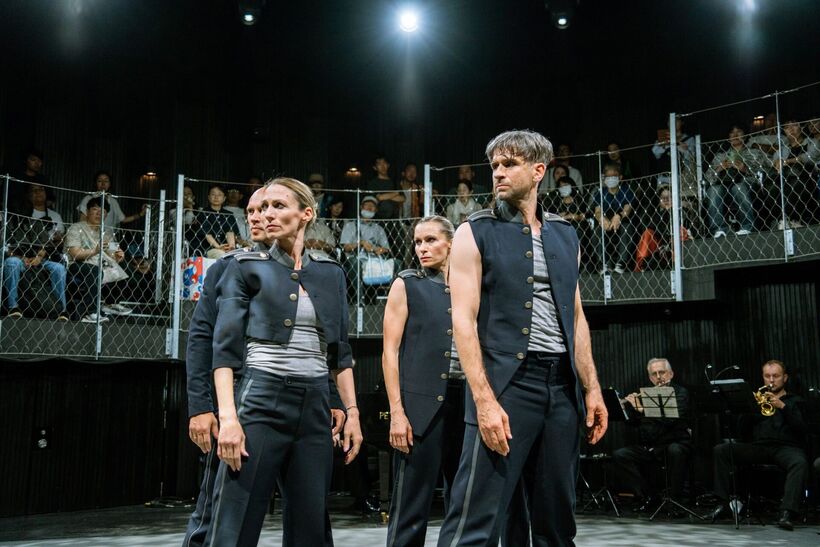
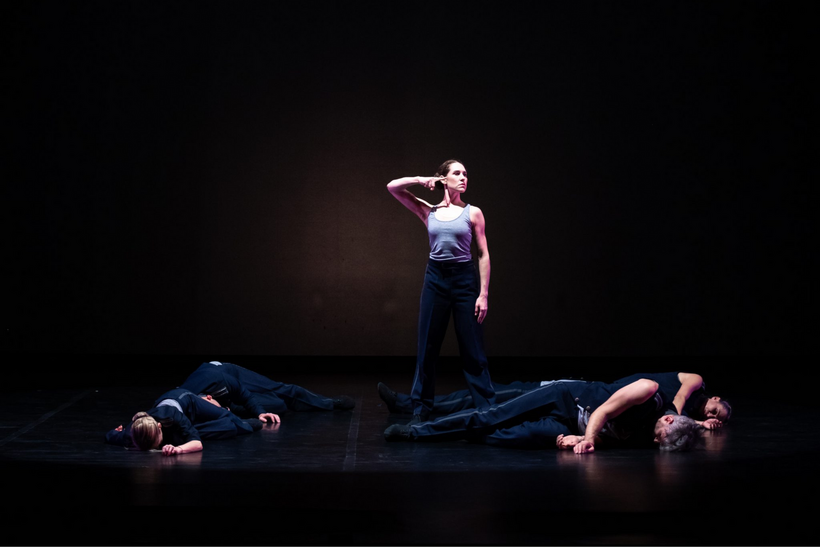
Japanese choreographer Magumi Nakamura worked as a dancer with the NDT and collaborated with leading figures in contemporary dance such as Jiří Kylián, Mats Ek, and Ohad Naharin. She interprets her Capriccio as a theme of confrontation with the adversity of fate, which often puts us in seemingly hopeless situations. Six dancers stand on stage in a combat stance with clear, specific shooting and saluting positions. They are wearing black trousers, black vests or jackets, under which gray undershirts are visible. They are undoubtedly a military unit that has come to kill. Recently, we have been living surrounded by military threats coming at us from all sides, so it is no wonder that the choreographer chose this theme. The music itself offers a succession of harsh, rhythmic gestures and lyrical, even melancholic passages. Nakamura's choreography makes use of precisely such contrasts. Military evil is represented by sharp, broken, almost machine-like movements and often unison formations. In contrast, there are moments of duets and solos, when soldiers become ordinary people. A moment of sensitivity is evoked by the duet of Petr Hose and Klaudia Radačovská. Even more striking is the part played by Ivona Jeličová and Martin Svobodník, in which the woman supports the man, but the growing danger makes their relationship impossible and subsequently full of suffering. Meanwhile, soldiers fall and die, only to rise again for another battle. The clear gesture of the "three wise monkeys" – hear no evil, see no evil, speak no evil – comes from Japanese tradition and represents a moral principle that urges people to avoid evil. Nakamura does not offer any groundbreaking ideas in terms of movement, but her strength lies in her message. The finale belongs to Nikola Marová, who recently left the stage. Her solo lament is the most powerful moment of the entire anti-war opus. Like Michelangelo's Pieta, she bends over the dead bodies and searches for a way forward. Everything returns to the beginning, the movement slows down, but she ultimately ends in the initial fighting gesture – "The show must go on."
 La Jolla
Bohuslav Martinů wrote La Jolla in 1950 on commission from the La Jolla Music Society in California. The composition has no specific extra-musical program; the title refers to the place of commission. It has the character of a concertante sinfonietta for violin, cello, and piano with chamber orchestra.
The author, Mário Radačovský, created the choreography especially for the Brno program. His work is closest to the principle of dance theater, which attempts to address interpersonal relationships in an intimate and psychological setting. Two characters, a man and a woman, are dressed festively and preparing dinner. The dominant scenographic element is a large table around which a small private drama unfolds. The husband and wife or partners live their daily rituals, under which, however, a certain tension is hidden from the beginning. The entire La Jolla is actually a duet performed by Ivona Jeličová and Petr Hos. Radačovský's vocabulary combines civil movements, the aforementioned neoclassicism, and, above all, a large dose of lifted figures. Nevertheless, the theme of conflict and growing tension between the partners gives rise to powerful moments of expression. Both soloists move with confidence and bravura. However, the more dominant Ivona Jeličová reigns supreme thanks to her strong dramatic grasp.
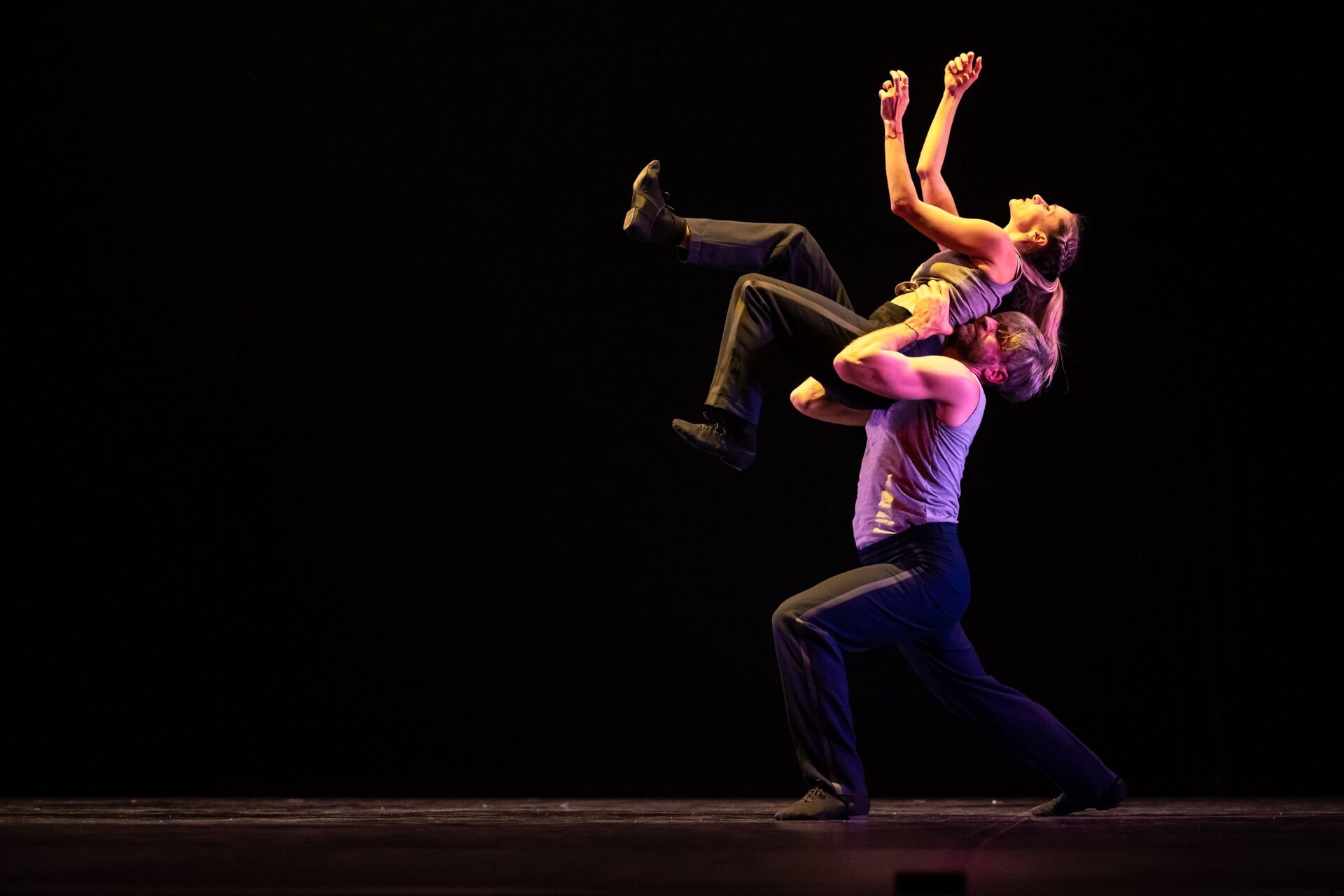 The second movement, Largo – Andante, offers an expressive slow flow. There is a change of mood. The partners sit opposite each other at a large table. This image reminded me of Mats Ek's choreography Place for Mikhail Baryshnikov and Anna Laguna. Radačovský sees the image as an attempt to resurrect a former relationship. She gestures to suggest the possibility of expecting a child, but her partner rejects her. At this moment, the drama culminates musically, but unfortunately the choreography leaves aside the subtle modulations and valours of the music.
For me, the third part of the work is essentially unclassifiable. A situation arises that is somewhat different from the rest of the ballet. A guest arrives, the woman's lover, or rather a caricature of him. The woman oscillates between the two men or stands against them. Is this a wannabe comic interlude? The first two parts hinted at an interesting path towards the possibility of working with mature dancers in terms of acting and expressive performance. However, I cannot come to terms with the "comic" part. And where will the situation lead? The final duet arrives with a sense of resignation and the woman's unhappiness. However, decorum and social conventions must be maintained. Guests arrive and the audience is faced with an open ending. The words "To be continued" appear on the back horizon.
On an Overgrown Path
Janáček's On an Overgrown Path is a well-known piano cycle of small pieces for solo piano, based on Moravian folk melodies. Although these are small piano miniatures, they have a strong emotional charge – they often express nostalgia, memory, sadness, or intimate moods. Janáček achieves a sensitive intimacy and authenticity in this work. This work has been the subject of two notable dance performances in the Czech Republic. In 1998, it was staged for the Prague Chamber Ballet by Pavel Šmok and Kateřina Franková-Dedková, and in 2013, the Moravian-Silesian National Theater presented Jiří Kylián's famous choreography as part of the evening Homecomings.
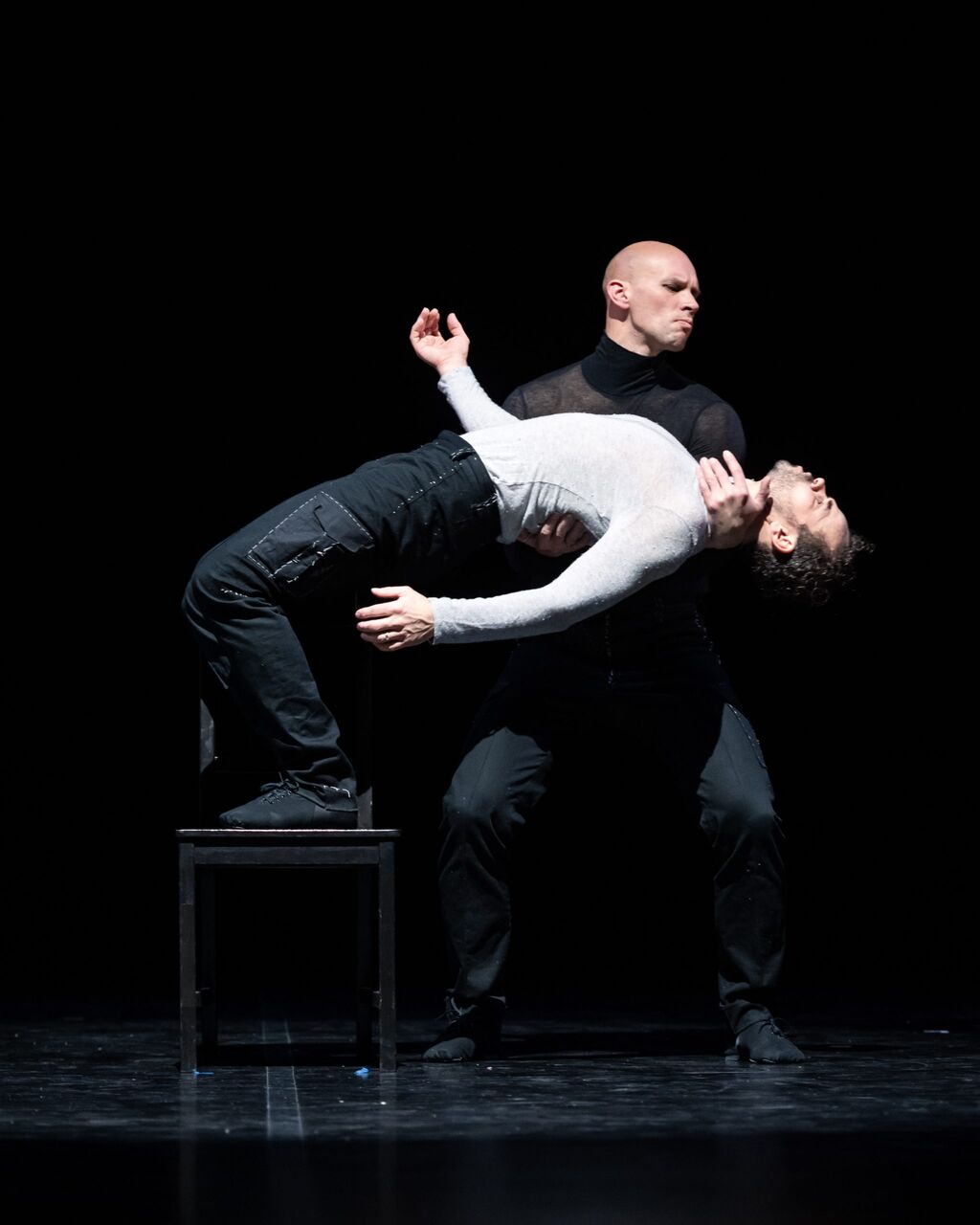 Mário Radačovský's choreography is described as a work that "deliberately emphasizes the theme of omnipresent transience" and, through the micro-stories of seven dancers, explores the passage of time and the finitude of life. A significant asset of the final part is the presence of the outstanding pianist Ivo Kahánek, who performs Janáček live with extraordinary sensitivity, thus enabling the closest possible collaboration with the action on stage.
The dancers sit on chairs on stage throughout the performance and alternately enter the action from this closed semicircular formation. However, their costumes do not suit them very well. They are uniform in nature, in the name of unisex, consisting of black trousers and tight-fitting gray turtlenecks. They remind me more of work clothes. The theme of the omnipresent "Memento Mori" is embodied by a figure in black, played by the charismatic Ilja Mironov. The movement vocabulary is essentially similar in all three parts – neoclassical, contemporary, and partner dance. Hints of folklore remain out of the picture, and the excessive acrobatics in the duet between Man and Death, performed by Petr Hose and Ilja Mironov, do not suit Janáček very well. In addition, we also find some lovely and pleasant moments represented by the girls' trio – playful, simple, and pure, often using the movement canon. The male trio works on a similar principle. Radačovský occasionally uses chairs on which the dancers sit. However, he does not work with them consistently. Sometimes they are just part of the scenography, sometimes he does not use them at all, and sometimes they can represent a partner. The key to their use is missing. The most fundamental and interesting aspect remains Death's constant interference in the dance. She plays with everyone, chooses, controls. Although Radačovský draws on the mood of the music, his choreography lacks a certain intimacy, sensitivity, and depth of listening.
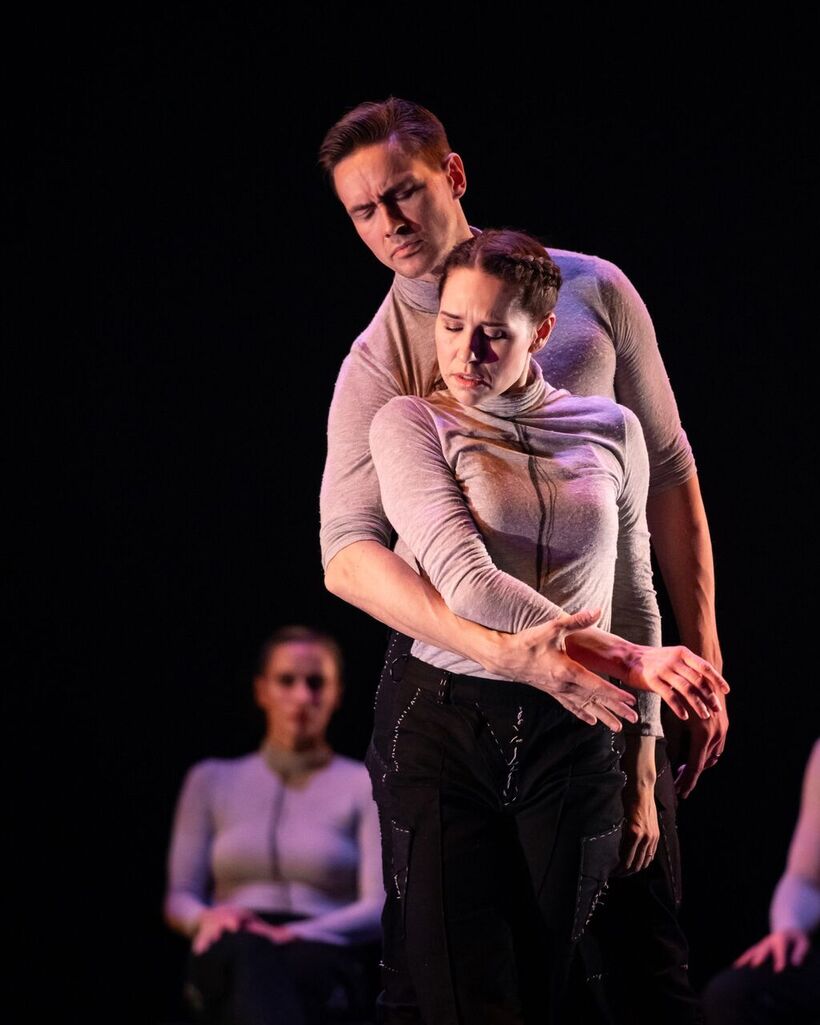 I went to the performance of Masters with high expectations and the idea of something extraordinary. Thanks to NdB 3, dancers with enormous stage and life experience came together here. I hoped to see something that would be "tailor-made" for them, highlighting their uniqueness and specificities. Unfortunately, these moments only flashed occasionally – in the expressive drama of Ivona Jeličová, the fragility and high movement aesthetics of Nikola Márová, and the masculine strength of Ilja Mironov. All the performers appear relatively young, beautiful, flexible, and full of energy. If their colleagues a generation younger had danced the entire evening, we might not have noticed much difference. Finding a deep and meaningful movement text for mature dancers is truly challenging. It requires penetrating to the very essence of the message, personal experiences, finding originality and irreplaceability, discovering their entire dance life.
Written from the premiere on December 10, 2025, Mahen Theater, Brno.
NdB 3/MASTERS
Capriccio
Choreography: Megumi Nakamura
Music: Leoš Janáček
Dancers: Klaudia Radačovská, Ivona Jeličová, Nikola Márová, Petr Hos, Martin Svobodník. Ilja Mironov
La Jolla
Choreography: Mário Radačovský
Music: Bohuslav Martinů
Dancers: Ivona Jeličová, Petr Hos, Klaudia Radačovská, Nikola Márová, Martin Svobodník, Ilja Mironov, Andrej Szabo
On an Overgrown Path
Choreography: Mário Radačovský
Music: Leoš Janáček
Piano: Ivo Kahánek
Dancers: Klaudia Radačovská, Ivona Jeličová, Nikola Márová, Petr Hos, Martin Svobodník, Ilja Mironov, Andrej Szabo