Certain movement sequences are intentionally repeated at times. The highlight of the duet is the “flying kiss,” in which the woman embraces the man while arching sharply, the man spins very quickly in place, and the woman’s legs fly through the air. This is not unusual in dance, but because the rotation lasts quite a long time, the combination of the building music and the romantic union is a tremendous experience. Both performers, Ida Frau and Gene David Goodman, executed the beautiful duet wonderfully. It is a pity that the audience is unaware of the connection to Preljocaj’s exploration of love and the “art of loving” from the previous dance sequence of his ballet, which takes place in gardens and settings created for the dramas of romantic intrigues against the backdrop of the 17th and 18th centuries.
Lea Bessoudo Greck and her conception of death
The French choreographer works in Israel with the Kibbutz Contemporary Dance Company and is currently a guest artist at the NdM in Ostrava. Last year, she created the choreography for Šárka as part of the Pure Joy of Dance evening and also collaborated with the opera (The Brandenburgers in Bohemia). It is expected that she will continue working in Ostrava. In the current premiere, she presented a choreography set to Mozart’s Requiem; specifically, she commissioned a special recording of the musical movements Requiem aeternam, Kyrie, Dies irae, Tuba mirum, and Rex tremendae without vocals, with sound design by Konstantinos Papazafeiropoulos.
Requiem without vocals feels cold, one might say stripped down, compared to the original musical composition as we know it. But given the interpretation the choreographer has chosen, this is appropriate. She drew great inspiration from danses macabres—medieval dances for the dead—as well as preserved drawings and frescoes. The author interprets death as a transformation toward a new beginning and calls it “the journey from absence to presence.”
The composition begins with a funeral procession. Dancers march slowly across the stage, both in the background and at the front; in the center appears a figure with a covered head and face hidden behind a light, transparent cloth, as was customary for the deceased. Is this some kind of ritual of preparation for departure from life?
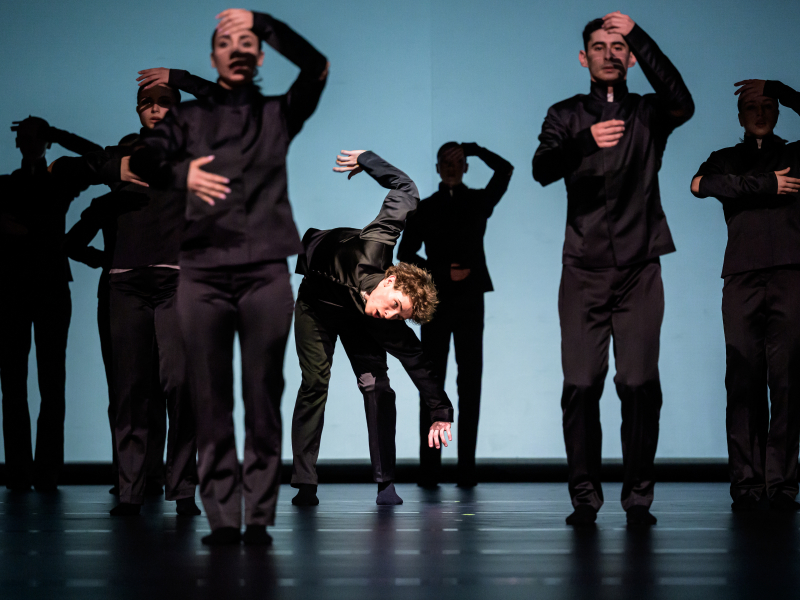
The marching participants form a crowd of waiting figures in the center, moving perpendicularly from the center to the back toward a black horizon. On it, white openings—rectangles, windows, or doors to the other world—gradually appear. The white rectangles then rapidly change and grow larger one after another.
The scene with a line of male and female dancers is very striking. Their impatient, rhythmic sidestepping from place to place seems nervous and stands out in Bruno Sultan’s set design. Everyone is determined or resigned to leaving; only the figure of the Chosen One resists death.
The choreography then features an increasing number of duets—first we see two, then three and four pairs, who subsequently dance in a circle and a spiral. Among them appears the Chosen One, superbly danced by Tom Bellec. A major change also takes place in the costumes by Pavel Knolle. At first, everyone is in black suits, light jackets, and trousers; then in white shirts, with the girls without long trousers. Gradually, the bodies are revealed, transitioning from black to white. Similarly, at the end, a white rectangle of light descends from above, and the stage remains bright. A sense of calm sets in, a metaphor for a paradise. Along with these transformations and the settling of the atmosphere, the original sections of the Requiem—a funeral mass with singing—come to the fore.
It is evident that Lea Bessoudo Greck is a sensitive choreographer, and her approach to dance expression certainly follows a logical progression. She has a good sense of space and, together with the company, has managed to create an interesting work that draws closer to the rawness of contemporary dance in its broken gestures and movement, as well as its harsher dynamics and expression; Bessoudo Greck is more influenced by her environment and her collaboration with Israeli artists.
Eric Gauthier and a Sense of Humor
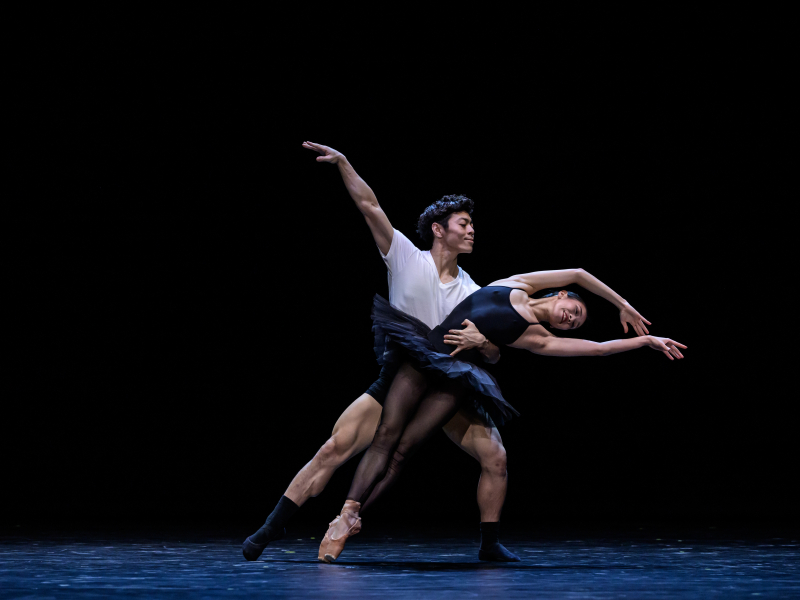
Amid the evening’s previous serious thematic elements, she inserted the short duet Ballet 102. The renowned Canadian-German choreographer and director of Gauthier Dance / Theaterhaus Stuttgart, Eric Gauthier, has successfully presented this piece at various concert-style gala evenings.
Ballet soloist Shino Sakurado in a black ballet tutu and on pointe, and dancer Rei Masatomi in a white T-shirt and black shorts, give their all as they follow commands from an audio recording. Everything takes place without music. The voice of the choreographer or teacher assigns individual classical positions for both dancers in brief solo or partner sequences, counting down the positions to the symbolic number 102. Both soloists are working themselves to the bone to complete them on time, as the instructions come in rapid staccato succession.
Following the commands, the dancers perform passé, coupé, pas de bourrée, attitude, port de bras, pirouettes, lifts, jumps, and jetés of varying quality; there are also references to many famous roles and dance styles, such as those of Marty Graham, William Forsythe, Jiří Kylián, and Mats Ek. The tempo is fast, and the positions are fragmented, brief, and to the point. Nothing is resolved in the duet; the couple merely blindly repeats the prescribed movements. With a humorously critical tone, Gautier offers a glimpse into the eternal dictates and endless drills that unfold daily in ballet training.
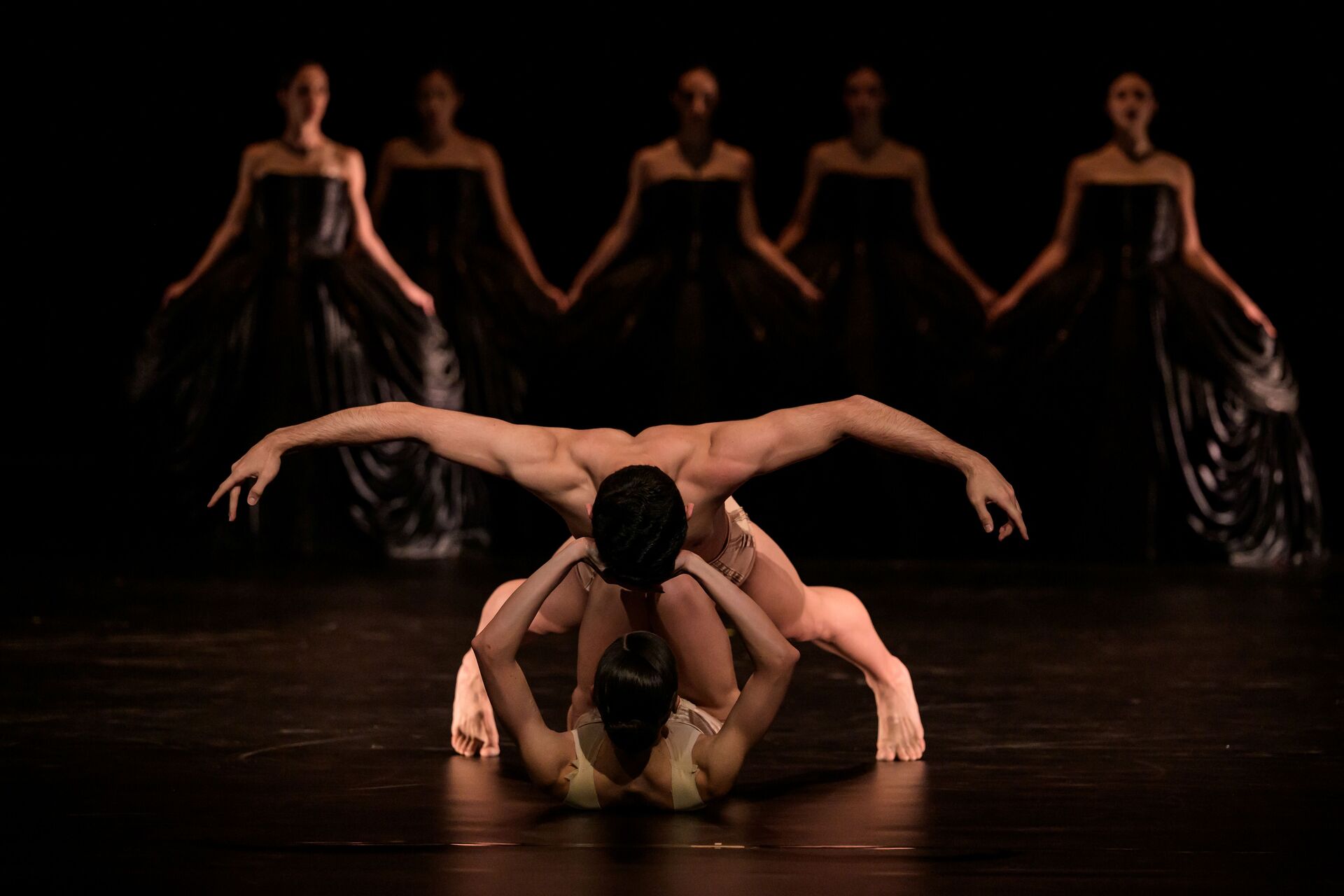
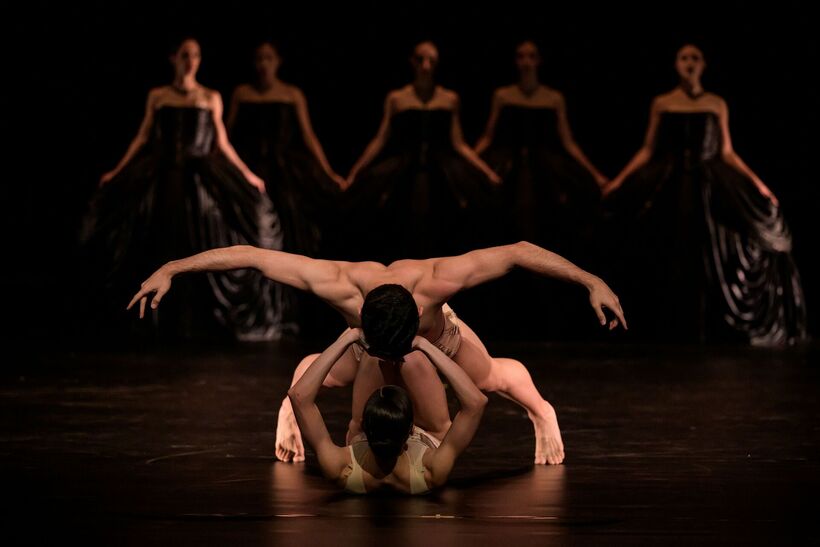
Kylián also employed a humorous image in the choreography of Petite Mort. Women and men in hints of underwear are at certain moments hidden behind massive black Baroque costumes with wide skirts, which are mobile and glide across the stage with them. As if they had returned to Mozart’s time…
Jiří Kylián returns to Ostrava
Kylián’s 1991 choreography Petite Mort is constantly performed on many stages around the world. It is undoubtedly one of the best works from the period known as Black and White. At the National Theatre in Prague, it was part of the mixed dance evening Bridges of Time (2018), and the NdB ballet company also had it in its repertoire as early as 2016. It is created for a cast of twelve—six men, six women, and six fencing swords.
It alternates between dance duets and group sequences in which the dancers must master the supreme art of partnering. Relationships and emotions, love and sex, and undoubtedly a certain nobility typical of Kylián’s style take center stage. Slow movements from Mozart’s Piano Concertos in A Major and C Major flow into a purely intimate dance confession, and the expression petite mort—or orgasm—takes on a greater, existential dimension.
Kylián also employed a humorous image in this composition. Wom aroque costumes with wide skirts that are fluid and glide across the stage with them. It is as if they have returned to Mozart’s time…
The Ostrava ensemble gave it their all to master the demanding duets in Petite Mort. Perhaps the dancers were already exhausted from the first half of the evening or were nervous, but their performance here lacked spark, the polish of the dance and expressive elements, and in some cases, technical precision. The most captivating pairs were Ida Frau and Rei Masatomi and Shino Sakurado and Barnaby James Packham.
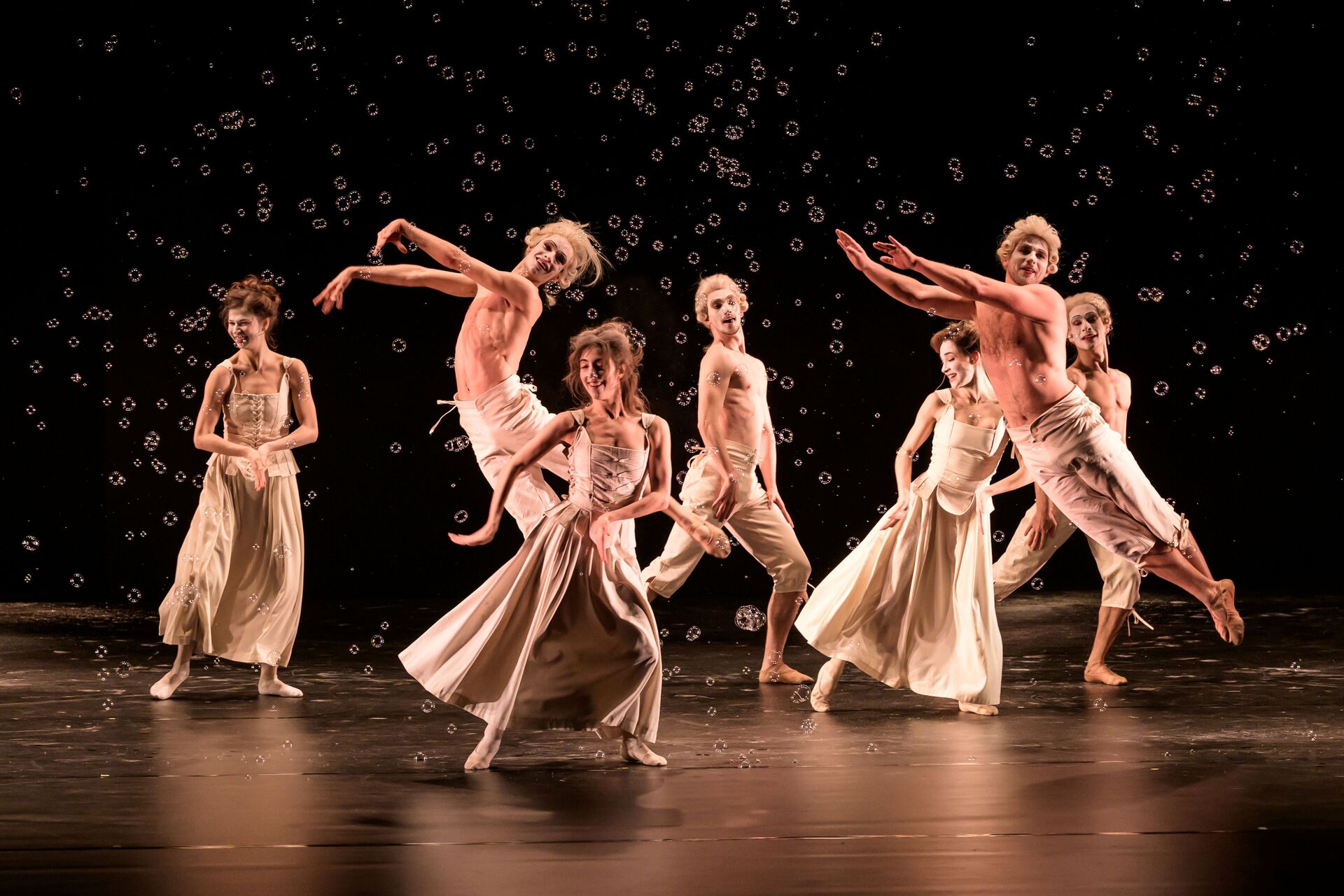
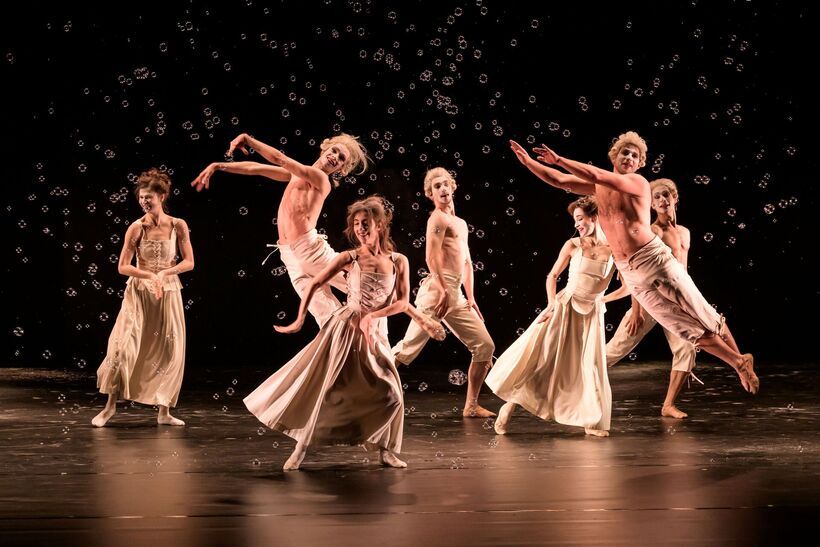
The following Six Dances is a grotesque dance fresco. Mozart wrote them under the title German Dances. Both men and women wear period wigs; with every movement or jolt, powdered dust spills from them. The costumes are somewhat careless, one might even say deliberately worn-out and imperfect. In six parts, featuring a diverse cast of men and women, brief, crazy stories unfold, as Jiří Kylián also mentions: “I have created six seemingly nonsensical situations that ignore their surroundings. They emerge in the shadow of an ever-present, unsettling world that most of us, for some inexplicable reason, carry within our souls…” The individual parts are subtitled The Shy Husband, The Frogs, The Jealous Husband, A Mysterious Murder Story, A Solo and Quartet Based on the Principle of a Move, The Jumping Quartet of Headless Nick, and The Finale with Megastars.
In this choreographic composition, all the participating dancers felt very much at home, and the audience also let loose appropriately, because there’s never enough humor. It’s wonderful that the NdM has another Kylián piece in its repertoire alongside Wings of Wax, which they performed until recently. And during this varied program, audiences will surely appreciate the connection between the brilliant music and so many different dance styles.
Written from the premiere on March 5, 2026, at the Jiří Myron Theater.
More Than Mozart!
Pas de deux from the ballet Le Parc
Music: W. A. Mozart Adagio, Concerto and Orchestra for Piano in A Major
Choreography: Angelin Preljocaj
Assistant Choreographer: Claudia de Smet
Costumes: Hervé Pierre
Lighting Design: Jacques Chatelet
Requiem
Music: W. A. Mozart, Requiem
Choreography: Lea Bessoudo Greck
Assistant Choreographer: Nadav Gal
Sound Design: Konstantinos Papazafeiropoulos
Musical Arrangement: Yuval Goren
Set Design: Bruno Sultan, Lea Bessoudo Greck
Costumes: Pavel Knolle
Lighting Design: Bruno Sultan, Lea Bessoudo Greck
Ballet 102
Choreography: Eric Gauthier
Costumes: Eric Gauthier
Sound Design: Eric Gauthier
Assistant Choreographer: Olivier Vercoutere
Petite Mort
Music: W. A. Mozart
Choreography: Jiří Kylián
Assistant Choreographer: Stefan Žeromski
Set Design: Jiří Kylián
Costumes: Joke Visser
Lighting Design: Jiří Kylián, Joop Caboort
Technical Supervision: Joost Biegelaar
Six Dances
Music: W. A. Mozart German Dances
Choreography: Jiří Kylián
Assistant Choreographer: Stefan Žeromski
Costumes and Set Design: Jiří Kylián
Costume Production: Carlijn Petermeijer
Lighting Design: Jiří Kylián, Joop Caboort
Technical Supervision: Joost Biegelaar