
Speak low if you speak love… - When dancers’ bodies fly in the air and deny gravity
Advertisement
The latest work of the famous Flemish choreographer and director Wim Vandekeybus deals with love – unstable, greedy, vain and capricious - the state of our mind, craving emotions and basic, insatiable passions.
Love conquers all! Crash-diving from the unmeasurable heights into deeps and often balancing on the edge of death and resurrecting again. If it turns against you, against your desire, you passionately endure the most cruel and excruciating pain. That is how the Flemish artist describes the states of love no one can escape. Wim Vandekeybus is a frequent guest in Prague, so the audience is not necessarily shocked by his unsettling, often rough message. The physical body and the soul do not carry the burden of romanticism. Vandekeybus always hits the target and the eight classically trained dancers and performers invest all their effort and professional skills into the performance. The two-hour performance of Speak low if you speak love… is a sequence of images, wild scenes of dense drama and music.
Vandekeybus collaborated on this piece with a well-known musician, guitarist, drummer and singer Mauro Pawlowski who accompanies the show together with two other members of his band, Elko Blijweert and Jeroen Stevens, and the African singer Tutu Puoane. Pawlowski’s band Deus is very famous and acclaimed in Belgium. In this piece, the musicians make part of the story. First we can only hear them, as they stay unseen behind the rear curtain, but then they play live and spontaneously throughout the whole piece. Their music is based on experimental rhythms, wild fusion of African rhythms and rock but also opera and opera singing. The music is thus part of the dancing which leaves us breathless.
The scenography creates the illusion of a jungle, maybe the Paradise lost, as there are trees on the sides of the stage which are also at play. The transparent curtains, intricately lit and casting shadows, produce a dim-like atmosphere. A rope, thrown to the auditorium, expresses constant hunt, lurking for the pray, connections and obsessions, tie-ups and break-ups. The lightness and certain carelessness which characterise Vandekeybus’ sketches of great personal dramas (alternating with humorous and provocative situations), stem from the thirty years of artistic life and hard work of the Ultima Vez company.
 It all begins with Adam and Eve
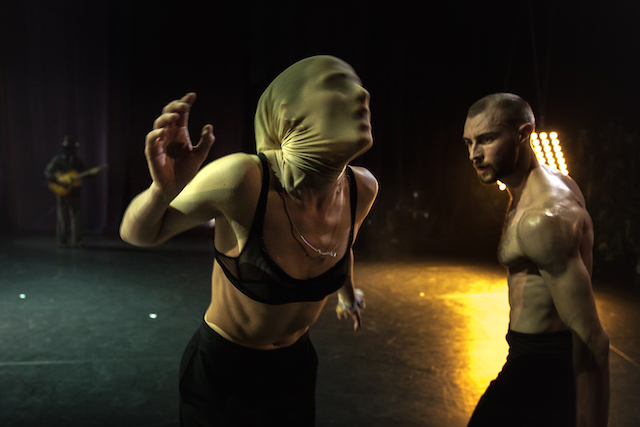
The first dance scene looks bizarre. The half-naked dancers have their heads wrapped in some kind of facecloth. Their blinded eyes might evoke a primitive ritual or the famous proverb – love is blind. Encounters full of desire and exploration, as well as frequent backward step combinations, are typical of Vandekeybus’ style – all this set to the touching voice of the African singer.
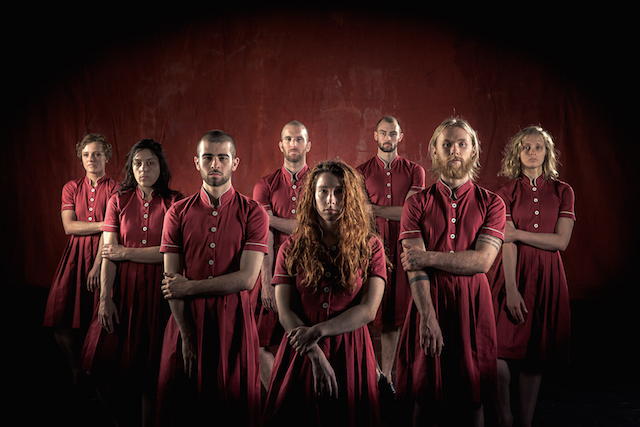
The next scene shows a merry society. Women and men clad in feminine red dresses dance a sequence of folk motifs of stamping, maybe tap dancing, maybe flamenco. It is a sort of intentionally unspecified fusion of folklore and joyous mood.
It all begins with Adam and Eve
The first dance scene looks bizarre. The half-naked dancers have their heads wrapped in some kind of facecloth. Their blinded eyes might evoke a primitive ritual or the famous proverb – love is blind. Encounters full of desire and exploration, as well as frequent backward step combinations, are typical of Vandekeybus’ style – all this set to the touching voice of the African singer.
The next scene shows a merry society. Women and men clad in feminine red dresses dance a sequence of folk motifs of stamping, maybe tap dancing, maybe flamenco. It is a sort of intentionally unspecified fusion of folklore and joyous mood.
It all begins with Adam and Eve
The first dance scene looks bizarre. The half-naked dancers have their heads wrapped in some kind of facecloth. Their blinded eyes might evoke a primitive ritual or the famous proverb – love is blind. Encounters full of desire and exploration, as well as frequent backward step combinations, are typical of Vandekeybus’ style – all this set to the touching voice of the African singer.
The next scene shows a merry society. Women and men clad in feminine red dresses dance a sequence of folk motifs of stamping, maybe tap dancing, maybe flamenco. It is a sort of intentionally unspecified fusion of folklore and joyous mood.
Then we are in the jungle again. The floor is covered in sand and earth. The performers fall to the ground and, hot-headed but concentrated, they look for grains of gold……….or of lost love?
One of the dancers looks almost savage with his long beard and hulky body. Adam’s forefather, conqueror or the wild Robinson’s descendant… His desire and lust have no limits. He conquers all women, he wants to tame them. And later he harnesses them. A girl is lying of a piece of cloth, she is bending backwards in the cradle position. The savage stands above her and holds the reins. The two are pulled by a pair of “harnessed” dancers. They go as fast as wind, as if gliding on the water surface or flying in the air. In the end, the society wants to get rid of the savage and confines him into a wooden box or coffin - another symbol that reappears in the following scenes. Desire and passion break down the barriers between life and death.
A woman seduces man and wants to be seduced
Gentle and erotic relations grow more intense. A girl is almost naked, looking like a Venus who should be protected by a man. He is putting her clothes back on again and again, wants to tie her pants (a piece of lingerie). But he does not manage because the girl is too excited.
And thus Vandekeybus’ symbolism develops and eventually splinters in to a total chaotic craze. Male couples, female couples, everything is blending and culminating into a super-difficult dance full of technically challenging steps, turns, changing-feet pirouettes with rondes, jetés en tournant, falls, rolls, and jumps, lifting, and tossing of the dancing partners. It is hard to find any fitting category for Wim Vendekeybus’ choreographic style – is it modern, contemporary or physical theatre?
His dancers seem to deny gravity and fly in the air. They even seem to generate energy. It remains in the air and the space of the Archa theatre slowly is absorbing this extraordinary artistic experience. The world premiere of Speak low if you speak love… took place on 7 July 2015 in Mons, Belgium. So the piece still keeps its fantastic energy and comes to Prague as a breath of fresh air.
Speak low if you speak love… Direction, choreography, scenography: Wim Vandekeybus
Music (live): Mauro Pawlowski, Elko Blijweert, Jeroen Stevens a Tutu Puoane
Artistic assistance and dramaturgy: Greet Van Poeck
Movement assistance: Iñaki Azpillaga a Máté Mészáros
Stylist: Isabelle Lhoas
Lighting design: Davy Deschepper a Wim Vandekeybus
Sound design: Bram Moriau a Antoine Delagoutte
Stage manager: Tom de With
Scenography consultants: Isabelle Lhoas a Davy Deschepper
Costumes: Lieve Meeussen
Technical coordinator: Davy Deschepper
Production: Ultima Vez (Brussels, Belgium)Co-production: Ultima Vez / KVS – Brussels / Le manège.mons – Mons / Festival de Marseille – Marseille / Foundation Mons 2015 European Capital of Culture Translation by: Tereza Cigánková