Abstract
Researcher self-reflection is an integral part of fieldwork, as well as of the process of writing the text itself. In connection with time spent in the field and the use of diverse methods, the researcher reflects on their own position and identity.
Within my research, my long-term focus lies particularly in various participatory forms of folk dance in contemporary urban environments. In this case study, I explore the identity of the research using the example of dance houses, i.e. public events dedicated to the teaching and active practice of folk dance. This identity intersects with the roles of participant, organizer, and folk dance instructor.
In this study, I combine the theoretical frame of dance anthropology with methods of embodied ethnography (Sklar 1991; David 2013) and analytic autoethnography (Anderson 2006), in which the researcher becomes the object of their own research. In this way, a dialogue emerges between academic reflection and personal experience, which enables dance to be understood not only as a cultural expression, but also a space for negotiating identity. I also reflects on the limitations and benefits of the autoethnographic approach. Drawing on a range of experience with dance houses, I demonstrate how these methods can be applied to the research on folk dance. At the same time, I examine how they can contribute to a deeper understanding of the topic under study. The aim is to contribute to a broader understanding of how a researcher in the field of dance moves between various roles and how this movement may influence the research itself.
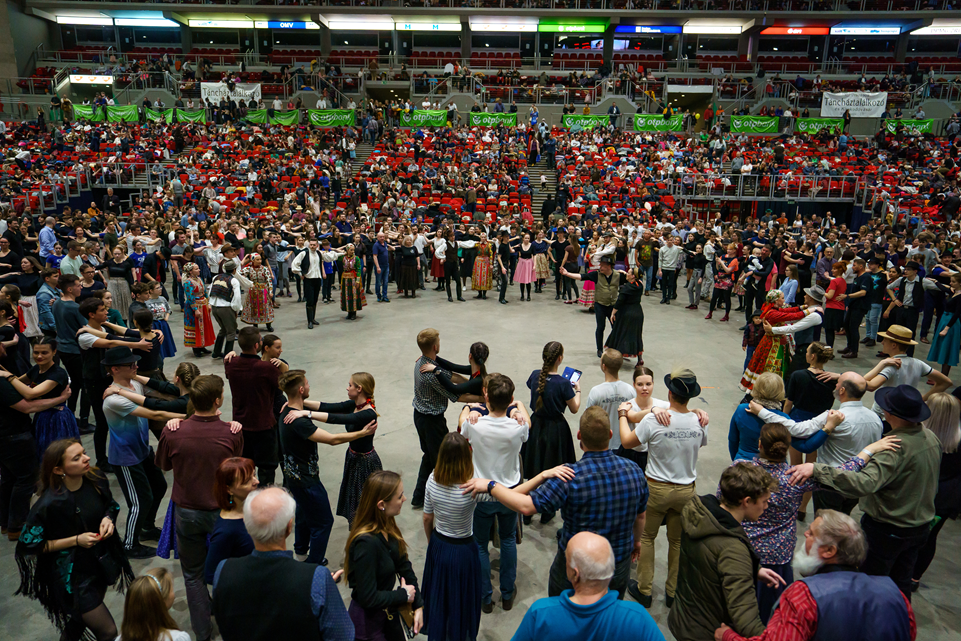
Táncháztalálkozó, Budapest, National Festival of Dance Houses, 2023.
Photo: Gorácz József Márk.
Key words
researcher identity, position within research, embodied ethnography, analytic autoethnography, dance houses
Introduction
Since the beginning of the twenty-first century, there has been a gradual increase in the number of events held in urban environments across Slovakia and the Czech Republic that offer folk dance in its participatory form to their participants.1 This trend is not limited to the activities of folklore collectives, which typically require regular attendance and other membership commitments, but extends to folklore activities that allow individuals of all ages, genders, and levels of dance or musical experience to participate. Examples include various folk dance courses, folk aerobics, informal folk music gatherings, and − last but not least − dance houses.2 It was the growth and popularity of such folklore activities that inspired me to explore more deeply the processes and meanings behind this phenomenon.
In my research, I define myself as an active folk dancer, as well as an organizer and instructor at folklore events. My personal engagement and many years of experience with folk dance influence the choice of research methods and fundamentally shape my perspective on the subject under study. The identity of the researcher is a key aspect, as it intersects with various roles. In this way, a dialogue emerges between academic reflection and personal experience, which enables dance to be understood not only as a cultural expression, but also a space for negotiating identity. This interwoven relationship raises the question of how a dance researcher both shapes and is simultaneously shaped by the activities being studied.