
Where did the idea to create a performance for twenty female directors come from?
I don't remember the very first impulse, because the idea was born five years ago. There were probably two things behind it. First, I hadn't been in the role of a performer for a long time, so I was curious to see if my authorial and directorial ego could handle being "just" material and completely surrendering to someone else. And that even though I would like to create differently or didn't agree with the idea. In acting, they say that an actor should be "like a saint" and surrender to "something higher." I wanted to see if I could still take a back seat and humbly accept absolutely everything that would happen to me. Similar to Marina Abramović in her performance Rhythm 0, which ended with her being cut, written on, and having a loaded revolver held to her head, which I assumed was not really a threat to me. I intended it as another of the tests I devise for myself from time to time to keep myself in a position of not knowing and of inner risk. It also trains my openness to accept impulses from others and not insist on my own truth.
There is a lack of women in management and creative positions in prestigious theaters, according to Miřenka Čechová.
Twenty choreographers and directors demonstrated their leadership and artistic abilities in the innovative work DVACETjedna (Twenty-One), in which the author of the concept and sole performer, Miřenka Čechová, placed herself in their hands. The production, which premiered at the end of last year, gave a voice to women who are often overlooked on the domestic theater scene.


And the second reason?
I noticed a clear inequality on large theater stages, where there are disproportionately few female directors, choreographers, and artistic directors compared to their male counterparts, even though there are more female graduates in these fields than male graduates, as confirmed by sociological research by Nela Winkler. Women in brick-and-mortar theaters are in less influential positions, traditionally providing support—for example, in the roles of dramaturgs, secretaries, producers, ballet mistresses... However, their decision-making power, reach, and influence on the theater system and the public are mostly limited. If women do hold dominant positions more often, it is in smaller, independent, or marginal spaces that struggle with economic uncertainty and have little influence in the public sphere. Yet most of the female directors and choreographers I see around me demonstrate leadership skills as well as artistic qualities. In addition, they have a strong authorial voice with which they speak about current issues and reap success not only in the Czech Republic but also abroad, provided they are allowed to work. There are twenty of them in DVACETjedna, but I could easily choose another thirty. So I wanted to point out that there are capable women here, but they don't get the same opportunities as men, and ask why that is. As a spectator, I also want to go and see works by authors who struggle with similar problems to me and choose topics that are relevant to me. According to research, more female than male spectators go to the theater, and it is mostly women who choose what to see when they go out as a couple.
Is it obvious that the work was directed by a woman?
Not necessarily, but you can tell how sensitive the author is to the world around them, what topics they choose, and how they treat them. Whether the work is viewed from a mainstream, dominant perspective—see the recurring image of the philosophizing man and the beautiful, unstable woman—or whether there is another, perhaps slightly marginalized voice that offers a different interpretation.
And now, in DVACETjedna, did you feel that you were being directed by women?
It was a very interesting experience. I had been directed by men several times before, and I'm not saying that they did it aggressively or violently. But they were dominant, they had a clear vision, and I had to follow it. I often voluntarily stepped outside my comfort zone, through fatigue, through the fact that after the sixth hour of rehearsal, I didn't want to start all over again. Now I wanted to go even further and use Marina Abramović's concept of true surrender. And I was surprised that none of the directors went down this path. There was dialogue with all of them. Some had a clear vision or came with a finished script. But none of them directly dictated how I should do it. There was not a single commanding sentence, no "Not like that. You must, you must not, don't do that, do this..." It was more about suggestions; the authors drew heavily on me and did not necessarily cling to their inner image. They thought through and reshaped the form as they went along, and we tuned into each other.
So, what you originally wanted to try didn't happen? I wanted to ask what it was like to do something someone else told you to do.
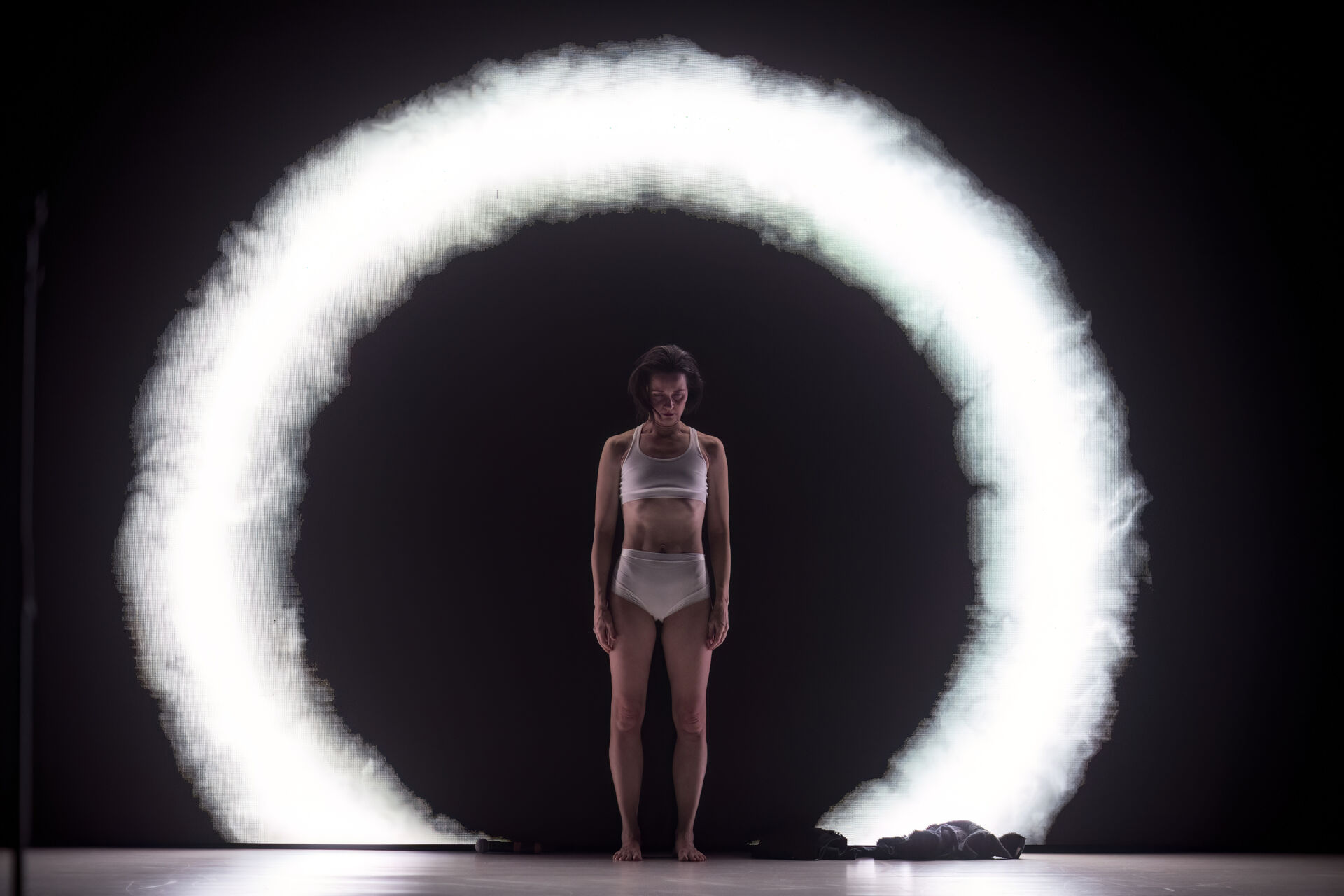
The concept was reworked. It wasn't about testing my limits and boundaries, but rather my abilities. The negative became positive, the possibility of reaching my limits became reaching the peak of my skills. However, there was one challenging moment. I didn't want to undress on stage anymore. But Yuliia Lopata had a convincing and compelling reason for wanting me to. She was also trying to convey to me her extreme physical experience of living in a war-torn country. She told me about how her close friends and family were dying on the front lines, how young choreographers and dancers had fallen, what it was like to live under the constant threat of drone strikes, what it was like to step over the broken glass of a café that had just been hit and order an espresso, and what it meant to decide to go to the front herself. It was crazy, impossible to empathize with her reality. I reached deep inside myself.
After your experience in DVACETjednička, would you ever want to be a performer again?
I really enjoyed having someone guide me. I thought to myself how comfortable it is when you don't have to think about everything yourself. All the intellectual aspects of creation—such as composition, dramaturgy, impact on the audience... Suddenly, I didn't have to deal with all the things that keep me awake at night. I could switch off my head and focus on my body, my emotions, just being instinctive. Suddenly, I slept really well. I would definitely like to repeat this experience, perhaps with twenty men, so that I have a real challenge (laughs). We have already agreed on further projects with some of the female directors. But I would like to work with everyone again.
What did you learn about women from this performance?
I realized that my experience is not unique and that we all deal with very similar issues in our lives as creators. We feel a certain conflict between the roles of mother and artist, or woman in a man's world, and the expectations placed on us. We wonder if it's even compatible. And then we come up against the system. The independent scene is more open and flexible. But in established, brick-and-mortar theaters, it's not flexible, and women often don't have the conditions to do their work and still have a quality personal and family life. I've come across exceptions, but they've always been enlightened people in management. For example, artistic director Tomáš Ondřej Pilař at the South Bohemian Theater was completely understanding of artists with families.
Did women of different generations and backgrounds have similar experiences?
Yes, it seems to me that women artists everywhere encounter essentially the same thing. Of course, there are countries where it is much worse and more complicated. In Kenya, for example, we can't really talk about equality and opportunities for women. There is also a high rate of femicide there. The situation in Iran is also critical, of course. However, women there are currently forming a very strong critical voice against the regime. They are ceasing to be afraid and are standing up against it. But it's not just about freedom, it's about access and working conditions, and that's quite similar among women.
In your many years of experience in the art world, have you noticed any changes for the better?
On the one hand, I would say yes. Ultimately, it is not about the division between men and women, but about the division between those who operate in a status-conscious, privileged, hierarchical, unquestionable manner, and those who are open to criticism, diversity, and voices other than the dominant ones, and who create space for others. It seems to me that younger people no longer usurp power under one dominant ruler who controls everything. On the other hand, how many prominent female artistic directors do we know of in our prestigious theaters? How many long-term resident directors? I think we could count them on the fingers of one hand. It seems to me that when it comes to positions of prestige, status, and money, there are no major changes. And when changes finally do happen, as in the case of Veronika Kos Loulová, we saw how it turned out (editor's note: Veronika Kos Loulová became the youngest opera director at the Moravian Theater in Olomouc, but resigned in 2024 due to disagreements with the theater's management).
So what major change do you think should take place?
The group that has the power and finances to decide on the dramaturgy could also consider topics that are not so-called "theirs." Personally, I would like to see a better coexistence of diverse attitudes alongside the classic ones aimed at traditional audiences. So that equal space is created for representatives of schools of thought that can appeal to other groups of viewers. I would also like to see the work of creators from various marginalized groups, so that we can learn what they are dealing with and where we meet. I myself am hungry for works that reflect the current complicated world of crises. I am looking for orientation, emotional attitudes, and I am very interested in the thinking of the youngest generation.
You have a son. What kind of man are you raising him to be?
I think it's important to have empathy and sensitivity towards others and the world. But when my son grows up, the situation will be different than it is now. We probably won't live in such peace and security anymore, so a lot of courage will be needed. Not to be indifferent to what's going on around you, and not to care only about your own well-being, but also about others.
We are mainly talking about your theater work. But you are also the author of several books, and last year you published the novel Co já? Co ty?. Does your work differ depending on the medium?
For me, creativity is a path to myself, and I would say that all my activities are connected by the fact that they come from deep within me. You stand on the street and think to yourself what a privilege it is to be in the world and what you should do to deserve it. My work, both in theater and literature, is a constant questioning of the meaning of existence and constant failure, which forces me to take another step and look for ways to be useful to others and to society. Sometimes I feel like I'm redeeming myself a little bit for being able to be here.
We talked about the obstacles that women artists encounter. How do you find the space for this deep immersion that your work requires?
Yes, you need both mental and physical space for that. Or you have it stored up inside you. Since I was ten, I have experienced many moments of solitude. I commuted to school in Prague and spent five and a half hours on the bus every Friday and Sunday. There were no cell phones back then, and I couldn't read because it made me sick. So I was just alone with myself. With my head pressed against the window, I thought about who I was, what I wanted to do, and had a dialogue with my own personal god. My works are based on this dialogue I have with myself, and I am also inspired by the crises and difficult situations I have gone through. They are a great source of strength that we can draw on throughout our lives.
Miřenka Čechová (1982)
She graduated from the Dance Conservatory in Prague (classical dance), DAMU (Alternative Theater, MgA.) and HAMU (Nonverbal Theater, Ph.D.). She received a Fulbright scholarship and worked at American University in Washington, D.C., where she taught physical theater. Together with Radim Vizváry, she co-founded the theater group Tantehorse and, with Petr Boháč, the artistic group Spitfire Company. She has received many international awards for her work, including The Best of Contemporary Dance from The Washington Post (2012) and The Best of Overseas Production in South Africa (2013). In addition to dance, she is also involved in literature and is the author of the titles: Miss AmeriKa (2018), Baletky (Ballerinas, 2020) and Co já? What About You? (2025). Based on Miss AmeriKa, she created a one-woman show of the same name, for which she was nominated for the Thalia Award, and for Ballerinas she was nominated for the European Union Prize for Literature and the Divadelní noviny Award for publishing.