
„Politics has always been an integral part of art, but at certain times it touches on it more than at others. Such is the current situation, as we find ourselves in the midst of a crisis of democracy and climate change that is affecting the work and lives of artists. This was already reflected in the choice of theme for this year’s issue, when the editorial board immediately and unanimously agreed that it had to be The Politics in Dance. The final form of this year’s issue then offers diverse perspectives on this issue it features both historical examples and pressing current topics,” says editor Petra Zeller Dotlačilová.
Where does politics begin in dance? The new issue of Dance Context Journal seeks answers.
Dance Context Journal is preparing its third issue. Following last year’s focus on identity in dance, this year’s edition explores the role of politics in the performing arts. The new issue of the academic journal Dance Context Journal will feature a variety of articles ranging from popular science pieces to peer-reviewed research articles. Together, they demonstrate that the political dimension of dance lies not only in the themes of productions, but also in the conditions of creation, the visibility of bodies, cultural institutions, education, mobility, representation, and the very way in which dance knowledge is transmitted from body to body.

Dance Context Journal 2026
Advertisement
Following an open call held in the fall of 2025, the editorial board's discussions produced a final selection of texts that approach the theme from various historical, geographical, and aesthetic perspectives, and show dance as a field in which political, cultural, and social questions are inscribed very concretely into bodies, space, and artistic practice.
The popular-educational section of this year’s Dance Context Journal features four articles that explore the topic of politics in dance from very different perspectives. In her article, performer and researcher Nela Winkler focuses on the representation of women in leading creative roles on the Czech institutional and independent dance scenes. Hungarian dancer and researcher Csenge Olexa traces the transformations of queer representation in Hungarian contemporary dance following the fall of communism. Robin Lamothe addresses the issues of mobility, carbon footprint, and sustainability in the European dance scene. Zuzana Smugalová revisits the history of Czech dance and movement education and, using the example of Eliška Bláhová, illustrates its connections to folk dance, women’s education, and the political transformations of the first half of the 20th century.
This issue will also feature two opinion articles. Hana Polanská offers a critical reflection on how the language of performance, efficiency, impact, and measurability is reflected in cultural policy. Lucia Bielik responds to the current situation on the Slovak cultural scene and to the political interventions that are affecting the functioning of independent art, performative art, and cultural institutions.
The peer-reviewedsection of the journal consists of four studies that explore the theme of politics in dance within historical, institutional, and theoretical frameworks. Anja K. Arend examines the dance department at the Folkwangschule between 1933 to 1945 and the functioning of art schools during the Nazi era. Anne-Lise Brevers analyzes romantic ballet, the gendered visibility of the female body, and the politics of disappearance in the ballets La Sylphide and Giselle. Johana Panenková examines the emergence of Chinese classical dance in the context of socialist ideology, Soviet and Korean influence, and the formation of the dance curriculum. Marianna Panourgia focuses on contemporary dance education in Greece and the dancing body as a political and pedagogical archive. The traditional season review rounds out the issue with a summary of the most significant events of the past year on the Czech dance scene.
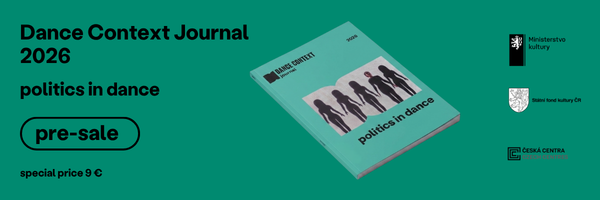
The latest issue of Dance Context Journal will be available this autumn, both in print and in electronic form. As always, all texts will be published in both Czech, or Slovak where applicable, and English. You can pre-order Dance Context Journal now at the discounted price of 199 CZK and be among the first to receive the new publication.