At times, Avant-Garde is far from avant-garde. Yet it is arguably the National Theatre Ballet’s best triptych in a decade
In mid-March, the ballet company of Prague’s National Theatre presented its second premiere of the season to its audience, as well as the first of two mixed programs this year: the triptych Avant-Garde, featuring two world premieres by Robert Bondara and Marc Goecke, complemented by one of the late works of Jiří Kylián. The title of the evening promises the avant-garde—that is, a pioneering approach, originality, and the discovery of the unknown (or, if we follow the word’s original French meaning, a military vanguard)— and given my previous experiences with the dramaturgy of the National Theatre Ballet’s management, I must note with surprise—but all the more delight—that the advertised premise is actually fulfilled quite well in two-thirds of the program. Which, for a start, is no small feat.
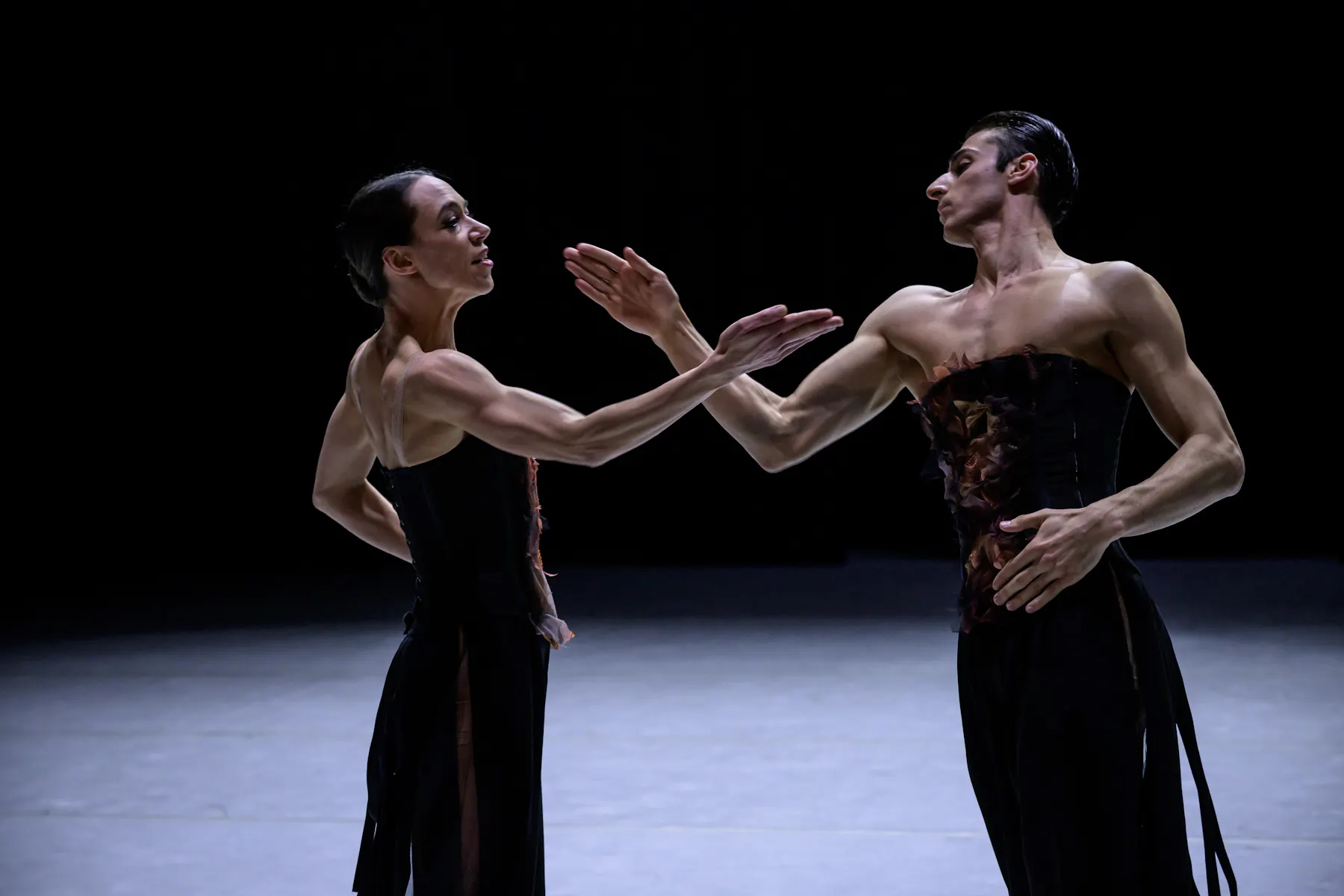
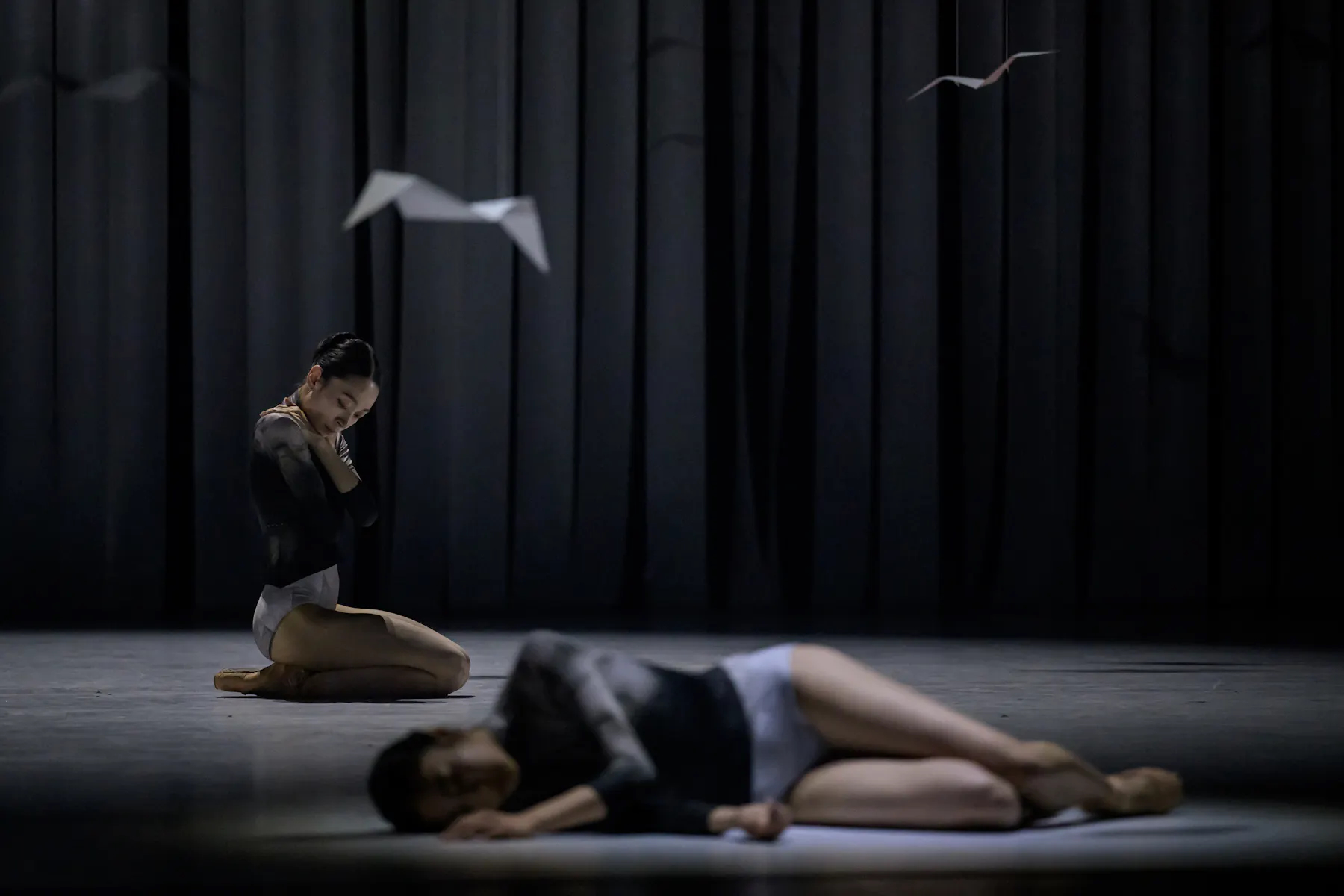
Avant-Garde. 4 Seasons. Photo: Serghei Gherciu.
In nearly a decade on the Prague stage, the artistic director of the National Theatre Ballet, Filip Barankiewicz, has produced several triptychs, the vast majority of which regularly fell into the category of uncertain, unbalanced, or downright nonsensical. In recent seasons, however, Barankiewicz has apparently either found his footing or simply gotten lucky; but following last year’s Sarkasmy, he has added a second program to the repertoire that abounds in ideas, logical dramaturgy, educational potential, and quality—qualities that are ultimately capable of outweighing even a single unsuccessful piece, the potential existence of which is always a risk of the profession. Sure, we could argue that with Kylián you can never really go wrong, and that even Goecke is more or less a safe bet these days, but let’s recall Kylián’s first Bridges of Time, where three of the four choreographies came from a single creative period of the author, or Beyond Vibrations, where Goecke’s Fly Paper Birds didn’t exactly vibrate in my eyes either… Even in this context, the current Avant-Garde must be appreciated and given a well-deserved pat on the back.
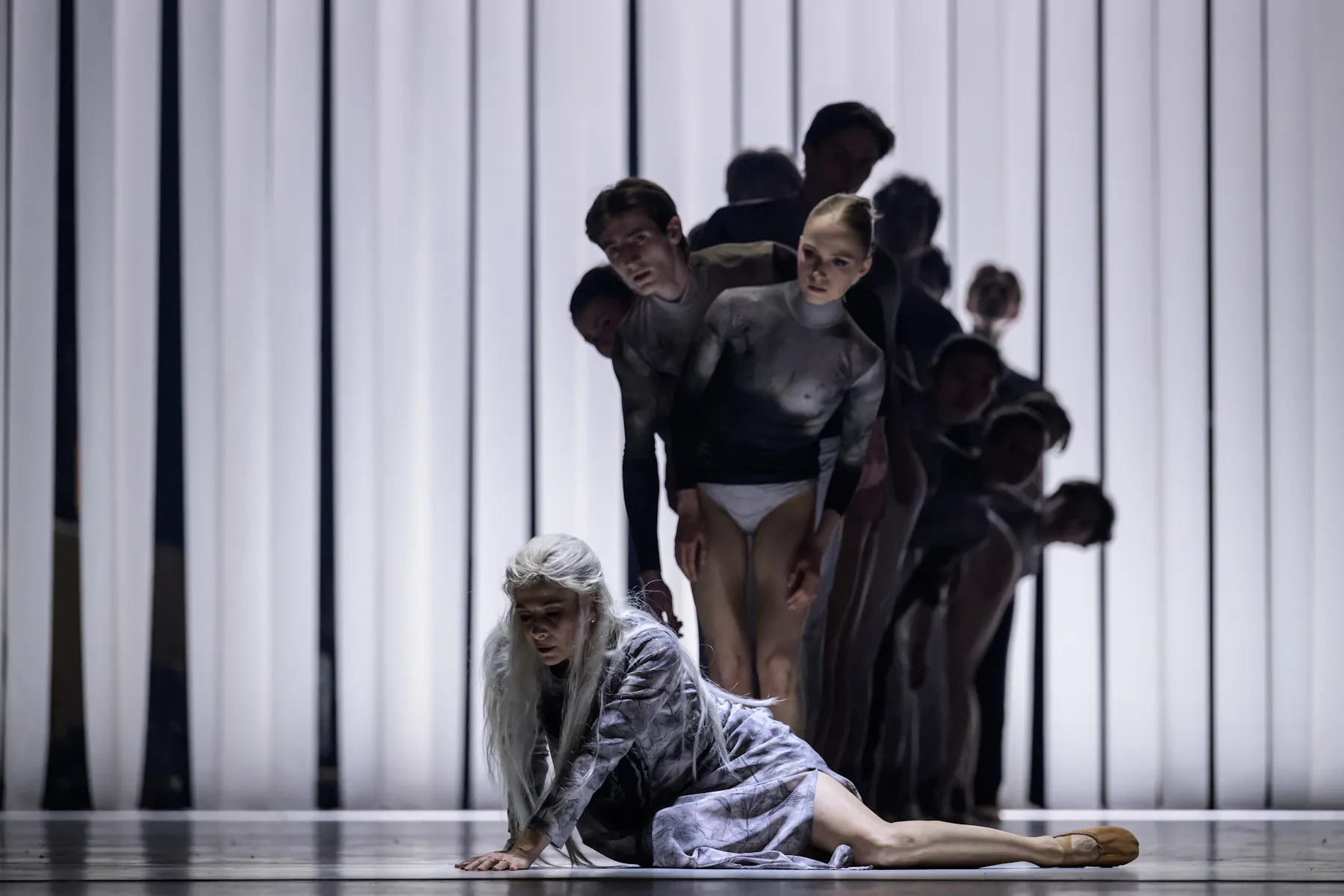
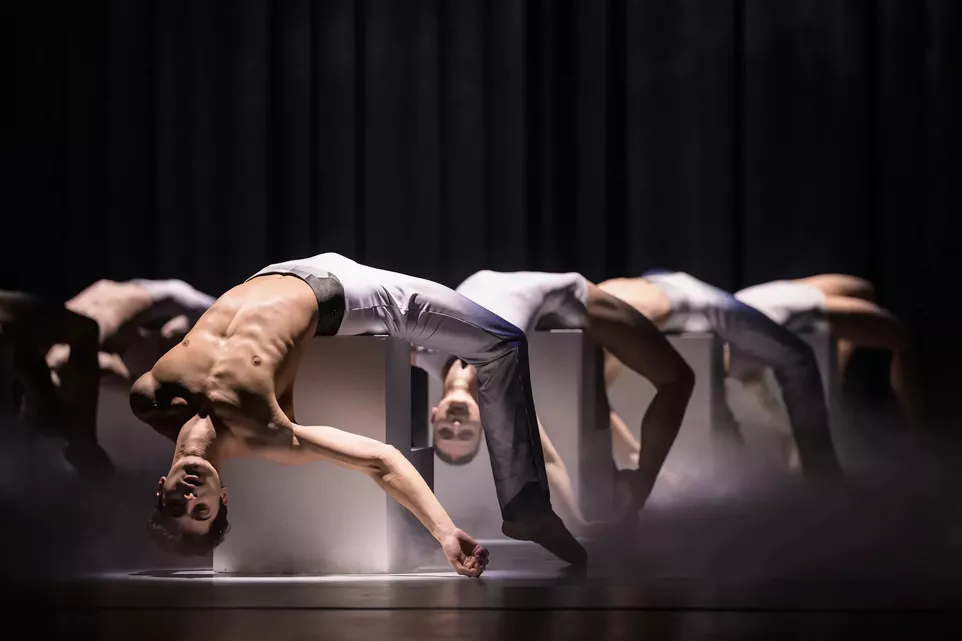
However, so that everything doesn’t seem overly bathed in warm spring sunshine, the new repertoire also includes Robert Bondara’s 4 Seasons, which opens the entire evening. To say that it is an awkward piece would likely be a polite way of putting it, but it would not fully capture reality. Bondara’s choreography for The Four Seasons in a recomposed version by Max Richter is, in fact, shockingly shallow, unimaginative, and, above all, emotionally utterly empty—which, combined with a score whose musical textures and shifting dynamics practically offer emotional depth for free (especially since it is performed live and the solo violin parts were barely off-key during the premiere), and the author’s inspiration—the experience of a loved one’s death—makes it doubly absurd. The work suffers not only from a routine, repetitive, and meaningless use of movement vocabulary—which the choreographer handles like a desperate school canteen cook, devoid of even a shred of imagination, with a frustratingly limited repertoire of basic ingredients—but also from the constant shuffling of white cubes back and forth across the stage.
The roughly 45-minute-long 4 Seasons relies primarily on completely interchangeable duets interspersed with ensemble passages, in which the choreographic principle of the canon most frequently appears—a principle that is undoubtedly functional, and at times quite pleasing, but after a while becomes tedious due to its lack of inspiration. The guide here is an older woman in a long, grey-white robe with waist-length hair of a similar colour, but even though the role went to Nelly Danko, an artist with the charisma of an ancient heroine, what good is that when she isn’t given a single task in which she could put her experience to use (and I’m not talking about the dramatic pathos of romantic pantomime).
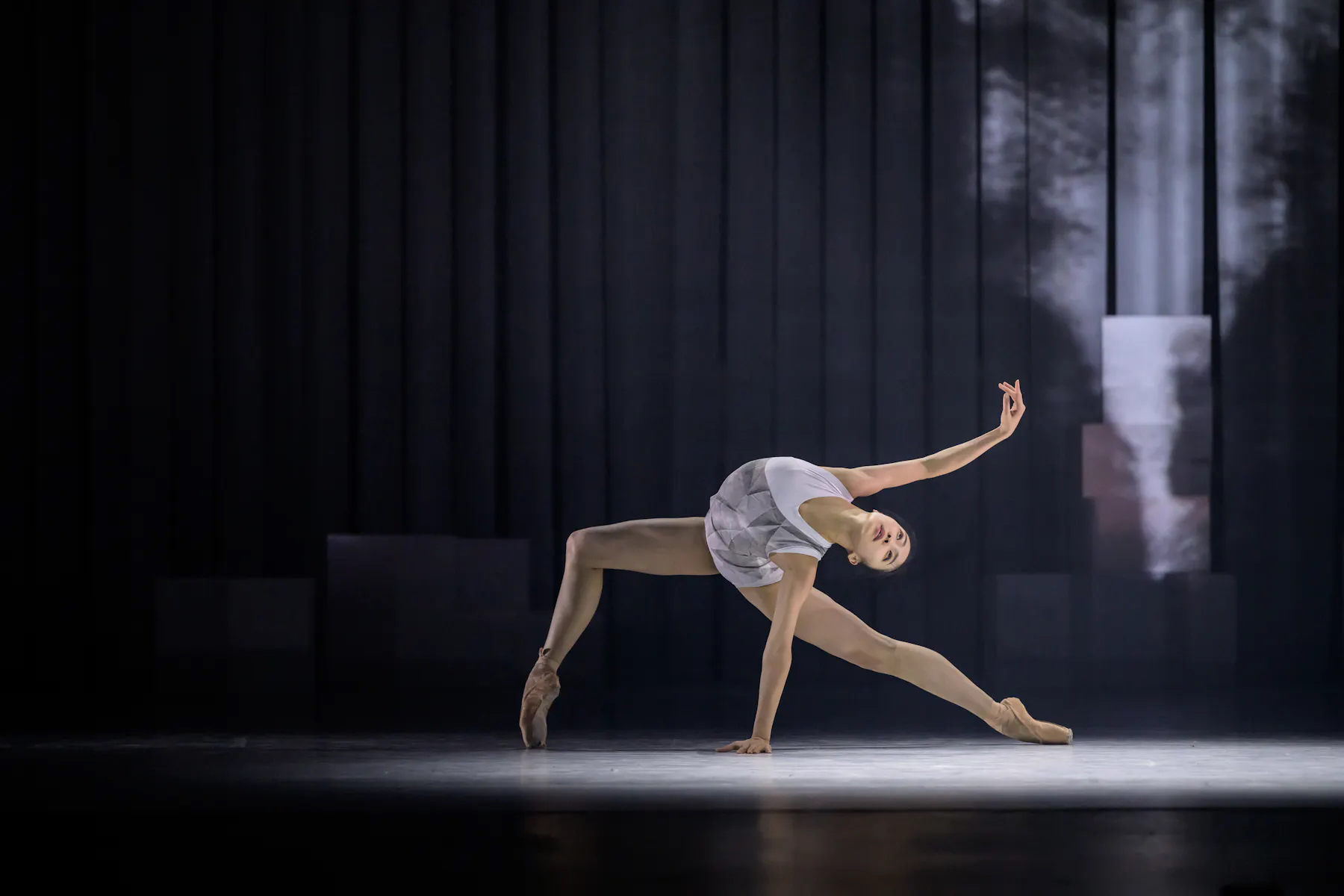
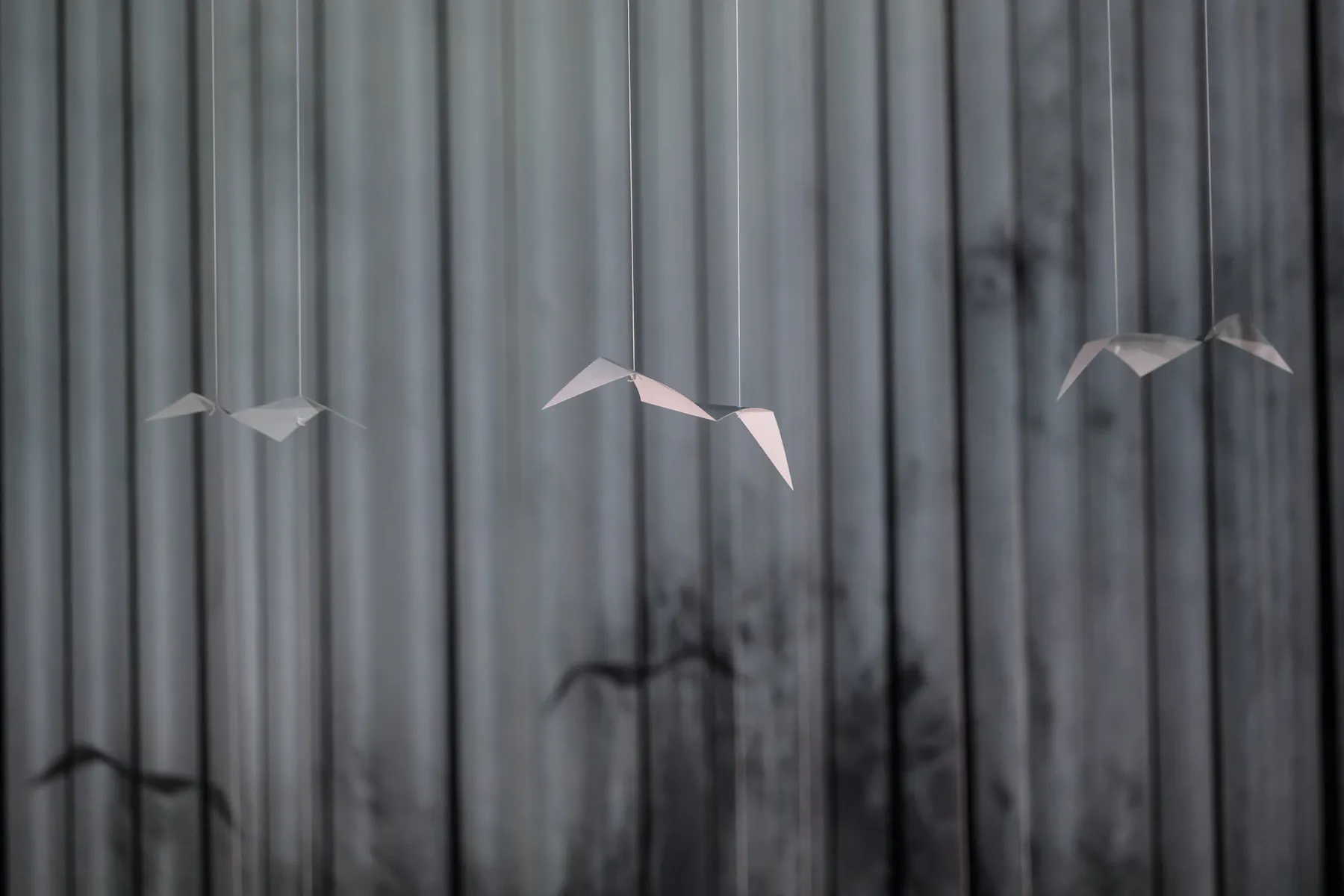
The opening scene itself, in which white paper planes begin to rise above the white stage, feels almost magical and seems to promise a minimalism that would have corresponded with the music. Similarly promising flashes appear in another two or three moments, paradoxically at times when, at first glance, nothing seems to be happening on stage and Bondara eschews the trite, cliché-ridden lifting figures seen a thousand times before, the immediately predictable partnerwork, and allows himself to pause, to simply be for a moment and let the music freely do its work. But that is painfully little, especially when I recall the opening of Autumn, accompanied by the raucous shouting and commotion of the dancers, which I can explain only as a temporary confusion of the senses.
Robert Bondara is the only performer of the evening working within a neoclassical framework, which is fine and entirely legitimate. However, if the dramaturgy intended to showcase an avant-garde approach to (neo)classical technique in the 21st century, there are many far more successful examples to choose from. Whether it be Richard Siegal or David Dawson, if we wish to explore a gymnastic-plastic vision, or Christopher Wheeldon, Justin Peck, or perhaps the “most restrained” Alexei Ratmansky.
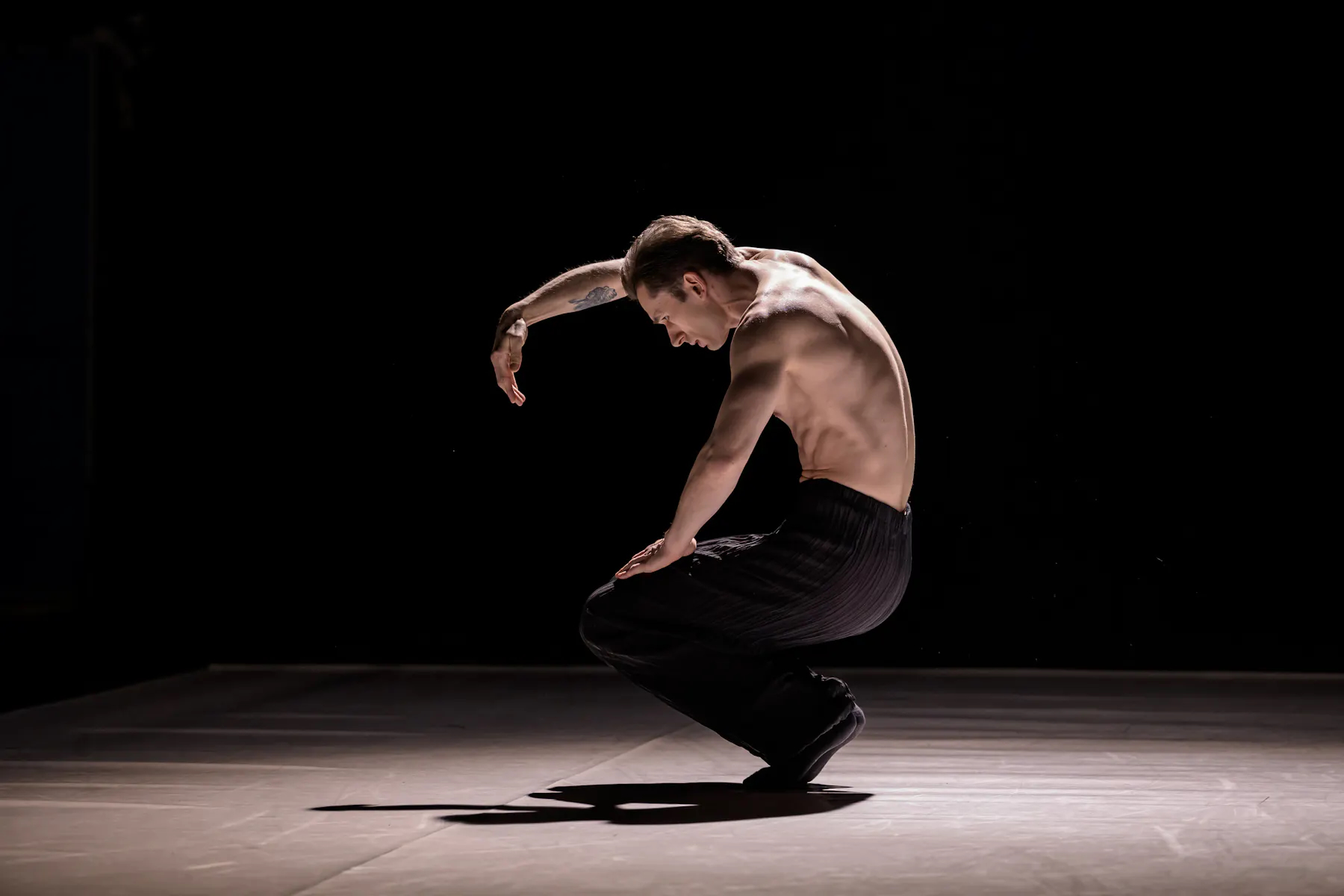
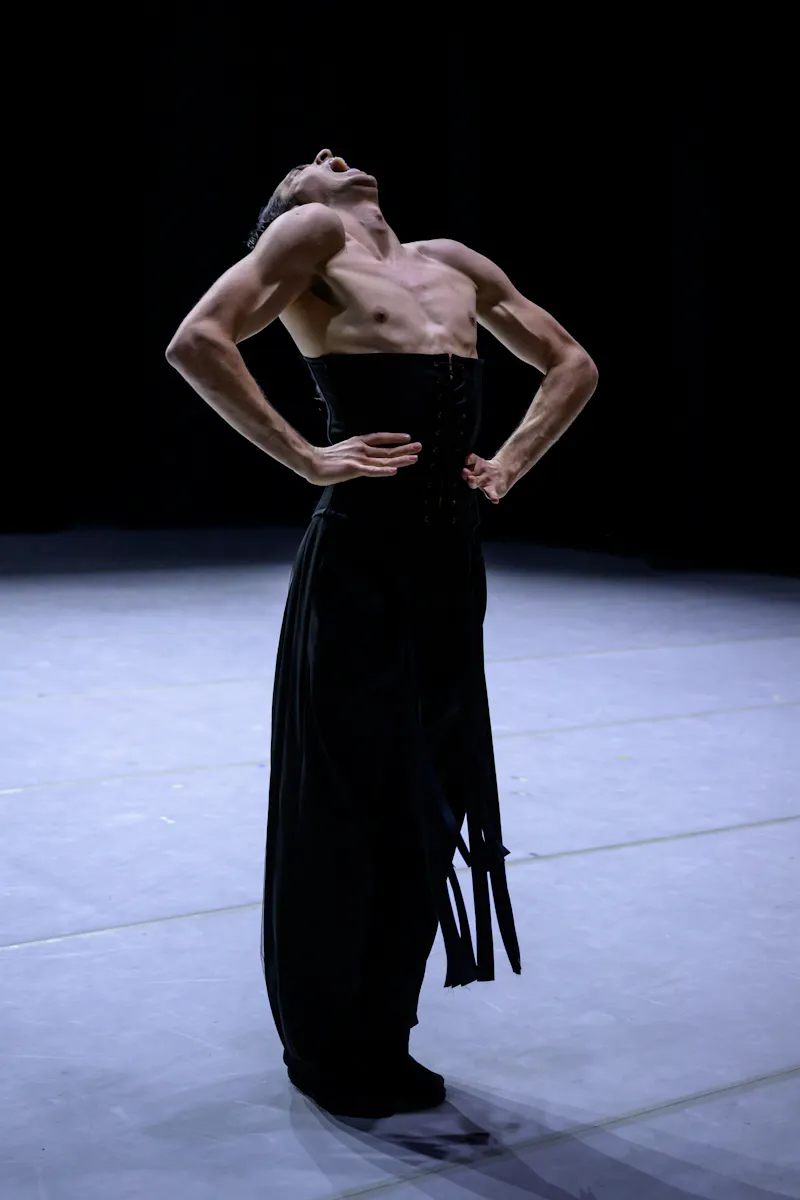
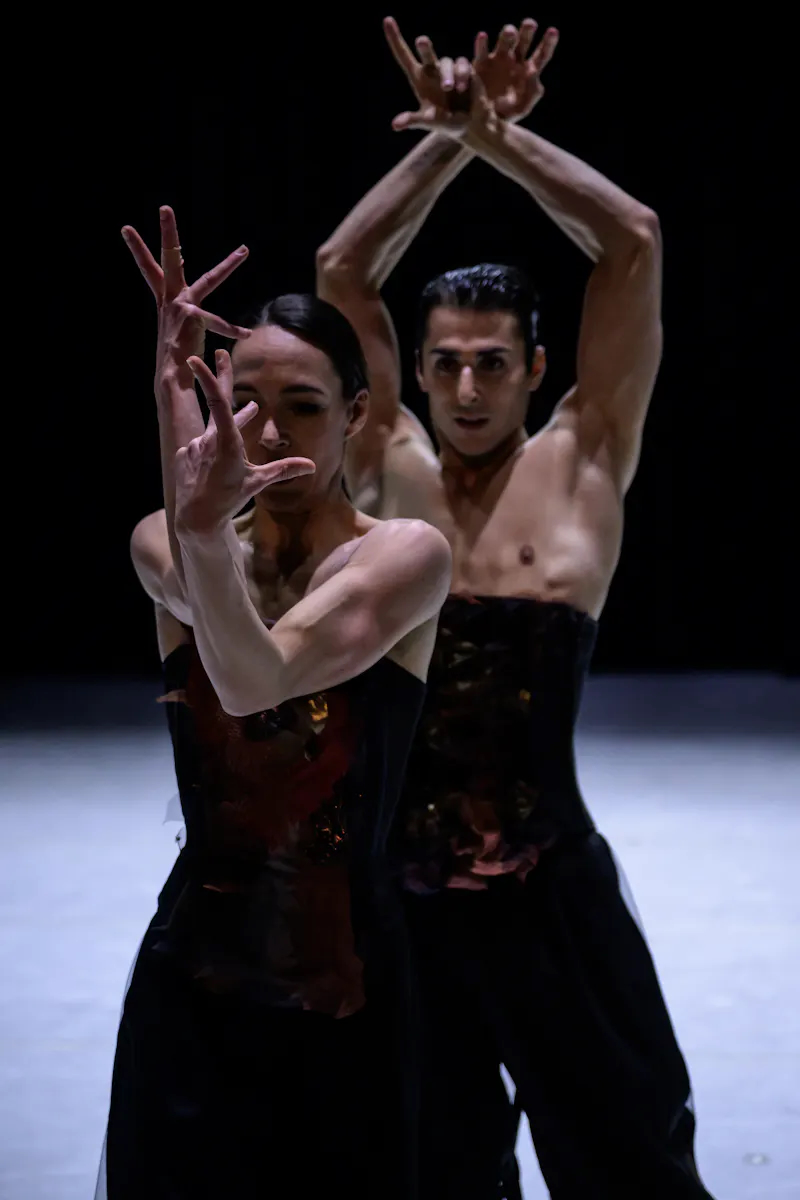
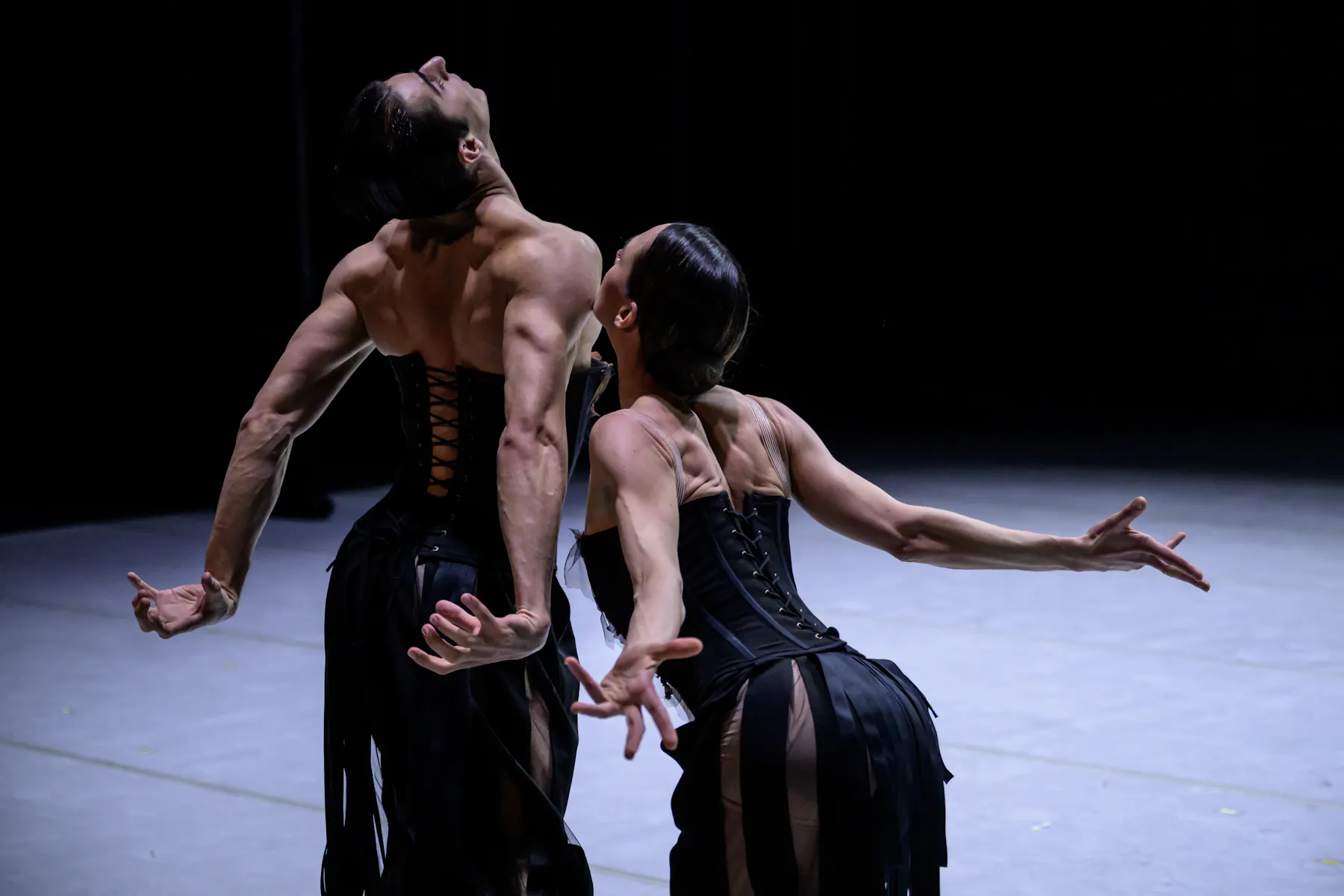
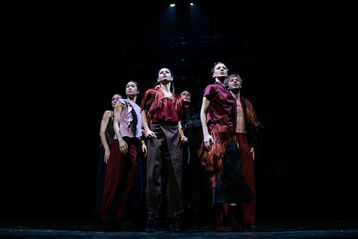
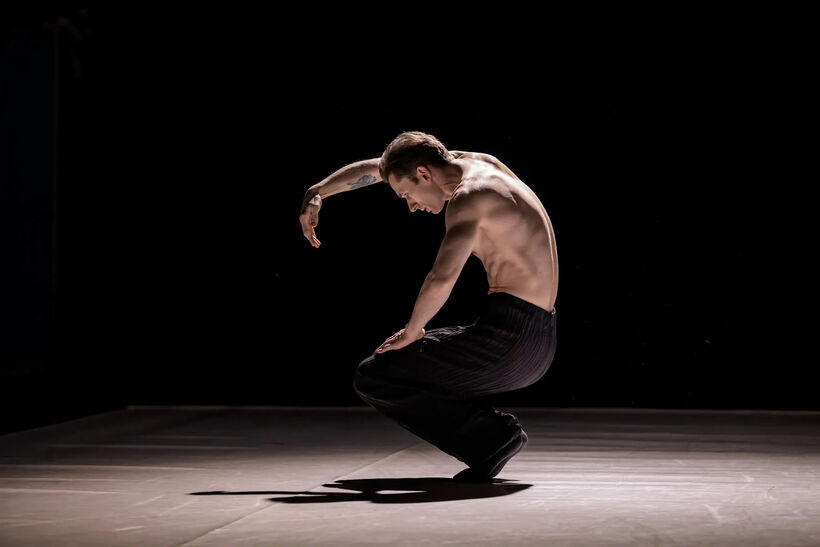
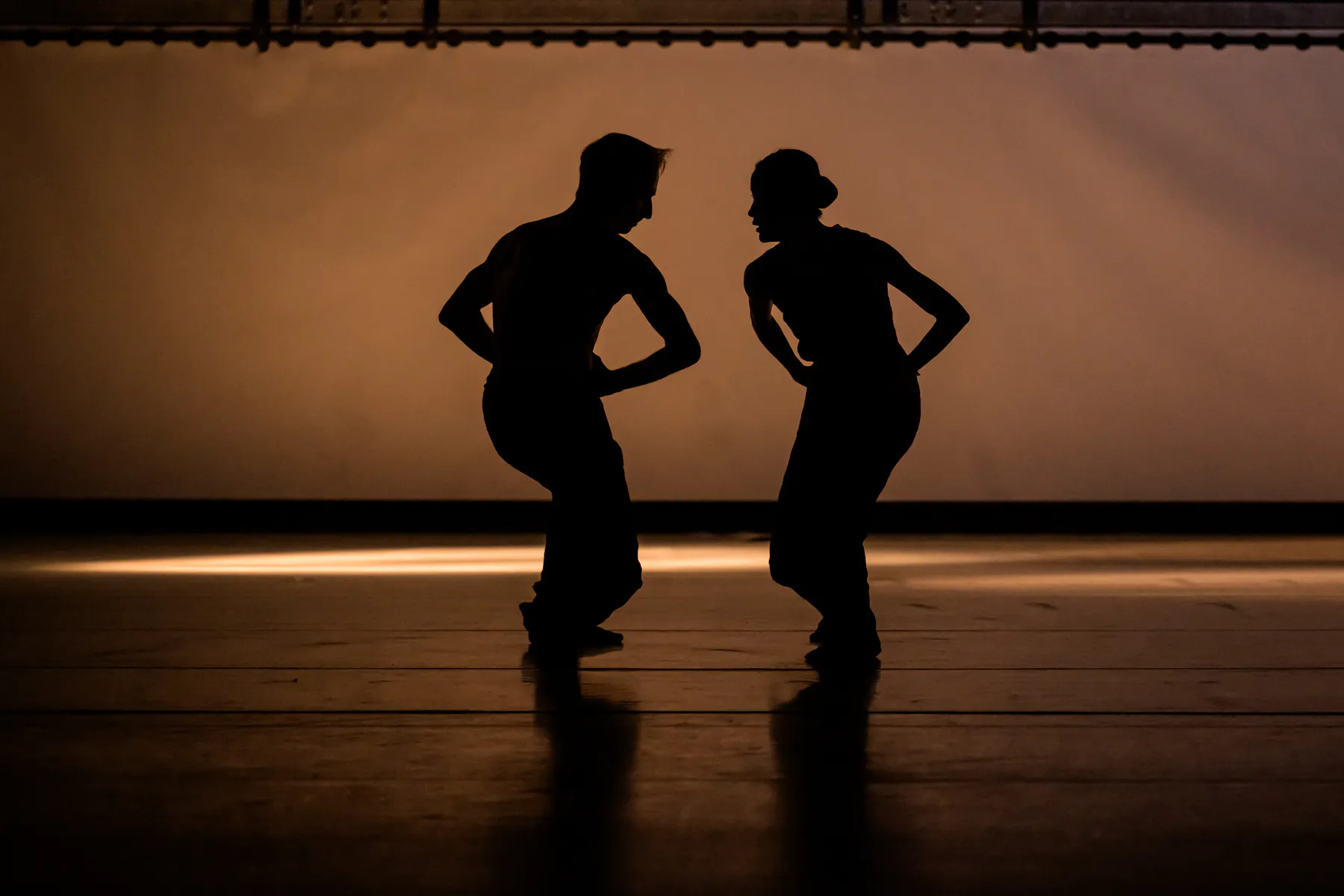
On the opposite end of the spectrum, Avant-Garde is framed by the second world premiere, the choreography Lovebirds by Marc Goecke, an artist whose vocabulary is, in many ways, also somewhat predictable; yet, thanks to his distinctiveness, nervous restlessness, and almost psychopathic essence, he is never boring. Once again, the choreographer relies on a stage shrouded in darkness, legs cloaked in black trousers contrasting with half-naked torsos and arms, on frenetic fluttering, exaggerated grimaces, and almost Tourette’s-like aggressive tics of the upper body—including the head—in the manner of deranged pigeons (or doves, to stay true to the title’s theme). Yet all of this is suddenly complemented by moments of stillness, a seemingly opposing calm, and an almost flowing legato—which would seem soothing in anyone else’s hands, but in Goecke’s case inevitably evokes a chill, paranoid uncertainty, and a sense of electrifying tension before the storm.
The atmosphere thus pulsates tirelessly, unsettles, and refuses to let one rest, constantly and indiscriminately offering new stimuli that poke in the ribs like an unwelcome, annoying index finger. Throughout, however, it masterfully balances on a razor’s edge, never once tipping over into unbearability. The dancers, every one of whom delivers an outstanding performance, accompanied by hissing whispers, gasps for breath, and psychotic laughter, feverishly, grotesquely, and clumsily seek a path to one another and to themselves. Individuals collide with one another in a way that is both confusing and touching; they explore possibilities and attempt, with varying degrees of success, to find forms of contact, though it is not entirely clear whether this stems from an inner impulse or an effort to fulfil an external norm.
By far the most surprising, however, is the choreographer’s work with music. Marco Goecke is, in fact, a world away from the traditional (and even non-traditional) conception of a musical composer; he approaches the accompaniment of his works very freely. At first (and often second and third) glance, everything appears to be pure coincidence, and the creator himself admits that music is by no means essential to him. I honestly admit that it was precisely this variable that most often prevented me in the past from fully immersing myself in his works, even though the theme might have moved me and I enjoyed searching for meanings within his vocabulary and letting myself be absorbed by the bizarre absurdity and black humour.
 With Lovebirds, Double Concerto for Two String Orchestras, Piano, and Timpani by Bohuslav Martinů (again performed live, much like the opening third of the evening, and it must be noted that on both evenings there were superb performances at the piano and on the timpani) and two songs by soul singer James Brown (a combination that probably shouldn’t work at all on paper, yet it does), I was, to my own surprise, unable to shake the impression that Goecke is, out of the blue and perhaps even quite unintentionally, musical. Perhaps this is because his movement material, by its very nature, is much more compatible with polyrhythmic modernism; in the case of Double Concerto, it also resonates with dramatic richness, its gloomy oppressiveness, suppressed fear, and bubbling rage, thus becoming a certain symptom of the times and its cruel, twistedly tragicomic reflection (Martinů wrote the work during the period of Hitler’s rising power in Germany and completed it on the day the Munich Agreement was signed, September 30, 1938).
At the centre of the triptych, sitting like a crown’s jewel, is 27’52” by Jiří Kylián, one of the works from the final, experimental period of the most famous Czech choreographer (not only) of the last fifty years, which premiered with the junior ensemble NDT 2 in 2002 (and one of the performers at the time was the Slovak dancer Lukáš Timulák). The title clearly and succinctly refers to the exact length of the piece, creating a counterpoint to the fluidity of time, which Kylián freely manipulates within the choreography.
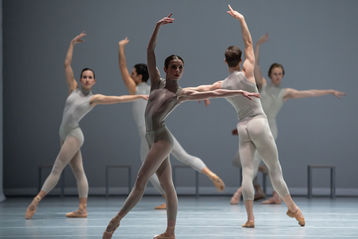
This physical quantity, relentlessly rushing ever forward, seems to lose its distinct contours, meaning, and direction in his hands. A vacuum thus emerges on stage, a world within a world, a spacetime capsule of timelessness (Jiří Kylián perfected this principle a year later in Last Touch, in which, for 30 minutes, he became such a master of time that even Doctor Who from the cult British series might envy him, as the Prague audience could also witness in the 2009 triptych Extrém). The choreographic vocabulary, within which three pairs move (and here I must especially highlight the cast of the second premiere, namely Kristýna Němečková, Anna Novotná, Kazane Takaki, Jakub Raška, Matěj Šust, and Patrik Holeček), pulsates with the shifting dynamics of fluid grace; it is effortlessly elegant, and the intertwining duets are naturally statuesque in an antiquity period sense, without being overly concerned with external structure. All of this is complemented by meaningful gestures, some subtle—a twitch of the fingers—others encompassing the entire body. One cannot help but notice that certain principles from Kylián’s choreography are employed by both Bondara (sudden kicks of the lower limbs in poses) and Goecke (rapid, repeated arm gestures), yet with Kylián they feel different. Authentic. Unique. Fresh. Lively. Even though his piece is nearly twenty-five years old.
The sound palette of Dirk Haubrich (vaguely inspired by Gustav Mahler’s unfinished Symphony No. 10) is complemented by four spoken passages in English, German, and French—touching on the essence of humanity, the art of movement, poetry, and loneliness. Their philosophical depth is subsequently eroded by slowing them down and playing them in reverse; meanings blur, fade, until they vanish entirely. Or, conversely, they reach their fulfilment for the first time. Space, too, loses its unambiguity; sheets of ballet floor drop over the stage, undulating beneath the dancers’ feet, offering refuge beneath them while also teasing with the potential to be swept aside—and thus disrupting the notion of a stable, comprehensible world. Throughout it all, however, the work maintains a subtle, barely perceptible humour, a quiet tenderness, and a mutual fragility. Humanity. Through it, the work touches the soul; thanks to it, it moves you; and because of it, it is quite possible that when, at the very end, those three white sheets of ballet floor fall to the ground due to gravity, you will find yourself crying in the audience.
Despite its stumbling start, Avant-Garde still earns its merits, and thanks to its extraordinary second and very good third parts, it boldly ranks among the best ballet triptychs of recent years at the National Theatre in Prague. True, it offers the audience no light relief in the true sense of the word, no humorous bite-sized treat, no intellectually undemanding—though honestly executed and high-quality—entertainment. It is even possible that some will leave the theatre in a mild state of depression or an existential crisis. Given the state of the world around us, however, this seems fitting to me, and I believe that a healthy dose of existentialism has never hurt anyone…
Written from the first and second premieres on March 12 and 13, 2026, at the National Theatre in Prague.
Avant-Garde
4 Seasons
Choreography: Robert Bondara
Music: Max Richter, recomposition of Antonio Vivaldi
Set design: Diana Marszałek
Costumes: Martyna Kander
Lighting design: Daniel Tesař
Projections: Jagoda Chalcińska
Musical direction and conductor: Jaroslav Kyzlink
Violin solo: Alexej Rosík (March 12), Ondřej Hás (March 13)
Harpsichord solo: Anna McBride (March 12), Tomáš Pindór (March 13)
Premiere: March 12, 2026
Lovebirds
Choreography: Marco Goecke
Dramaturgy: Nadja Kadel
Music: Bohuslav Martinů, James Brown
Costumes: Michaela Springer
Lighting design: Udo Haberland
Musical direction and conductor: Jaroslav Kyzlink
Piano solo: Anna McBride (March 12), Tomáš Pindór (March 13)
Timpani solo: Pavel Rehberger (March 12), Tomáš Koubek (March 13)
Premiere: March 12, 2026
27’52”
Choreography: Jiří Kylián
Music: Dirk Haubrich
Set design: Jiří Kylián
Costumes: Joke Visser
Lighting design: Kees Tjebbes
Technical supervision: Joost Biegelaar
Premiere: February 21, 2002