
For some time now, there has been a surge in discussions regarding the repertoire of Italian contemporary dance, along with calls to give greater support to dance reconstructions. Such initiatives aim not only to valorize the history of Italian contemporary dance, but also to critique the tendency of the performing arts market towards the “new.” Indeed, at first glance, the reconstruction of past works by the very artists who originally created them might seem to contradict the nature of contemporary dance — usually inclined to produce new works. However, the practice of transmitting older works to the younger generations of dancers has gradually been legitimized as a “contemporary” practice that puts the past, present, and future in dialogue with one another. Virgilio Sieni’s Sonate Bach. Di fronte al dolore degli altri (2006) and Raffaella Giordano’s Tu non mi perderai mai (2005) – re-staged in Rome this January and February respectively – are two recent examples within the Italian contemporary dance scene of established choreographers revisiting their earlier works. Although nearly twenty years have passed since their creation, these two pieces show no visible signs of ageing; nothing in them betrays the passage of time as, for different reasons, they continue to feel strikingly contemporary.
Choreographies Re-Lived: Virgilio Sieni and Raffaella Giordano at the Orbita|Spellbound Dance Season in Rome
Over the past five years, Orbita|Spellbound National Centre for Dance Production has, under the direction of Valentina Marini, curated Rome’s dance season, spanning from the cold winter days of January to May’s summer-like evenings. Named Scintille (“Sparks”), this year’s programme aims to instigate change and inspire collective reflection, as in Virgilio Sieni’s anti-war choreography and Raffaella Giordano’s choreographic hymn to unconditional love.

Anti-war choreographies
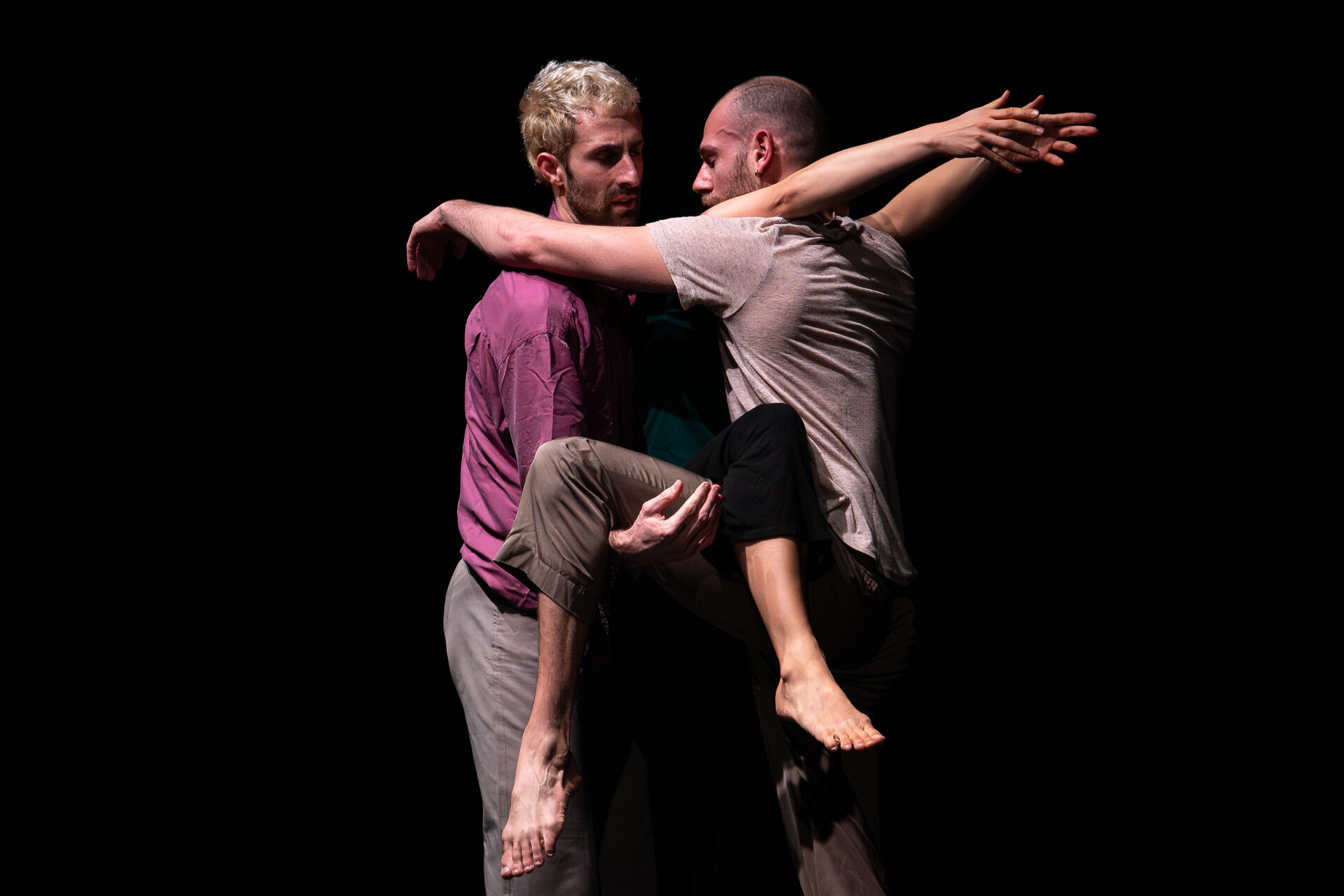
Virgilio Sieni is a choreographer who made his debut on the Italian dance scene in the mid-1980s, later becoming the director of the Dance Department of Venice Biennale (2013–2016). Currently, he is the artistic director of the Centro di Rilevante Interesse per la Danza, which also bears his name. His restless creative mind, guided by a belief that dance should be inclusive of all humanity, urged him to create works for various communities, including the elderly, people with visual impairment, or simply “everyday people” drawn to the allure of dance. Sonate Bach – subtitled Regarding The Pain of Others to echo Susan Sontag’s homonymous book – is a work made for his company, first performed as a quartet by Simona Bertozzi, Ramona Caia, Massimiliano Barachini, and Pierangelo Preziosa. Since 2006, it has often been performed by Sieni’s dancers and its most recent version, the one which opened the Orbita|Spellbound dance season, is a quintet with Jari Boldrini, Maurizio Giunti, Giulia Mureddu, Andrea Palumbo, and Valentina Squarzoni.
In Sonate Bach, hundreds of photos from the archives of war reporters became the point of departure for every single choreographic act – eleven in total – forming a modular choreography of compassion. As the minimal information projected on the black background depicts, each act corresponds to a specific date and location, including cities in the Middle East, the Balkan region, and Africa, areas which experienced conflict between 1994 and 2007. The piece is set to three sonatas by Johann Sebastian Bach; eleven sections that aim to heal the trauma of war, genocide, and loss.
Here, the bodies are more often than not entangled with one another, spiraling in the vortex of movement. They give the impression of being crucified or abandoned, seemingly surrendered, as if soulless, to other single or constellated bodies; they look for support and relief in a liquid choreography that combines flow with sudden accents. Sieni choreographically sculpts the immaterial space with frequent changes of level and direction; the high and the lows, from right to left and across all the intermediate planes in between. Yet, his choreography is far more than movement for movement’s sake. Every small gesture carries a significance without ever becoming imitative or narrative. Walking on one’s knees while holding the soles of one’s feet from behind brings to mind amputated bodies struggling to shift their weight in space. Running demonstrates the emergency of escape, covered eyes suggest the need to hide tears, lowering one’s body conveys the instinct to hide oneself and seek protection as the world collapses; upside down bodies are reminiscent of falling from the sky. The absent bodies become palpable, and the possibility of suddenly being left alone is ever imminent. Sieni molds the rhythm of time through speed variations and moments of suspension that give the dancers time to connect with each other, along with a sense of the depth of touch, which always arrives in time to catch a body before hitting the ground. At times, fleeting images emerge, almost religious tableaux vivant or portraits of pain, sorrow, and suffering, before dissolving again into the flow of movement.
Sieni does not seek to mirror the profound pain of others; rather, through a process of abstraction, he ignites small sparks of humanity that redirect our attention toward the vulnerability of the Other. The striking relevance of Sonate Bach to the present moment is not only the result of a company in excellent condition or a process of careful dance transmission that sustains the work across time. It also stands as a sombre reminder that little has changed in our world – if not, perhaps, for the worse. Conflict and violence remain persistent characteristics of our civilisation.
A choreography of incomplete love and devotion
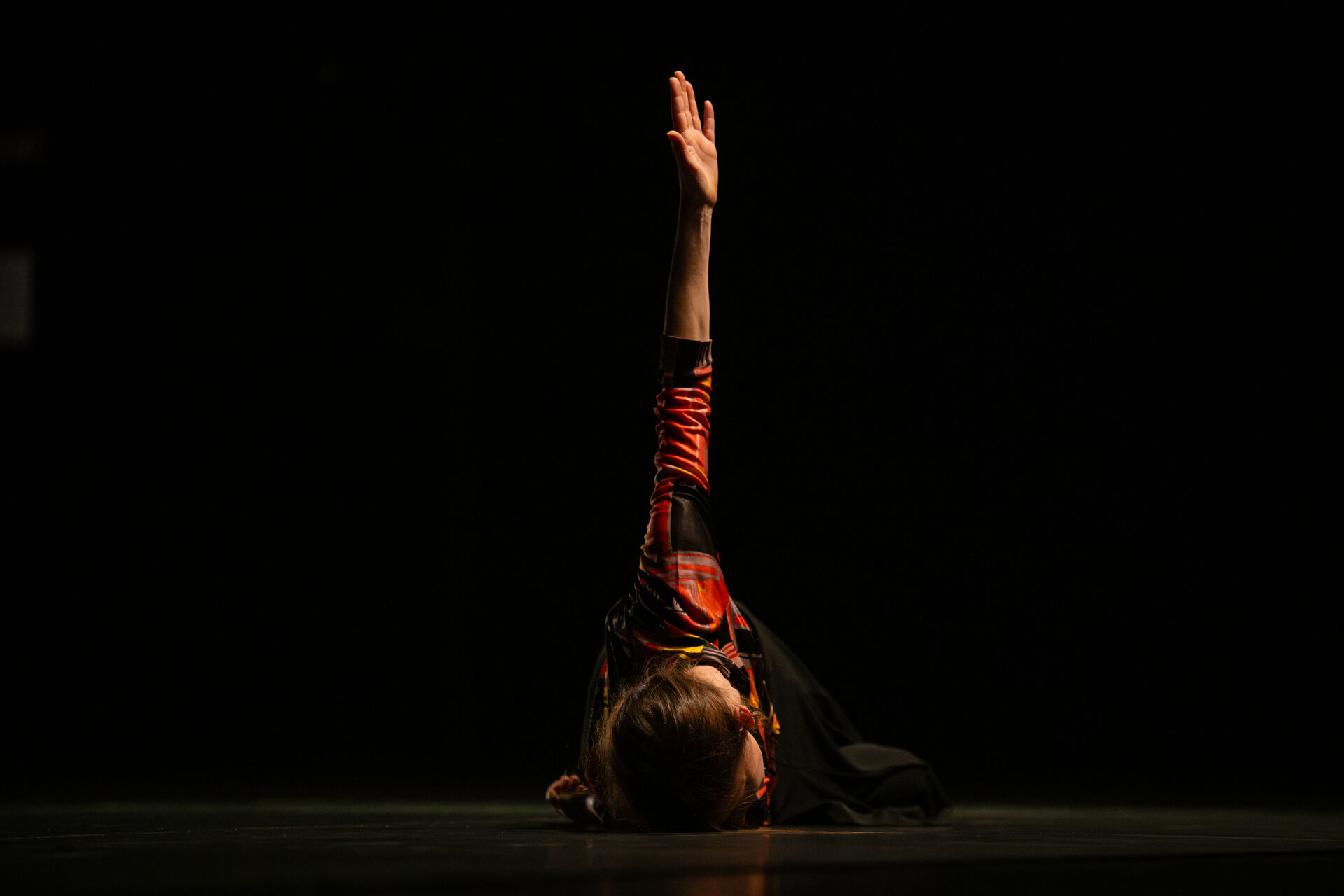
Tu non mi perderai mai (“You Will Never Lose Me”) is a solo originally created and performed by Raffaella Giordano, founding member of the groundbreaking Italian dance company Sosta Palmizi (1985), recently transmitted to dance performer Stefania Tansini. The work draws inspiration from The Song of Songs, a biblical text on desire, love pursuit, and devotion, a metaphorical exploration into the relation between humanity and the divine.
Slowness and softness shape the unadorned choreography of Tu non mi perderai mai, which unfolds in a smooth, silent, introspective way with no accents, as if to activate the audience’s imagination. The movement pattern seems precisely pre-written: how to move, how long to live inside a pause, when to break it, when and how to touch the air and the ground, how to place one’s body in space. Tansini is elegantly dressed (costumes by Beatrice Giannini): black midi skirt, a blouse with geometric patterns in the colours of flames and darkness, a white purse and modest black low heels, perhaps the only accessory that evokes a different era. She stretches both hands towards the sky, and when both wrists kiss each other, they form – as if handcuffed – a silent promise of eternal love and fidelity. She walks backwards crookedly; she steps to the side carefully, squats and curls into a small ball, unexpectedly exposing her white thighs. In the memory of or in the desire of another body, she flails, and when she removes her shoes, they are left empty and abandoned, but still waiting to be worn again. These exact shoes create a subtle, parallel story on their own; they are the tangible traces left behind, along with bits of earth from the rectangular piece of soil on the stage. A fruitless garden, a grave or the remains of Eden?
Each gesture and step appear sacred, imbued with a quiet solemnity. As the choreography proceeds, its trace lingers in space, like the trail of an airplane that gradually dissolves in the sky – indeed, there is a sudden aural texture carefully woven in the sound design of Lorenzo Brusci and Jòhann Jòhannson. It is as if the choreographic pace and the movement choices are answering the promise embodied in the poetic title You will never lose me with a precise, sculpted definition of every single movement in space and time; with a soft and ephemeral geometry that can simultaneously vanish and be recalled. As if wishing to express through the somatic language that once “you” (the “you” in the title) start looking for me, “you” will be able to find me, following the path I traced and curved so carefully in space. In this intimate journey, Tansini transforms from a scared teenage girl into a mature woman, embodying the intensity of love, squeezing twenty years or so of life into sixty minutes of performance time. Her pale face depicts both innocence and plenitude at once.
Tu non mi perderai mai is remarkable for its precise and atmospheric approach, as well as for its poetic clarity. It renders absence and presence constitutive, producing a somatic material of desire and devotion through the economy of slowness. But it also left me curious to witness the process of transmission that underpins this solo, what dance scholar André Lepecki frames in The Body as Archive (2010) as the act of “excorporation” of knowledge from one body and its “incorporation” by another, a process whose very enactment carries performative force. Advocating for the empowerment of the ageing body on stage, I was left eager to witness both bodies – the body of the person who transmits and the body of the person who receives, Giordano and Tansini respectively – to co-exist in parallel universes of embodied archives, negotiating memory, transmission, and future.
The review of Sonate Bach. Di fronte al dolore degli altri was written from the performance of 19 January 2026 in Teatro Ambra Jovinelli, Rome, and the review of Tu non mi perderai mai was written from the performance of 24 February 2026 in Spazio Rossellini, Rome.
Sonate Bach. Di fronte al dolore degli altri
Choreography and Direction: Virgilio Sieni
Performers: Jari Boldrini, Maurizio Giunti, Giulia Mureddu, Andrea Palumbo, Valentina Squarzoni
Music: Johann Sebastian Bach, Three Sonatas for Viola and Piano (BWV 1027, 1028, 1029)
Costumes: Marysol Maria Gabriel
Light Design: Andrea Narese, Virgilio Sieni
Technical Direction: Marco Cassini
Tu non mi perderai mai
Choreography: Raffaella Giordano
Performer: Stefania Tansini
Light Design: Gianni Staropoli, Maryse Gaultier
Sound Design and Electroacoustic Composition: Lorenzo Brusci
Additional Sound: Jòhann Jòhannsson
Costumes: Beatrice Giannini
Technical Sound Execution: Andreas Froeba
Technical Lighting Execution: Maria Virzì, Lucia Ferrero