
Cullberg Ballet Presented New Programme Full of Contrasts
Advertisement

Cullberg Ballet, one of the leading Swedish dance ensembles, founded in 1967 by the famous choreographer Birgit Cullberg and later directed by her nephew Mats Ek, premiered its new piece called Works in the autumn 2014. The first premiere night took place on 11 October in the northern Swedish city Umeå, which holds the title of the European Capital of Culture for this year. On 16 October, the company started off a series of performances in Stockholm’s Dansens Hus.
The new piece consists of two choreographies, so called double bill, and as the very general title Works suggests, the two parts have really nothing in common. Even the printed programme did not pretend any transient connection between the first and second performance, the dramaturgic unity was not the Cullberg Ballet’s main objective. The single evening featured choreographies as different as we can only imagine within the spectre of contemporary dance.
The author of the first piece was a young Swedish choreographer Stina Nyberg who has just recently gained her degree in Choreography at the University of Dance and Circus (DOCH) in Stockholm. For her project Tones & Bones, she selected six dancers and together they plunged into the research of relations between music and dance.
Subordination of dance
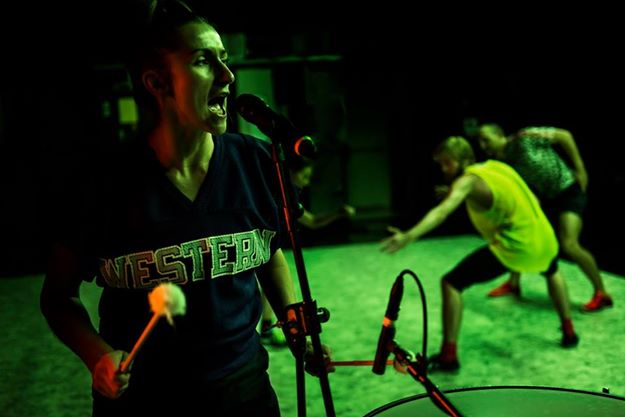
This choreography was presented earlier this year, in August, as work in progress within the Parkteatern project, which provides the space of the open-air Vitabergspark theatre for free dance, opera and theatre performances and concerts (this year, for instance, it was the choreography Kolik váží vaše touha? by the Czech dance group VerTeDance, which performed a day after the Cullberg Ballet). It was clear even then that Tones & Bones did not aspire to be a world-shaking piece, and the subsequent two-month development of the choreography and its placing into the theatre space did not change anything about it.
Tone & Bones was an experiment typical for choreography and movement student researchers, interesting for the creators and performers themselves, but hard to digest for the audience. The choreographer was dealing primarily with the hierarchy of music and dance, how such a hierarchy can be built, destroyed and reconstructed. From the six dancers, she formed a “band”, although none of them could actually play a musical instrument. At the beginning of the performance, the dancers stepped on the stage, each one taking some instrument (drums, bass guitar, keyboard, triangle, rattles and various electronic “staff”) or a microphone and they began to “create”. Their musical production was probably not a matter of chance, still we could not call it a composition. The basic principle was to keep the rhythm, because after a few minutes of the introductory “concert”, the dancers started, one by one, shifting in the space, and to follow the given rhythm. When the last of the performers abandoned his musical instrument, the theatre resonated with the beats of monotone rhythm.
It determined every movement of the dancers who were obviously improvising. Each beat matched a change of posture, direction, level…when the paths of two of three dancers intersected, it resulted in an interaction. And as these interactions were purely random, they often ended into breakneck and improbable positions that made the audience laugh embarrassedly. And concerning the hierarchy of music and dance, or rather rhythm and movement (because we cannot talk about dance), the result was a total subordination of movement. The dancers were entirely reined by the rhythm and did not attempt at more creative approach to the music accompaniment. The overall monotone pace of the piece was occasionally disturbed by fluorescent light, highlighting some parts of the costumes in reflexive colours, or blinding flashes of light directed to the auditorium.
Absolute stylization
In many aspects, the second choreography of the evening, 11th Floor by Édouard Lock, was in sharp contrast to the first one. The choreographer Édouard Lock is no beginner, on the contrary, he is one of the prominent authors of the 20th century world dance, one of the founders of the Canadian company La La La Human Steps and author of choreographies for ensembles such as NDT, Les Grands Ballets Canadiens of Paris Opera Ballet. His choreographic vocabulary is characteristic for its fast, almost wild movements and extreme positions, combined with sudden freezes and salient arm gestures.
For the creation of 11th Floor, Lock was inspired by the tradition of the 1950’s film noir, jazz music and tango. Gavin Bryars’ original compositions were played live on stage by four musicians and the music was really beautiful.
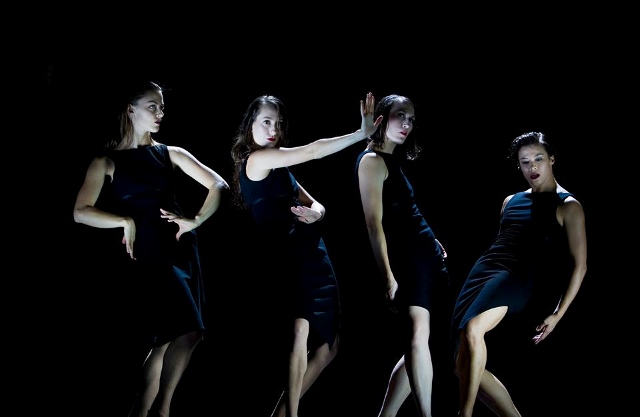 Nine dancers dressed in elegant clothes alternately appeared on stage and performed short episodes from individual rooms of the fictitious 11th floor. They showed stories of love crimes and curious relationships, full of unpleasant tension, interpreted through the accelerated tempo of hectic gesturing. The female dancers, wearing “little black dresses” with high slits and teamed with high heels, entered the stage with the same provocative posture: knees slightly bent, one leg stepping forward and leaning on a tip toe, the back bent a bit backward and one hand touching the loin. The men marched in assertively and stood in macho poses with arms folded on the chest. During the entire performance there was a silent battle going on between the strongest sides of the two sexes: the women were seductive, but mean, men demonstrated their physical strength – the female principle prevailed, not only because there were six female dancers and only three male ones.
The exaggerated movements of the dancers resembled the heroes of some dark comic story or fast-motioned old movie. The physically challenging choreography was composed of wide arm gestures and sharp footwork, very closeto tango argentino, combined with high kicks and grand pliés; all those elements together made an impression of aggression, though not reflected by the dancers’ facial expressions. The movement was in direct contrast with the smoothly flowing, almost meditative music. A very salient feature of the piece - the light design (combined with the costumes and music) - created a sophisticated and nearly mysterious atmosphere: it consisted of simple beams of light pointing at the stage from the rear upper portal. The beams drew the audience’s attention to individual performers: the stories cumulated and overlapped, the beams multiplied and the light design got more and more complex. The effect of the dancers being spot-lit from behind gave very interesting impression of depersonalisation and resemblance to black and white movies.
The 11th Floor is a choreography of consistent style and atmosphere which grabs your attention not just by the fascinating dancing and beautiful music (both exquisitely performed) but also by the developing situation which keeps the audience in constant suspense. Unlike Stina Nyberg, Édouard Lock leaves little space for chance and accident, his piece is dominated by absolute stylization – from the costumes and lighting to the movement and use of music. Thanks to that he was able to create his own bizarre world on stage, one that the audience must be absorbed into. It is necessary to add that the Swedish audience expressed its attitude to the new premiere very clearly: the first part of the evening was followed by half-hearted, almost inaudible applause, while the second piece was rewarded by loud ovations.
Written from the premiere on 17 October 2014, Dansens Hus, Stockholm.
Tones & Bones
Nine dancers dressed in elegant clothes alternately appeared on stage and performed short episodes from individual rooms of the fictitious 11th floor. They showed stories of love crimes and curious relationships, full of unpleasant tension, interpreted through the accelerated tempo of hectic gesturing. The female dancers, wearing “little black dresses” with high slits and teamed with high heels, entered the stage with the same provocative posture: knees slightly bent, one leg stepping forward and leaning on a tip toe, the back bent a bit backward and one hand touching the loin. The men marched in assertively and stood in macho poses with arms folded on the chest. During the entire performance there was a silent battle going on between the strongest sides of the two sexes: the women were seductive, but mean, men demonstrated their physical strength – the female principle prevailed, not only because there were six female dancers and only three male ones.
The exaggerated movements of the dancers resembled the heroes of some dark comic story or fast-motioned old movie. The physically challenging choreography was composed of wide arm gestures and sharp footwork, very closeto tango argentino, combined with high kicks and grand pliés; all those elements together made an impression of aggression, though not reflected by the dancers’ facial expressions. The movement was in direct contrast with the smoothly flowing, almost meditative music. A very salient feature of the piece - the light design (combined with the costumes and music) - created a sophisticated and nearly mysterious atmosphere: it consisted of simple beams of light pointing at the stage from the rear upper portal. The beams drew the audience’s attention to individual performers: the stories cumulated and overlapped, the beams multiplied and the light design got more and more complex. The effect of the dancers being spot-lit from behind gave very interesting impression of depersonalisation and resemblance to black and white movies.
The 11th Floor is a choreography of consistent style and atmosphere which grabs your attention not just by the fascinating dancing and beautiful music (both exquisitely performed) but also by the developing situation which keeps the audience in constant suspense. Unlike Stina Nyberg, Édouard Lock leaves little space for chance and accident, his piece is dominated by absolute stylization – from the costumes and lighting to the movement and use of music. Thanks to that he was able to create his own bizarre world on stage, one that the audience must be absorbed into. It is necessary to add that the Swedish audience expressed its attitude to the new premiere very clearly: the first part of the evening was followed by half-hearted, almost inaudible applause, while the second piece was rewarded by loud ovations.
Written from the premiere on 17 October 2014, Dansens Hus, Stockholm.
Tones & Bones
Nine dancers dressed in elegant clothes alternately appeared on stage and performed short episodes from individual rooms of the fictitious 11th floor. They showed stories of love crimes and curious relationships, full of unpleasant tension, interpreted through the accelerated tempo of hectic gesturing. The female dancers, wearing “little black dresses” with high slits and teamed with high heels, entered the stage with the same provocative posture: knees slightly bent, one leg stepping forward and leaning on a tip toe, the back bent a bit backward and one hand touching the loin. The men marched in assertively and stood in macho poses with arms folded on the chest. During the entire performance there was a silent battle going on between the strongest sides of the two sexes: the women were seductive, but mean, men demonstrated their physical strength – the female principle prevailed, not only because there were six female dancers and only three male ones.
The exaggerated movements of the dancers resembled the heroes of some dark comic story or fast-motioned old movie. The physically challenging choreography was composed of wide arm gestures and sharp footwork, very closeto tango argentino, combined with high kicks and grand pliés; all those elements together made an impression of aggression, though not reflected by the dancers’ facial expressions. The movement was in direct contrast with the smoothly flowing, almost meditative music. A very salient feature of the piece - the light design (combined with the costumes and music) - created a sophisticated and nearly mysterious atmosphere: it consisted of simple beams of light pointing at the stage from the rear upper portal. The beams drew the audience’s attention to individual performers: the stories cumulated and overlapped, the beams multiplied and the light design got more and more complex. The effect of the dancers being spot-lit from behind gave very interesting impression of depersonalisation and resemblance to black and white movies.
The 11th Floor is a choreography of consistent style and atmosphere which grabs your attention not just by the fascinating dancing and beautiful music (both exquisitely performed) but also by the developing situation which keeps the audience in constant suspense. Unlike Stina Nyberg, Édouard Lock leaves little space for chance and accident, his piece is dominated by absolute stylization – from the costumes and lighting to the movement and use of music. Thanks to that he was able to create his own bizarre world on stage, one that the audience must be absorbed into. It is necessary to add that the Swedish audience expressed its attitude to the new premiere very clearly: the first part of the evening was followed by half-hearted, almost inaudible applause, while the second piece was rewarded by loud ovations.
Written from the premiere on 17 October 2014, Dansens Hus, Stockholm.
Tones & Bones
Choreography: Stina Nyberg
Sets and light design: Chrisander Brun
Music: Rebecca Digby 11th Floor
Choreography and light design: Édouard Lock
Sets: Claude GoyetteCostumes: Ulrika van Gelder
Music: Gavin Bryars
Musical interpretation: Adam Forkelid (klavír), Dan Berglund (kontrabas), Lisa Eriksson Långbacka (akordeon), Nils Berg (basklarinet) Translation by: Tereza Cigánková