Perhaps Havel himself, with his renowned sense of the absurd, would have smiled wryly at the fact that the library – which was supposed to preserve his legacy, modelled on similar American institutions – has, in the very last few days, lost its name due to a profound internal crisis and become the First Presidential Library. It is therefore wonderful that live theatre has also become involved in the efforts to interpret Havel’s legacy, without attempting to impose all manner of meanings upon it. Radim Vizváry, artistic director of Laterna magika and the author of the concept, chose the purest approach – simply to adapt Havel’s dramatic works. At the same time, the creative team has lived up to Havel’s director’s note on the libretto, which the playwright wrote in the spring of 1989 whilst in prison at the request of his friends: ‘There are no limits to the imagination!’
Vizváry himself had already worked with the text of Perpetuum mobile in the past. In 2014, it was discovered by the theorist Ladislava Petišková, who recommended it for the final examinations at the Department of Non-Verbal Theatre at HAMU. Under the guidance of the current artistic director of Laterna magika, it was staged at the time by the mime artist Vojtěch Svoboda. Vizváry has now entrusted the direction to Petr Boháč, though the performer Roman Zotov-Mikshin – who hails from Putin’s Russia and has found refuge in the Czech Republic – also contributed creatively to the production. Palina Šarenda-Panasjuk, a former political prisoner of Lukashenko’s regime, also contributed her experiences; she attended the premiere alongside other Belarusian former female prisoners. The women agreed that watching the performance was like returning to their prison cells.
Seven Days in a Cell
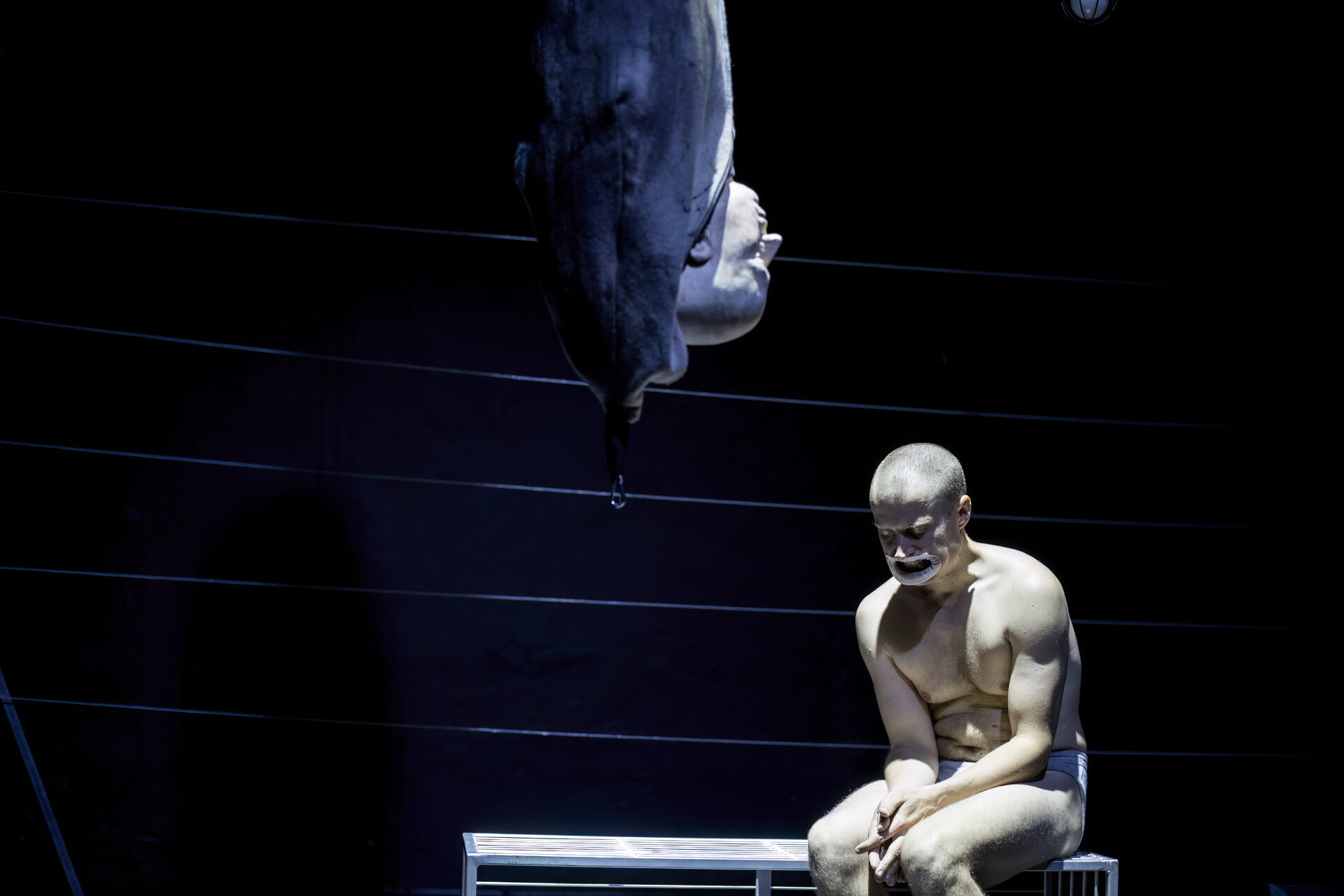
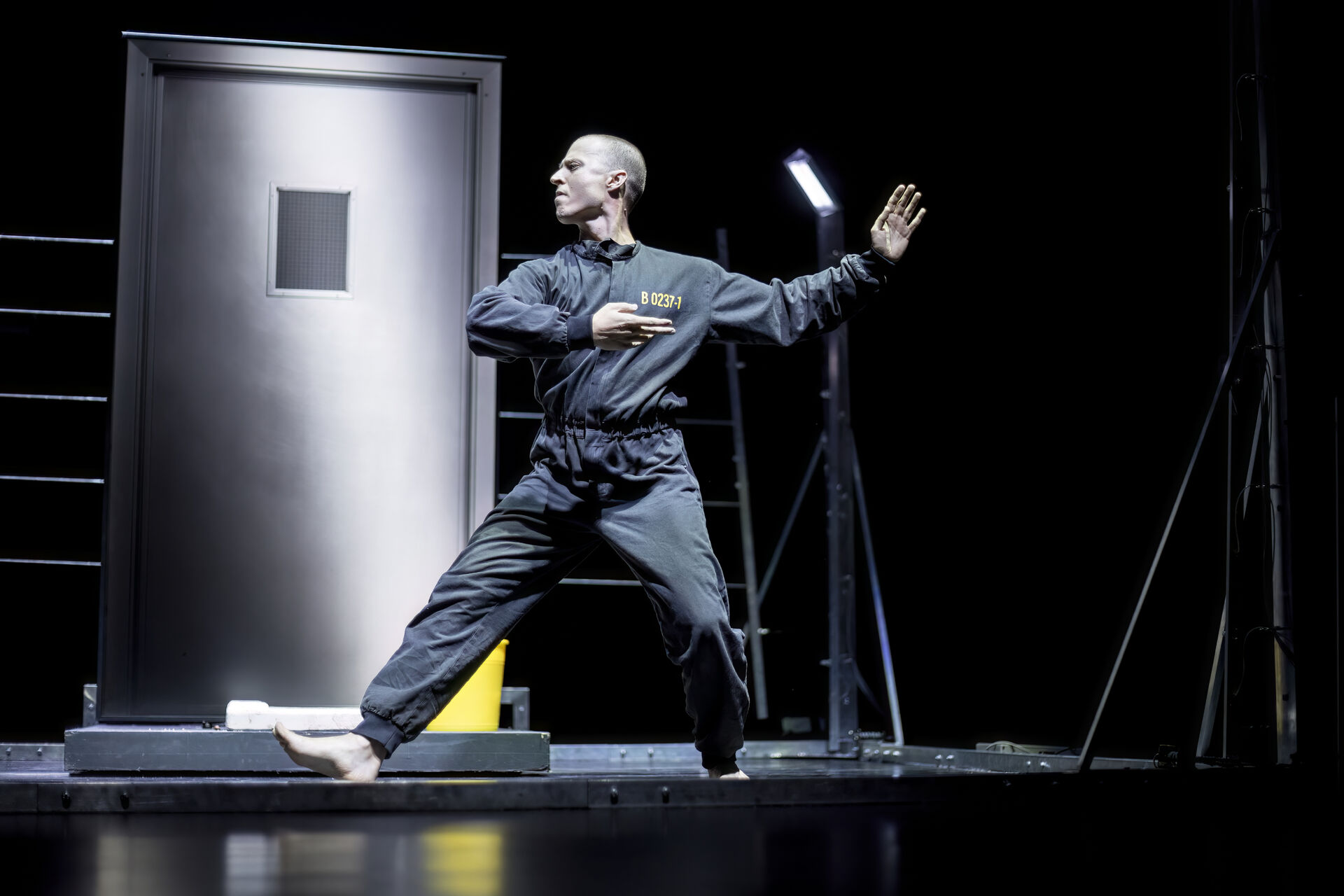
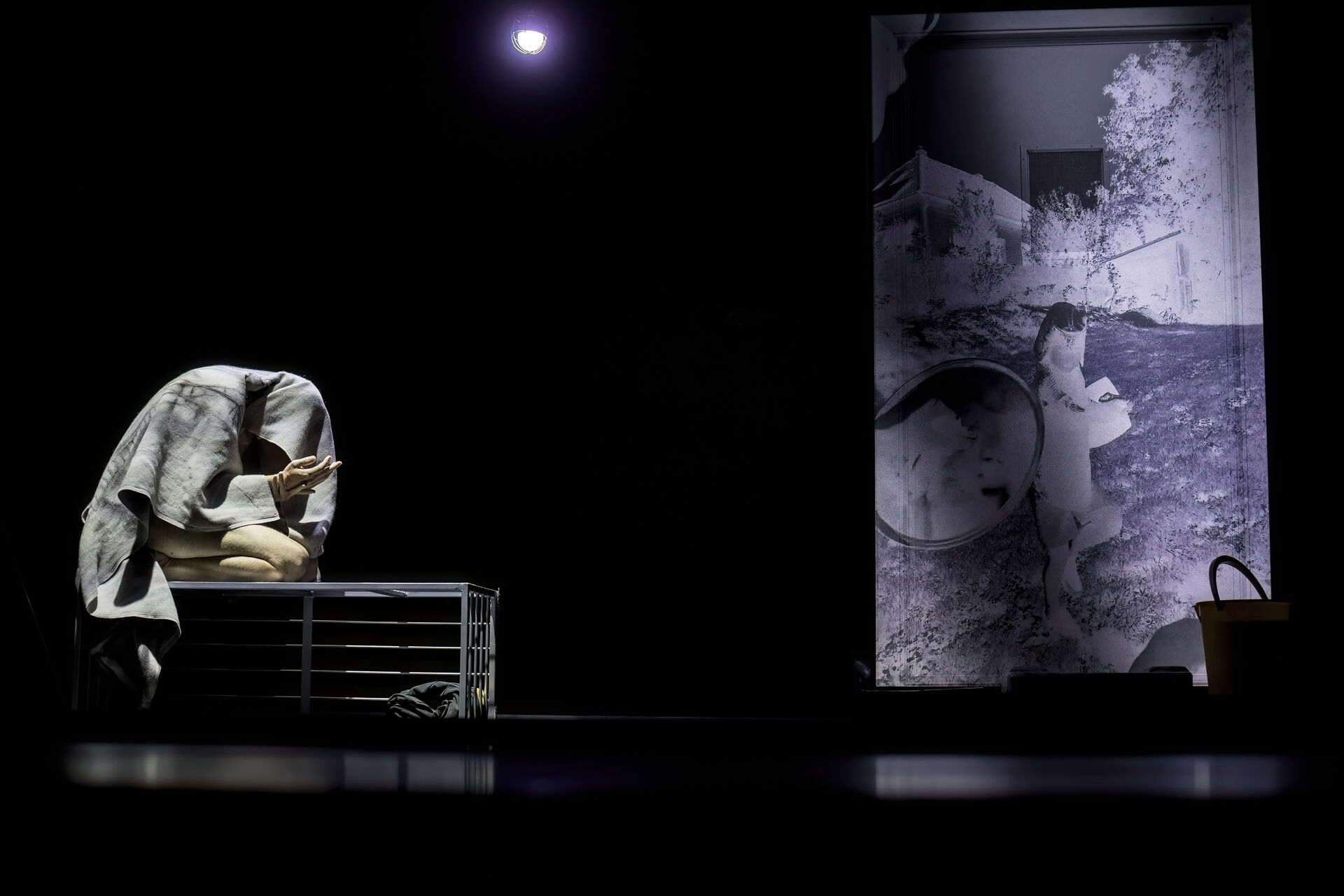
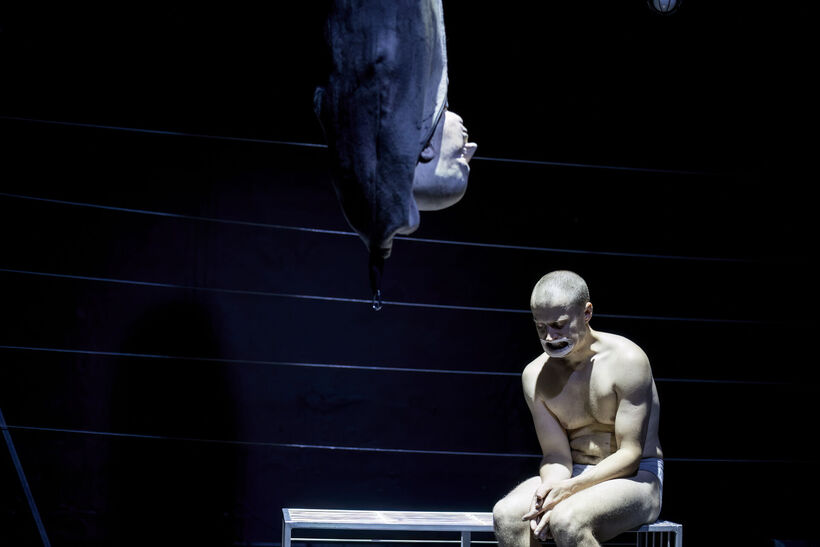
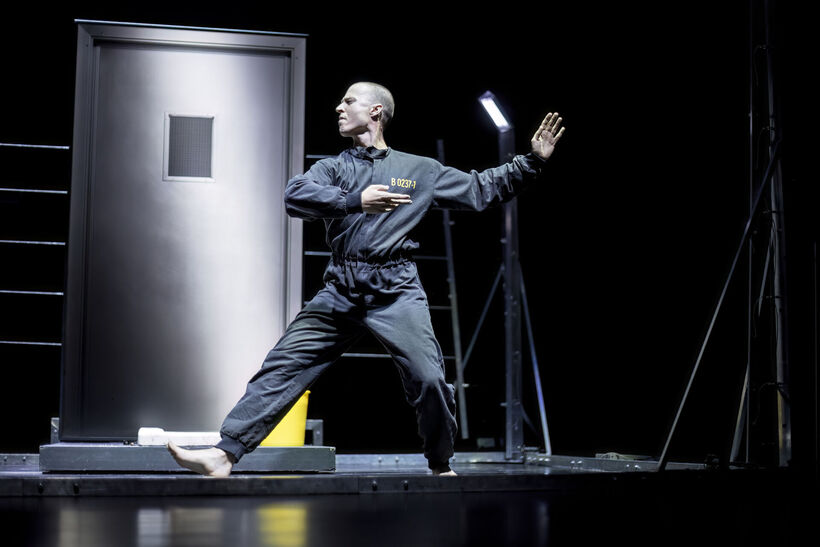
A single bench, an electric fence, a latrine in the form of a hole in the ground, and harsh white lights. Pavlína Chroňáková’s set design alone evokes a cold, oppressive atmosphere. In keeping with Václav Havel’s libretto, the seven days of political prisoner Mr A unfold before the audience’s eyes. He sleeps fitfully on an uncomfortable bench under a grey blanket, dons a prison uniform, then, to the grating sound of brass instruments, performs an energetic warm-up consisting of jumping jacks and other exercises, occasionally holding the corners of his mouth with his fingers to force a fake smile.
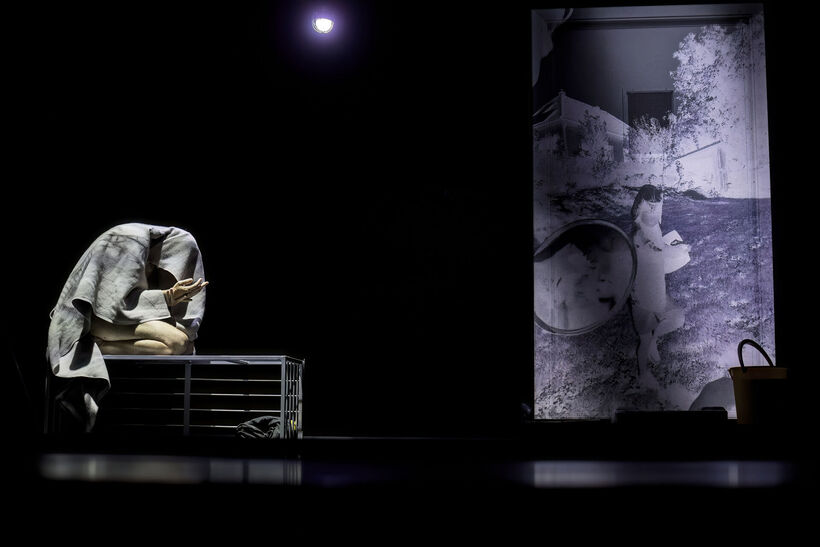
When a prison guard, embodied in a digital image projected onto the cell entrance, pounds menacingly on the door, the performer undresses, squats over the latrine and brushes his teeth whilst doing so. A striking stage prop is the dental retractor, which he inserts into his mouth and sometimes uses to maintain his feigned smile.
It is becoming clear what the title of Havel’s original play, Perpetuum mobile, refers to – not only do the days repeat one after the other, but the prisoner himself gets out of bed day after day, driven solely by inner inertia.
Zotov-Mikshin carries the entire hour-long performance with ease. His movements are soft and fluid when he dances the waltz with an imaginary partner. Conversely, he is full of tension and determination when he moves across the stage with his hands clasped beneath his chin in a pistol gesture. He captures the merging days in prison with utter conviction. He spends most of his time in his own head, trying to entertain himself in all sorts of ways. For example, he dances with a tin tray, using his tongue to catch the prison rations he’s been given – perhaps a chickpea. He then tries to keep it on his outstretched tongue, balancing it as he moves across the stage. At other times, he sinks into darkness and writhes on the floor with a grey blanket wrapped around his head, or swings his fists about and fights an imaginary enemy – likely that authoritarian regime, which is just as daunting in its abstract nature. At the same time, he demonstrates that the only place of freedom for a persecuted person remains, and remains solely, their mind.
The connection to the present day
But even this inner freedom is gradually being curtailed. Whilst there is no physical violence, the psychological torture brings perhaps even greater torment. As Mr A.’s week progresses, the atmosphere becomes increasingly chaotic and oppressive. The performer gradually encloses himself within an electric fence. The guard’s visits become more frequent, yet less regular and predictable. When the guard bangs on the door, the prisoner must undress and sit on the latrine. Gradually, however, he becomes increasingly skittish; he does not know whether he should chew the unappetising food or brush his teeth in front of the guard. At times, he points his toothbrush warningly at the audience, as if to say: ‘I’m serving this sentence for you too.’ The creators make no recourse to physical comedy, a device often used to lighten particularly heavy themes. The chilling atmosphere persists from start to finish, and even the conclusion offers no sense of relief. It remains unclear whether Mr A. will ever leave his cell, and if so, whether he will retain his inner freedom or be broken by the regime.
Perpetuum Havel is a successful contribution to the debate on Václav Havel’s legacy. Particularly at a time when right-wing extremism is on the rise in many countries – a movement that does not hesitate to divide people into the better and the worse, those worthy of protection and those worthy of contempt – the film can also serve as a warning. Persecution for one’s views need not be confined to closed societies such as Russia or Belarus. A cautionary tale is the recent victory of the far-right AfD in Saxony-Anhalt, a party that fantasises not only about the repatriation of illegal immigrants, but also of people with German passports who are of partly non-European origin.
Nor is the approach of the Czech government particularly encouraging, as it seeks to restrict the ability of the media and journalists to ask it critical questions.
Written on the occasion of the premiere on 10 September 2026 at the Akropolis Palace.
Perpetuum Havel
Script and direction: Petr Boháč
Collaboration on script and performance: Roman Zotov-Mikshin
Story idea: Radim Vizváry
Set and costumes: Pavlína Chroňáková
Video, music and sound design: Martin Hůla
Lighting design: Filip Horn
World premiere: 4 July 2026 as part of the Off programme at the Avignon Festival