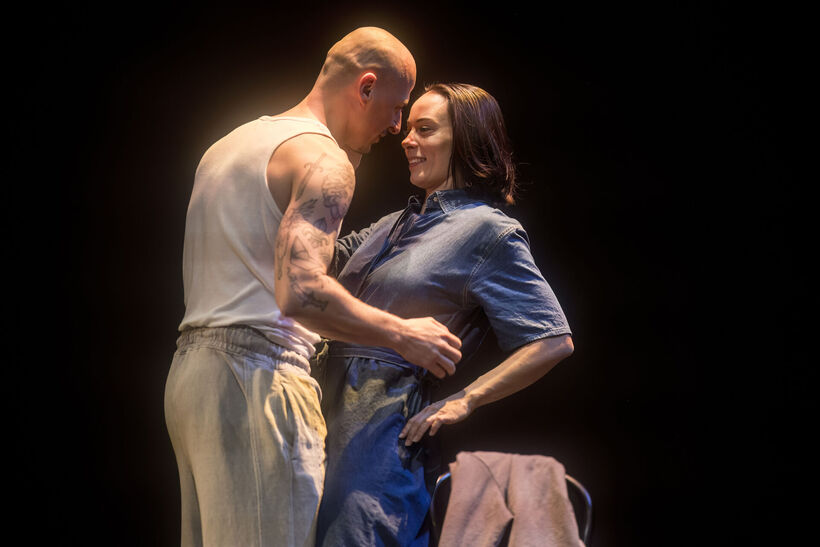
The movement sequence is maintained throughout; the dancers do not slip into the expected dance routine, and the choreography does not allow for the breathtaking partner dance collaboration one would expect from this company. A different story of movement unfolds on stage, skilfully woven from the threads of physical theatre and natural movements, which other couples perform just as the central pair do. Perhaps even on that very same evening, when they meet at home after work and want to have dinner.
Right from the start, it is impossible not to notice how skilfully and precisely the musical and sound elements are interwoven with the movement. The composer and multimedia artist Christos Parapagidis does an admirable job here – combining an electronic music-based soundscape with dozens of sounds and noises that specifically accompany the dancers’ movements. Without the absolute precision of both elements, this effect could not have been achieved – movement, the perception of sound and light all work brilliantly here, thanks to the highly focused performance of both performers in the flat and all the creators behind the scenes.
 As the scene of the couple preparing to end their day draws to a close, the woman changes into her nightwear and the lamp goes out. Once again, we are engulfed by darkness and take away the impression of a couple in love and their peaceful life together in flat number 24. To our surprise, however, when the lights come back on, we realise we are back at the beginning and the woman is turning on the hob once more. The loop plays out again, but this time we see the entire sequence that took place earlier projected onto the screen behind her. The wife or girlfriend suddenly exists in two forms: one alive and one in the film version. The demands of being on stage intensify, not only because she must be in sync with the soundtrack, but now she is also moving in tandem with her twin self from the screen behind her. We witness exactly the same sequence of events, including the husband’s arrival, the welcome, dinner together and the decision to go to bed. Once the lights go out, we can already guess what is likely to happen – yes, the cycle repeats, but now both the man and the woman inhabit the film loop twice. On the screen, we see not only the first recording but also the second, whilst watching the third couple live.
The viewer’s senses of observation begin to feel overwhelmed, but then they suddenly realise that things are no longer proceeding exactly as before. The embrace is no longer as heartfelt; in the next loop, it doesn’t even happen. Both the man and the woman gradually sink into a routine, and their relationship and coexistence slowly, in microscopic steps, deteriorate. We observe small nuances, subtle changes in movement, which we would not have noticed had the previous events not already been filmed and played out on screen at the same time.
The images on stage are a poignant metaphor for a long-term relationship threatened by the shadow of routine and monotony, which, with each successive loop, erodes the intimacy of a couple who no longer even have dinner together. It is a chilling sight for anyone who has ever been in a relationship, as many couples find themselves in the same situation. Through physical theatre, projections and the soundtrack, the choreographer and the dancers succeed in portraying a study of the breakdown of a relationship that initially seemed idyllic.
On the other hand, however, we do not witness any resolution or any attempt by the partners to acknowledge or address the crisis. Joe Baker does not deal with this in his Apartment 24. He presents the audience with repeated layers and cycles of events in the flat, where the man is ultimately left alone. The production then offers a further possibility of the relationship plummeting into the abyss, namely when the couple are joined by their child. In the flat where several friends used to gather, a young family now lives: a woman, a man and a constantly crying baby, whom the mother holds in her arms whilst still trying to carry on with all the routine chores before her partner comes home. Here, too, the characters are duplicated and tripled, and the stage is eventually taken over by dark, shrouded demons who deepen the relationship’s spiralling crisis.
The strength of Jose Baker’s production lies in its precision, its emphasis on the chosen movement vocabulary, and the detailed, gradual, subtle work with variations in movement, which demonstrate the changes in an otherwise routine relationship (which in itself need not be negative). Outwardly, or at least initially, the couple appear to be doing fine, even though they are heading for a crisis.
The Lenka Vagnerová & Company ensemble did not disappoint. Their original new work brought something slightly different to the Czech dance scene once again, whilst being excellently executed. Above all, it offered the audience plenty of food for thought – not only on interpersonal relationships in general, but especially on one’s own approach to everyday life.
Written following the first repeat performance on 11 October 2026 at the Komedie Theatre.
Apartment 24
Concept, direction, choreography: Jos Baker
Artistic collaboration: Jeanne Procureur
Original music: Christos Parapagidis
Co-creators and cast: Adam Sojka, Paolo Terranova, Lukas Lizama Garrido, Jana Hampl Maroušková, Paula Morejón García, José Guzmán
Costumes: Simona Rybáková and artistic collaboration by Barbora Kotěšovcová
Assistant director: Madlen Moravcová
Lighting design: Michal Kříž
Projections: Michal Kříž
Lighting: Robert Štěpánek
Sound design: Eva Svobodová, Kryštof Leiský, Jos Baker, Christos Parapagidis
Producer: Soňa Hájek Bartková
Premiere: 10 October 2026