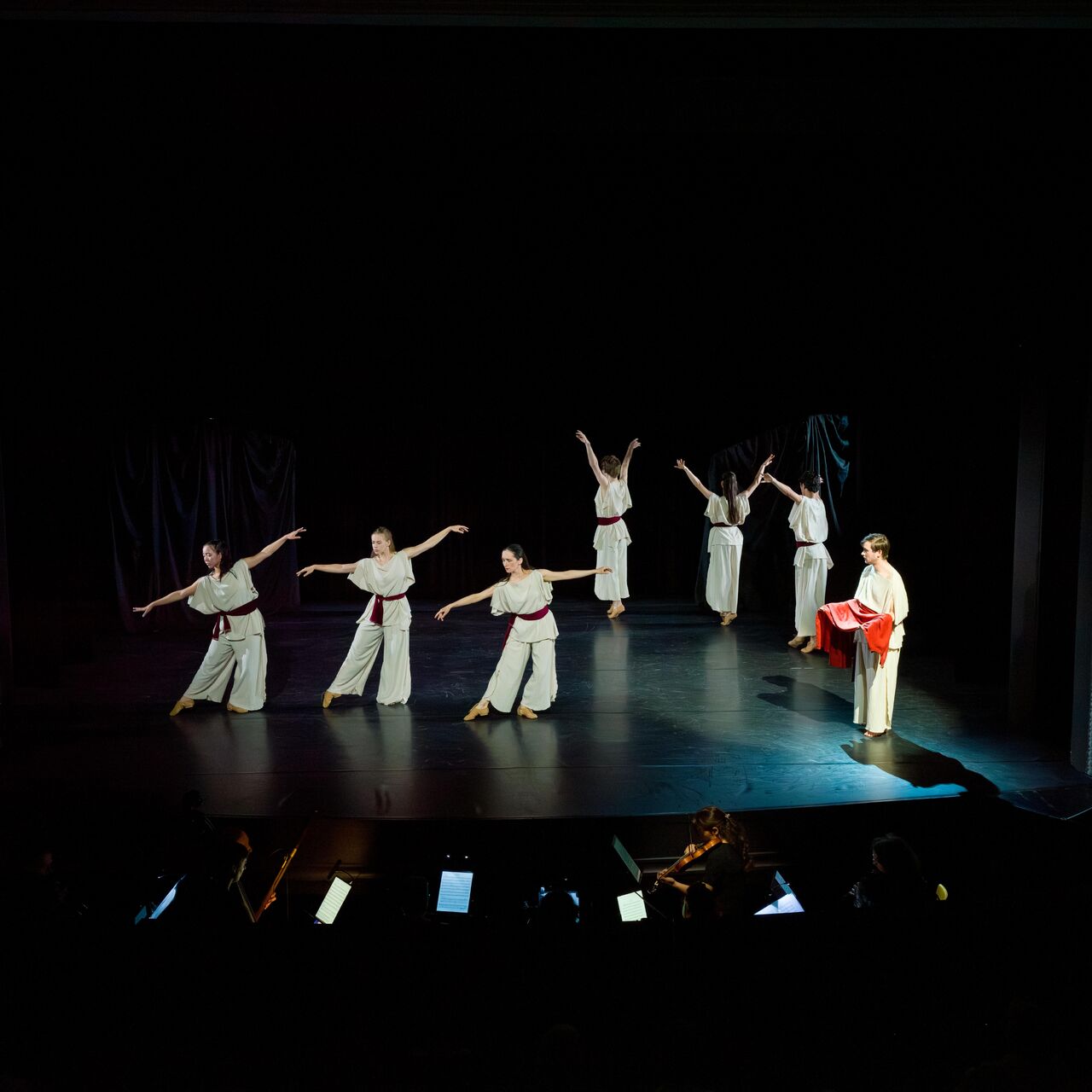
The opera’s staging concept was minimalistic, with only the two singers (the chorus was omitted), a small group of dancers, simple costumes loosely reminiscent of Ancient Greek dress, and no set. This minimalism helped focus on the expression of emotion and music. This was supported significantly by the artistry and stage presence of the countertenor Julian Schmidlin and soprano Kathrin Hottiger. Their arias were filled with emotion and drama without excessive physical movement: kneeling with his head down, Orpheus embodied the devastation of loss, before going on to sing the famous Cosa farò senz’Euridice with his incredibly clear voice. The dramatic dialogue between Eurydice and Orpheus is filled with tension, holding hands, standing close, but without looking at each other. Of course, in the end, Orpheus succumbs to her pleas and takes a look at her, losing everything once more.
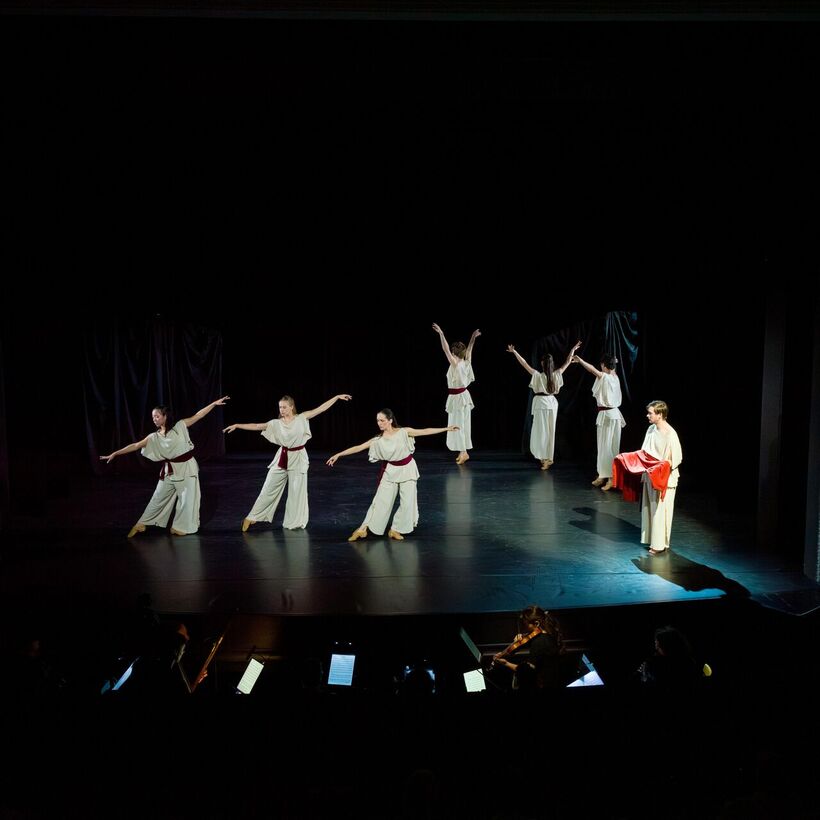
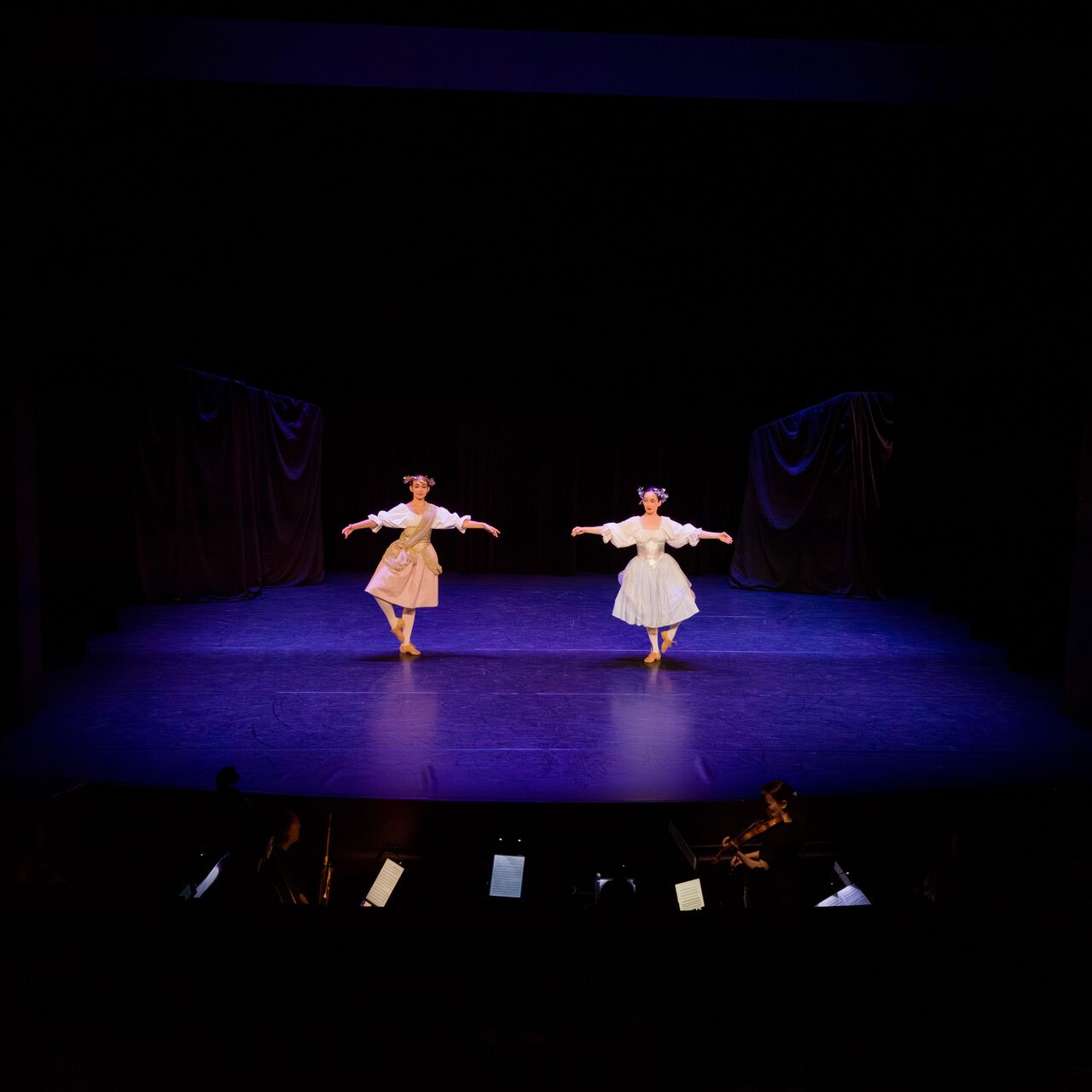
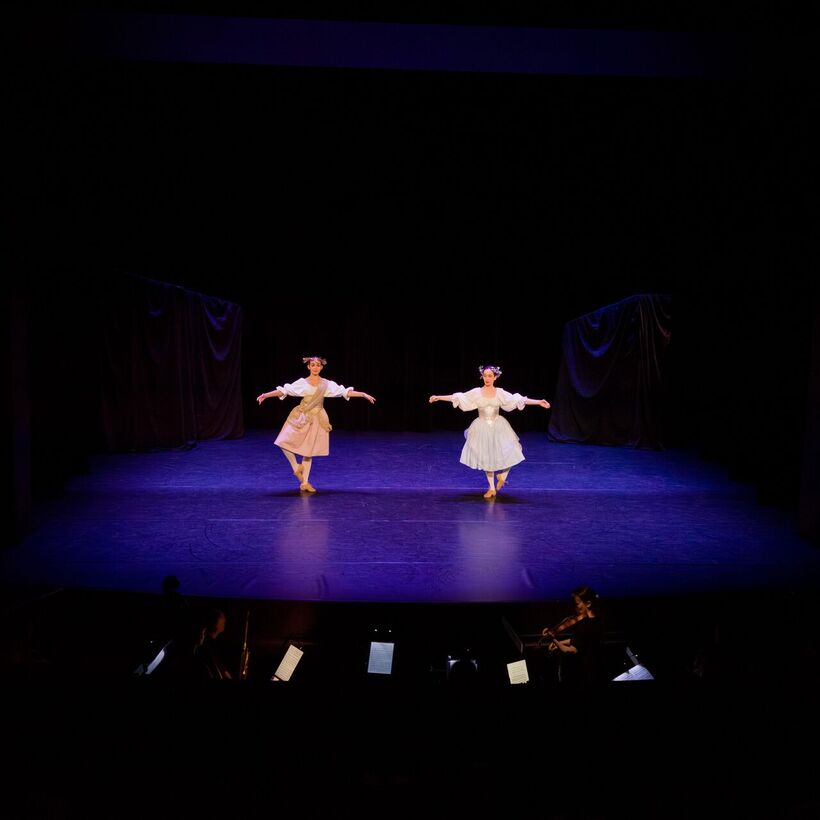
With the omission of the chorus, dance dominates the piece, which is faithful to the 1774 Paris version, which had considerably expanded dance sections. In the first act, the Greek chorus is embodied by dancers rather than singers. As Orpheus’ companions, they first appear as a purely accompanying presence, gradually transforming into commentators and co-bearers of the events. Through their movement, they articulate loss, despair, and pain, and later empathy and shared consolation. The choreographic material uses eighteenth-century aesthetics merely as a starting point, developing them freely into a non-codified movement language that also incorporates tendencies from traditional Greek dance (choreography by Mojca Gal). Only in the underworld, among the blessed in Elysium, do we encounter the strict symmetry of late eighteenth-century ballet. The dance of Furies, choreographed by Antonin Pinget, contained quick turns, sharp changes of direction, high jumps and even lifts, which might correspond to these underworldly characters, but the swinging of the arms reminded me more of iconic port de bras of swans, which seemed a bit out of place here. On the other hand, the dance of the Blessed Spirits, choreographed by Edmund Fairfax, held more strictly to the serious and semi-serious style, according to his research: slow leg gestures and sustained positions for the first, and battu jumps and turns, reminiscent of classical adagio and allegro variations.
In search of La Chercheuse
The challenge of reconstructing a pantomime ballet is well known to dance historians and HIP (Historically Informed Performance) experts. Dance notation grew increasingly scarce in the second half of the eighteenth century, leaving scholars to work from textual descriptions, librettos, scores, period reviews, and visual sources, which are, of course, ambiguous. A painting of a dancer tells us about pose, not about how the pose was reached, nor what it felt like to execute. For the pantomimic passages, the evidentiary base is even thinner: gesture manuals and acting handbooks offer prescription without embodiment, and no notation system of the period captured the fluid, face-driven expressivity that made the genre comprehensible to its audiences. To reconstruct La Chercheuse is therefore not merely a scholarly exercise; it is a claim about what historically informed performance practice can and should attempt — that the gap between archive and living body is bridgeable, not by guesswork, but through rigorous historical, artistic, and most of all, collaborative expertise.
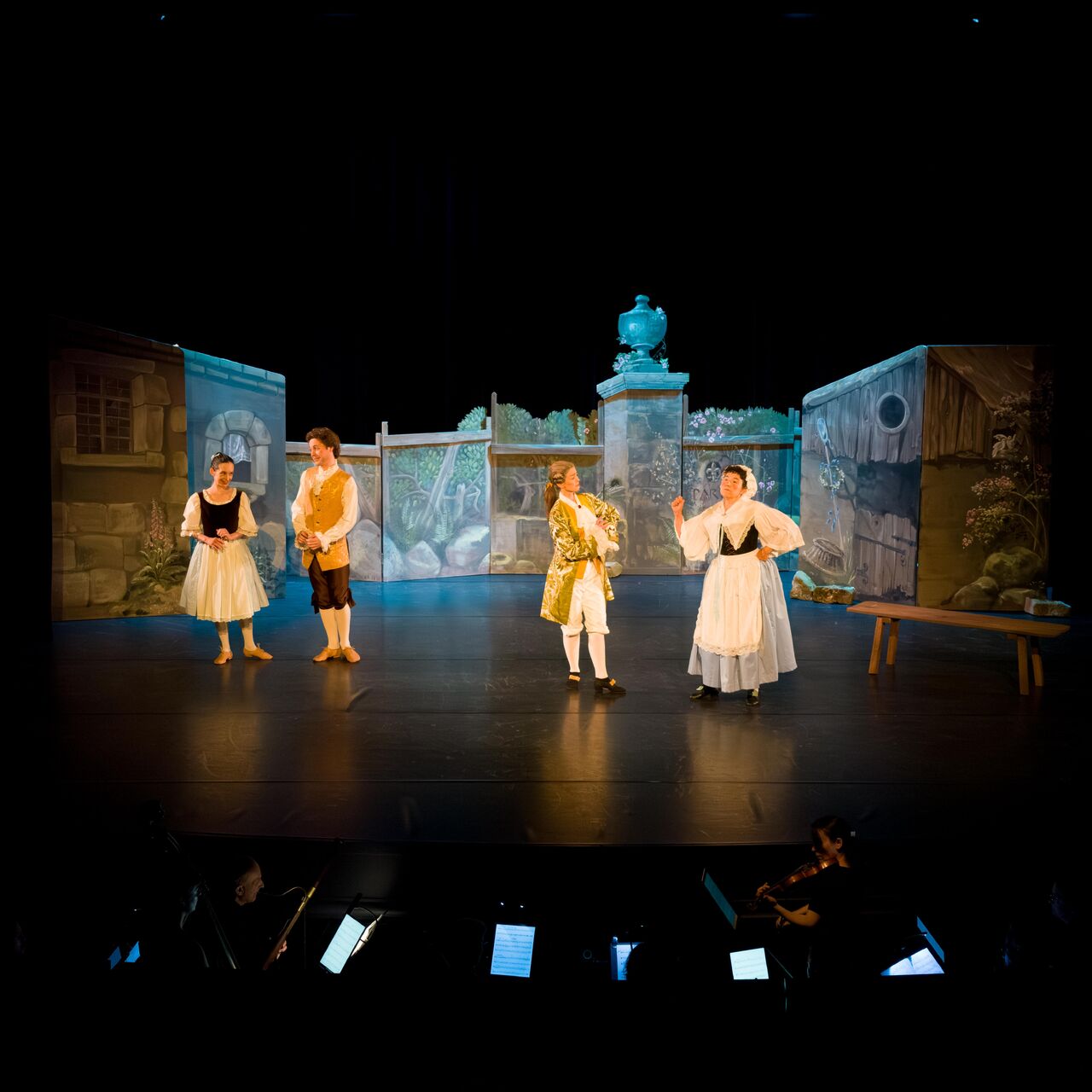
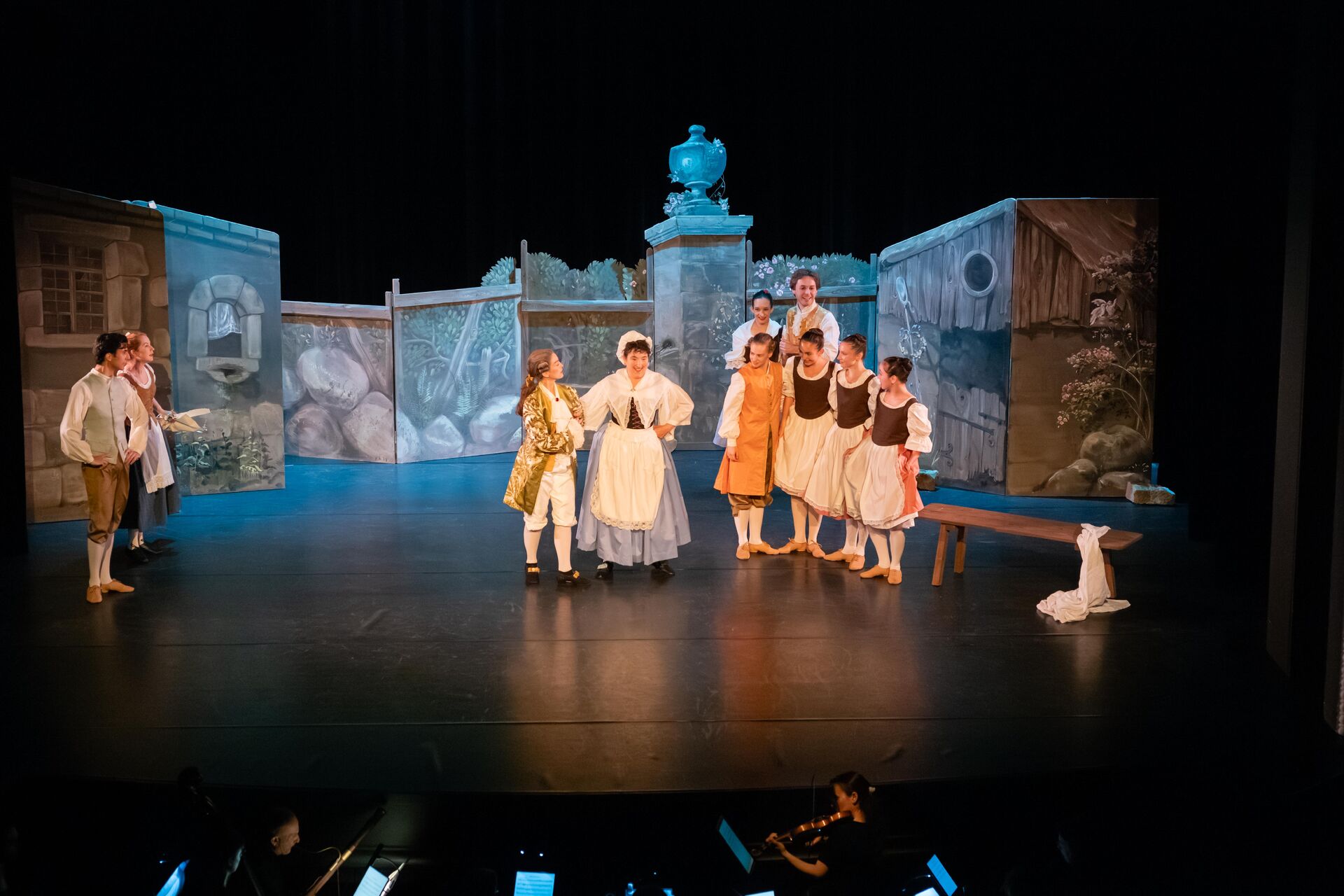
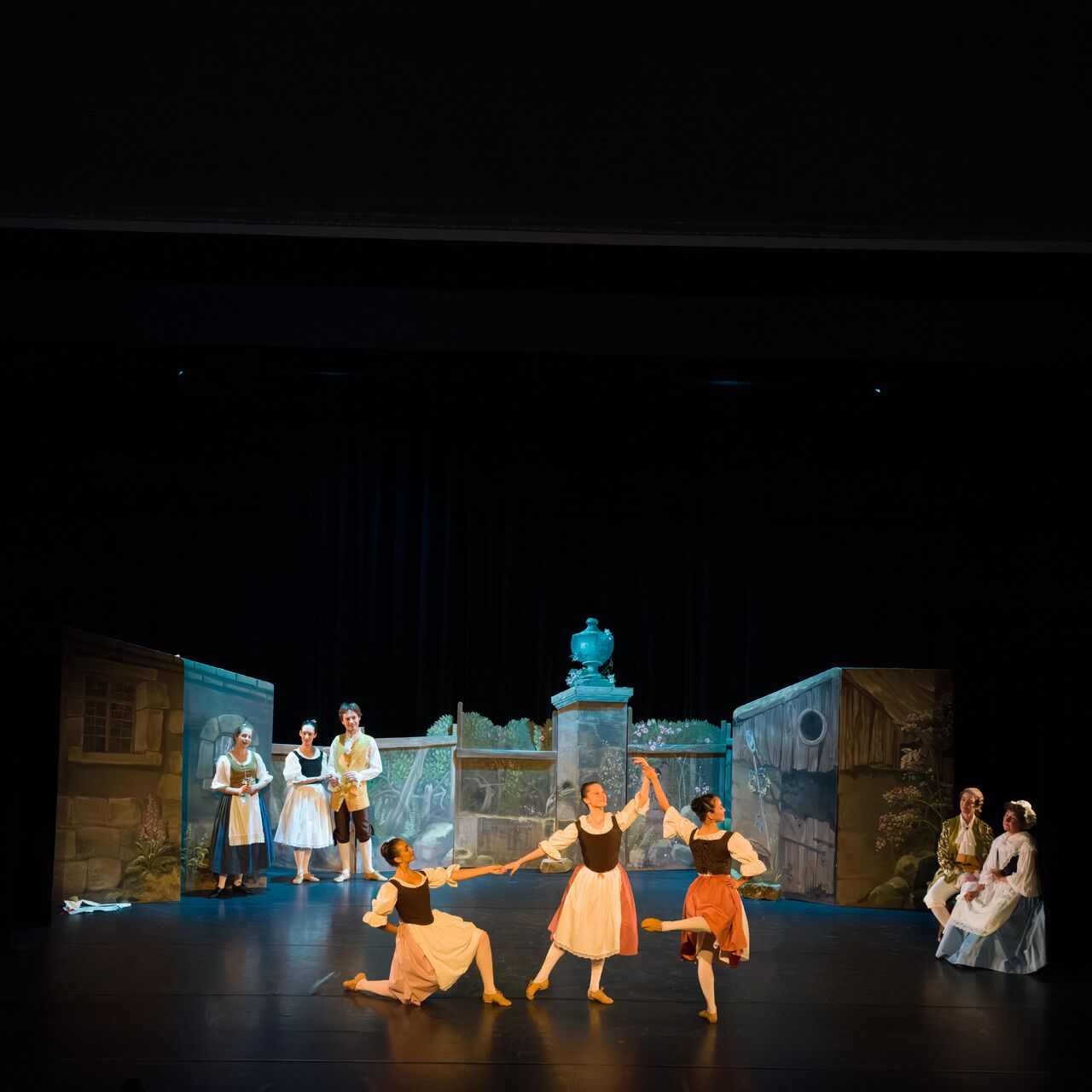
The team assembled for this production adds real credibility to this claim. Edmund Fairfax, whose scholarly monograph The Styles of Eighteenth-Century Ballet (Scarecrow Press, 2003) remains a foundational reference for the field, serves as choreographer and primary reconstruction architect. The mime passages were shaped through the involvement of Laila Cathleen Neuman of the Dutch Historical Acting Collective, an group dedicated to the practical recovery of pre-modern gestural performance. Berenike Heiter brings additional grounding in both historical dance and historical acting, with experience that includes but is not limited to commedia dell’arte — a tradition where physical grammar overlaps meaningfully with the comic-grotesque register Garde’s ballet requires. This creative team represents a convergence of specialisations that the genre itself demands. The dance group was composed, besides Mojca Gal, of experienced historical dancers such as Antonin Pinget and Barbara Leitherer, as well as young dancers who embraced the style with enthusiasm (Mia Voltzenlugel, Ashley Tsuyu Burks, Pau Miguez Pérez Gallardo, Carlota Fijo, Jimena Puch Rodeiro). Barockensemble Grenzkland delivered the evening’s musical performance expertly, supporting the dancers with their energy and colourful interpretation. Finally, given that the visual aspect of pantomime ballet was crucial (the gesture and dance, the costume, and the scenography worked together to communicate the action), it was great to see flat, hand-painted sets, albeit in a somewhat reduced and modified form, the result of production constraints. Artist Philipp Grässle painted a rustic village set, inspired by the eighteenth-century scenography preserved in the historical theatres.
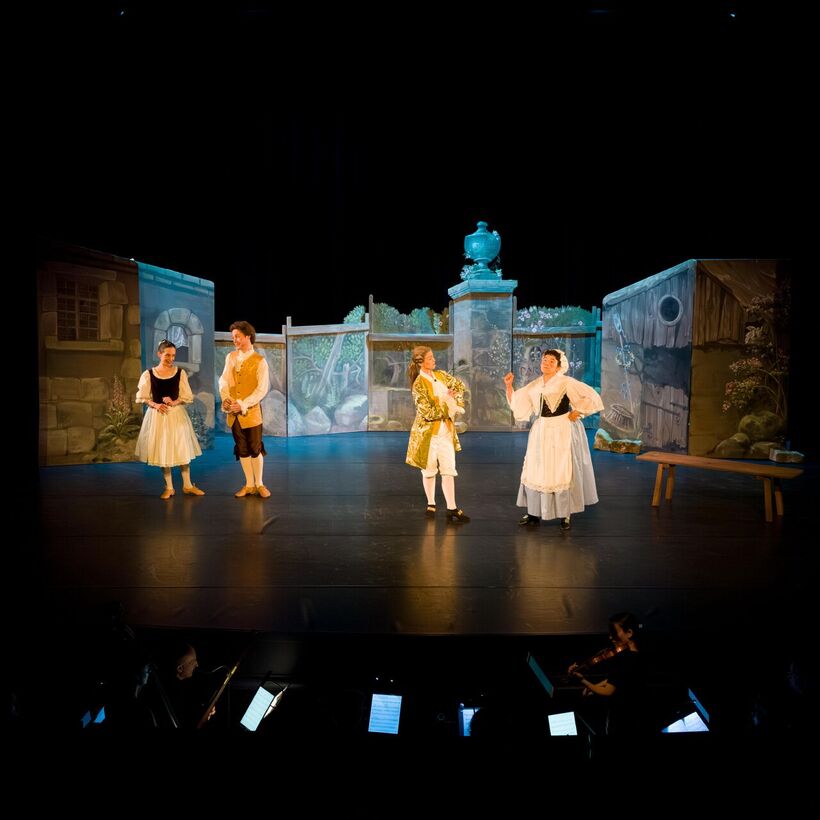
Since none of Gardel’s original choreography has survived in notation, Edmund Fairfax’s reconstruction draws on a carefully triangulated body of evidence spanning several distinct documentary traditions. The primary narrative scaffold is the detailed printed programme from the ballet’s 1777 Choisy premiere — a document typical of the period, when pantomime ballets routinely published verbose scenario descriptions precisely because the genre was still sufficiently new to require audience orientation. For the choreographic substance, Fairfax consulted period treatises on dance technique and aesthetics, contemporary reviews of ballet performances, and accounts of performances preserved in memoirs and diaries, supplementing these with surviving choreography, recorded either in dance notation or verbal descriptions, and with iconographic sources: prints, paintings, and drawings depicting dancers in their poses. The music presented its own distinct reconstruction challenge: the surviving pastiche score at the Bibliothèque Nationale de France required editorial decisions about which version of the frequently altered divertissement to follow, resulting in a composite drawn primarily from the 1778 Opéra production, supplemented by a piece from the 1777 Choisy version, a substitution from Pierre Gardel’s 1790 Télémaque dans l'île de Calypso, and the interpolation of a hornpipe from Antoine Bournonville’s 1789 Fiskarena — itself an adaptation of the mid-eighteenth-century English piece, College Hornpipe.
La Chercheuse in performance
La Chercheuse d’Esprit is a comic, naive tale of rustic innocence and erotic awakening set in an unnamed French village, adapted from the eponymous opéra-comique by Charles-Simon Favart (1741), which in its turn was inspired by La Fontaine’s 1674 satirical poem. Nicette, the simple-minded daughter of the imperious Madame Madré, is deemed too foolish to marry the pompous bailiff Monsieur Subtil, yet too foolish also to understand her own heart. Ordered by her mother to find her wits, she consults a learned savant, whose book falls uselessly to the ground, and a worldly young man, whose lesson is interrupted by his jealous fiancée Finette. It is ultimately Alain — Monsieur Subtil’s equally guileless son, with whom Nicette shares a mutual, wordless attraction — who provides the real education: not through language or intellect but through the mimicked rituals of courtship. By the time the adults return to impose their own matrimonial arrangements, Nicette and Alain have already taught themselves everything that matters. The moral, inherited from La Fontaine’s 1674 satirical poem, is delivered without ambiguity: l’esprit comes not from books or authority, but from the body, from desire, and from the oldest lesson of all.
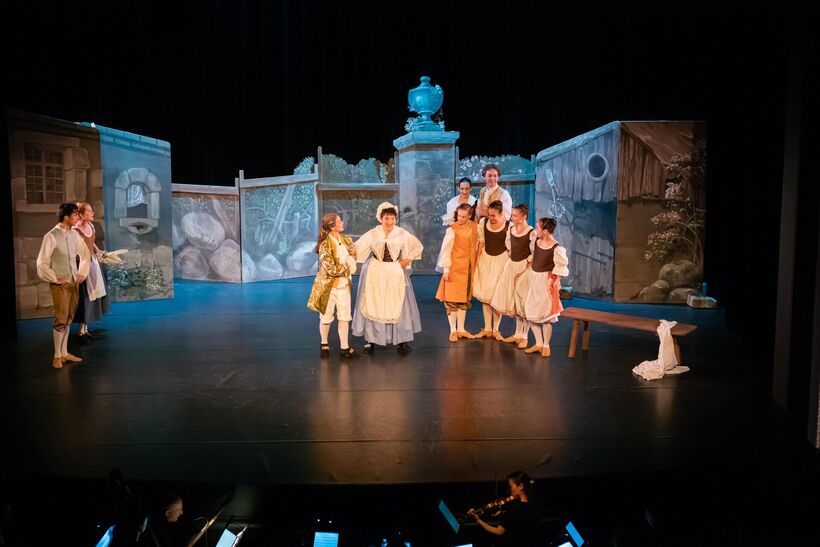
The production’s central dramaturgical wager — that all of the action, taking up more than half of the piece’s duration, was entirely mimed — works with unexpected completeness and efficiency. What the eighteenth-century style demands of its performers is not psychological naturalism but a codified sign system: the grand révérence as punctuation, the turned-out foot as social declaration, the loosened arm as an index of intellectual “simplicity”. We could call the acting naïve, but it is certainly working.
Mojca Gal, as Nicette, navigates this vocabulary with precision and comic intelligence. Her early scenes deploy parallel foot positions, loosely hanging arms, and humorous, unflattering expressions and gestures, what the taxonomists of the time would classify as belonging to the grotesque register, representing a deliberate somatic argument: a body that has not yet been organized by desire or knowledge. The uprightness arrives incrementally, as Nicette acquires wit through touch rather than instruction.
Barbara Leitherer, performing the role of Nicette’s mother, also excelled in the pantomimic register. She came across as especially cruel and merciless towards her daughter in the beginning, before cutting an immediately ridiculous figure when courting the young boy, Alain. By the end, she showed some goodwill and gave the young couple her blessing. Her acting was extremely precise and funny. Antonin Pinget in the role of Alain was endearing, both in his initial naiveness and later in expressing his feelings for Nicette.
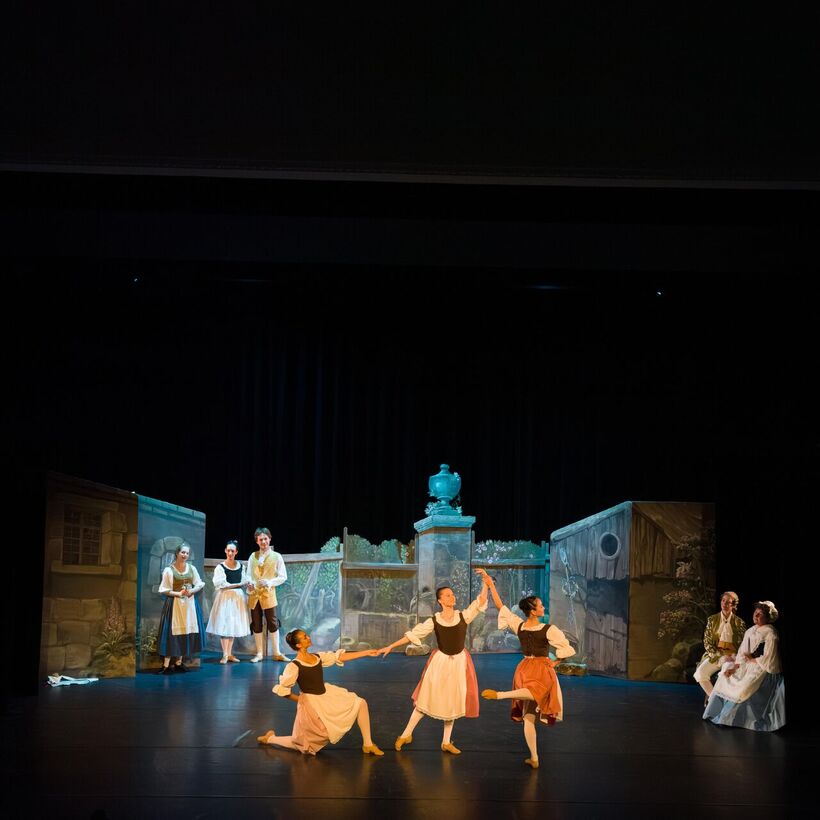
The divertissement reversed the earlier pattern entirely, surrendering pantomimic action in preference of pure dance. In a sequence of quartets, trios, duets and solos, the cast were afforded the opportunity to showcase their remarkable dancing skills. Present was a variety of dance styles and registers that were apparently required for the final divertissement in an eighteenth-century ballet or opera. Nicette and Alain’s serious duet, with its sustained adagio and sculptural poses that reference known iconographic sources, sat in deliberate contrast to the hornpipe for two men, which deployed the comic-grotesque jumps described in Gennaro Magri’s 1779 treatise: feet drawn under the airborne body, weight gathered and released with percussive clarity. Other entrées were in a demi-caractère style (e.g. the lovely trio for the village girls), deploying a livelier tempo, with brisk footwork, battues, turns, and medium jumps. A comic solo by Madame Madrés evoked, in many ways, Simone the widow’s well-known solo from La Fille mal gardée, which is certainly no coincidence, given the various similarities and temporal closeness between the two pieces. The final lengthy contredanse for four couples featured complex steps, formations, changes of position, and patterns typical of a staged contredanse performed by professionals, and ended in a group pose with all the performers joining in.
Professional delivery in precarious conditions
The creative team embarked on a very difficult journey with this project: the recreation of a pantomime ballet, a genre with very few sources regarding its actual physical execution. Hardly straightforward then, but with the added complication of producing it as freelance artists. Without a theatre or festival production to offer organizational and material advantages, this project was created entirely against a backdrop of precarity: Rehearsals and meetings conducted remotely or across various locations, challenging time limitations, and three performances taking place in three different venues. Mojca Gal, who produced the show, also choreographed parts of it, performed the main role, sourced and even sewed some of the costumes!
In the midst of the creative turmoil, certain aspects were lost or omitted. For instance, the programme contained a very detailed description of the action and its related musical parts (including tempi), but was without a cast list. Furthermore, despite listing the musical parts, it withholds the origins of those pieces entirely — a peculiar omission given that Fairfax has apparently identified most of them, and that the allusive logic of the pastiche score was probably the ballet’s central source of understanding and entertainment. The eighteenth-century audience would have recognized the vocal ghosts haunting each tune, borrowed from vaudevilles or well-known operas. The 2026 audience was left to experience the music as a pleasant accompaniment rather than an ironic commentary. The semiotic richness of the score — its capacity to undercut, explain, or ironize the visible action — is effectively privatized, available only to specialists.
Nevertheless, the extraordinary effort did pay off, because the result was not an “interesting experiment” for a couple of historians, but a functional, pleasing, entertaining, and even touching performance. To recreate this, it takes deep historiographical knowledge and great artistry, affording an informed respect and understanding towards the historical material, while making artistic choices that are led by communicative and emotional clarity. This is extremely rare in the era of Regietheater, when the original aims and historiographical contexts of works are often ignored, if not completely butchered. On the other hand, historically informed performances of pantomime ballets are extremely rare and suffer from a lack of sources and good performers, leading to either modernisation or rigid “museification”.
For me, La Chercheuse d’Esprit represents the right balance between the historically informed and artistically-efficient, which gives us a plausible image not only of how this ballet might have looked, but also of its effect on audiences and why it became so popular. This type of production, of course, represents a very small niche in the wider context of contemporary theatre. However, there should be an audience for it, such as those who are enthusiastic about early music and history generally, and who look for alternatives to the Regietheater approach, contemporary dance, and classical ballet on offer in most theatres. The dream would be to see this production in one of Europe’s beautiful eighteenth-century theatres, such as Drottningholm, Ludwigsburg, Český Krumlov, or Petit théâtre de la Reine at Versailles, where it truly belongs.
Written from the premiere on 13 June 2026, in Querfeld-Halle, Basel, Switzerland
Opera – Ballet / Orphée et Eurydice – La Chercheuse d'Esprit
Orphée: Julian Schmidlin, countertenor
Euridice : Kathrin Hottiger, soprano
Barockensemble Grenzklang:
Irene Benito Temprano und Sabine Stoffer (Violin), Annette Kappeler (Viola), Bettina Messerschmidt (Cello), Dina Kehl (Double Bass), Sabina Weyermann (Oboe), Nadja Camichel (Traverso), Nikolaus Broda (Bassoon), Olivier Mourault und Andres Sanchez (Horn)
Ballet Rococo:
Mojca Gal, Antonin Pinget, Barbara Leitherer, Mia Voltzenlugel, Ashley Tsuyu Burks, Pau Miguez Pérez Gallardo, Carlota Fijo, Jimena Puch Rodeiro
Acting: Gerrit Berenike Heiter, Laila Cathleen Neuman
Choreography and direction La Chercheuse d’esprit: Edmund Fairfax
Direction Orphée et Eurydice: Laila Cathleen Neuman
Choreography Orphée et Eurydice: Mojca Gal (Act 1), Antonin Pinget (Dance of Furies), Edmund Fairfax (Serene Spirits)
Scenography: Philipp Grässle
Lighting: Théo Frick