
The theme of interdisciplinarity and the convergence of different art forms and environments was also highlighted during the grand opening of the new Vysočina Cultural and Creative Centre, known as HUB 800, which was created by converting the convent of a former Cistercian monastery within the castle grounds.
The KoresponDance festival successfully fostered a dialogue between the arts. The undisputed highlight was the contemporary circus performance Miettes
From 17 to 19 July 2026, Žďár nad Sázavou came alive for the fourteenth time with the KoresponDance festival. This year’s edition was characterised by a dialogue between the arts. Dance and new circus performances, music concerts, the now-traditional dance battles, a film installation and a programme dedicated to specialist literature – including works on architecture and lighting design – were seamlessly integrated into the castle setting, alongside a guided tour of the New Generation Museum.

KoresponDance Festival. Photo: Adéla Vosičková.
Advertisement

This clearly defined space thus gave festival-goers the chance to sample and experience things they might not originally have come to the festival for. All they had to do was walk past and let themselves be drawn in and surprised.
One of the festival’s distinctive features is that it regularly collaborates with the local community. In this year’s edition, French choreographer Alban Richard brought together over thirty participants from different generations in the piece Insane (meaning ‘mad’). Individuals in colourful, layered clothing, with scarves covering their entire faces, initially formed a bizarre, uniformly moving herd. Blinded, devoid of free will.
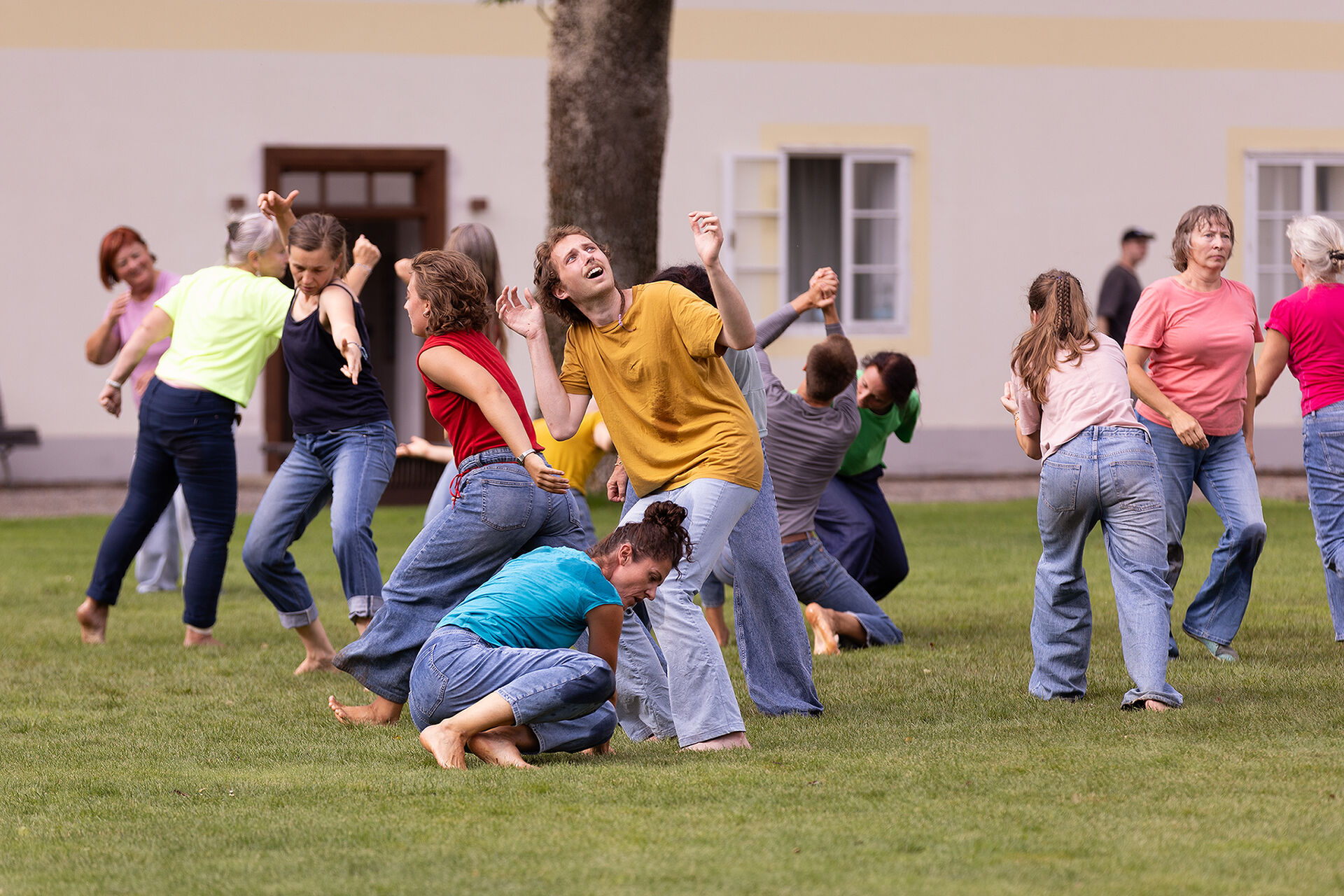 As if they had suddenly regained their sight, the group broke up into smaller units. The performers removed the outer layers of their clothing, including their scarves, and began to contort their bodies into a series of poses, gestures and grimaces, in which one could read suffering, pleas, but also a determination to fight. Towards the end, they all came together as one again, but, filled with hope, they launched into a joyful, boisterous group celebration, which culminated in individual movements and drew the audience into the dance as well. The gathering moved together to the courtyard, where the festival was officially opened.
The very first piece from the Sandworks – Black Sand triptych by former Swiss acrobat Ueli Hirzel gave visitors a glimpse into the newly opened space of the HUB 800 centre. Spectators were able to watch the patterns emerging and disappearing from the black sand not only from the chairs set out around the space, but also from the stunning white spiral staircase, which dominates the atrium.
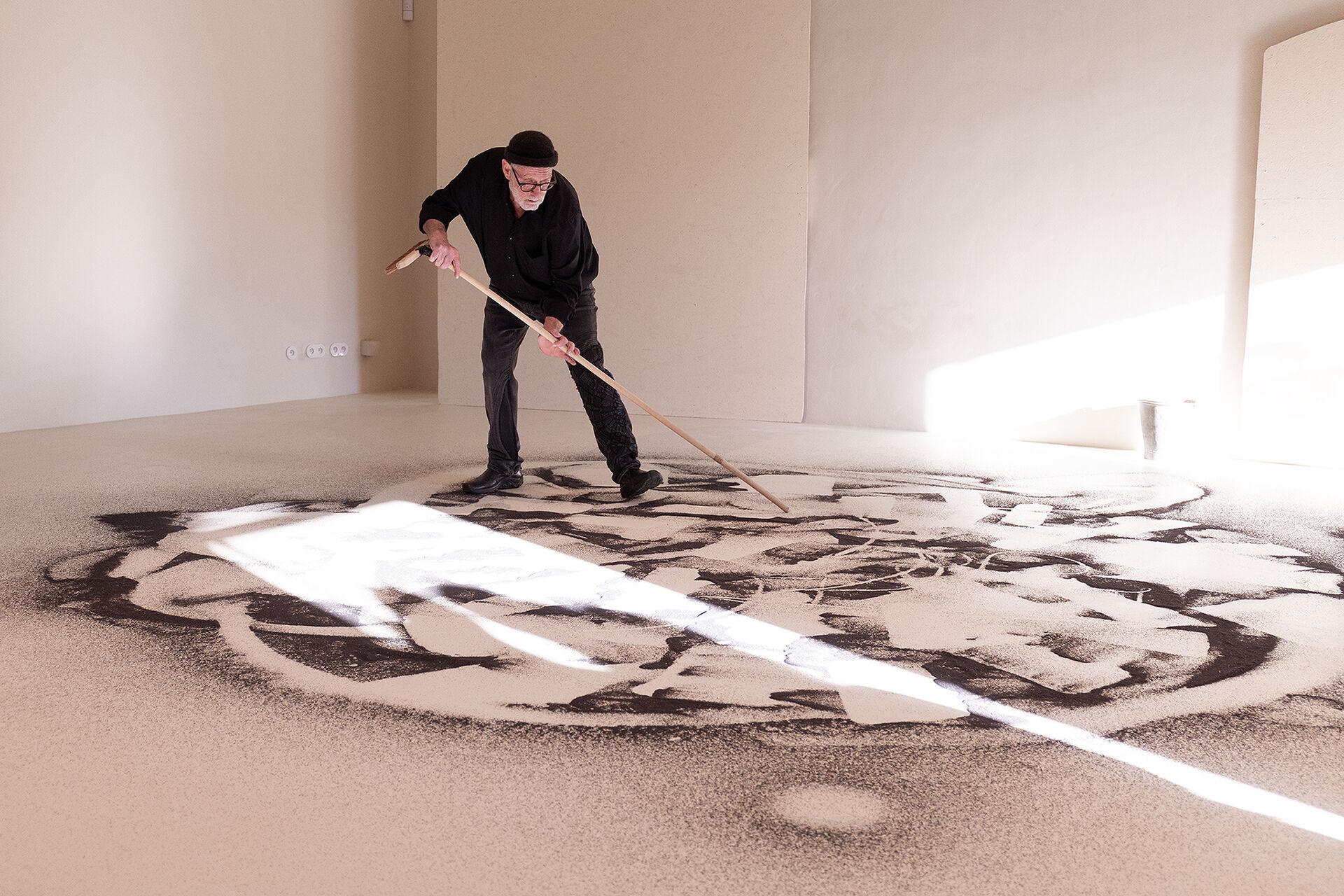 The fine sand was constantly shifted by Hirzel’s hands or by the bristles and handles of brooms, evoking ever-changing images and associations. From isolated circles to disordered patches, from sharp lines to rounded curves culminating in a concentric circle. From chaos to harmony.
In HUB’s main theatre space, aptly named Archa (the wood-panelled ceiling vaguely resembles the upturned hull of a large ship), a deconstruction of Maurice Ravel’s famous Boléro – Bolero – Extended – was subsequently performed by eight cellists and the Lithuanian Šeiko Dance Company. Danish choreographer Palle Granhøj based the first part of the choreography on a series of consecutive solos consisting of the constant repetition of a movement loop amidst increasing restrictions on mobility.
A figure in white dances freely until a figure or figures in black catch them or pin them to the ground so that they can barely move; yet they do not give up and, within the limits of their ability, at least hint at the sequence of movements. Ravel’s music is broken down into various motifs and excerpts, which are creatively interpreted by a single cellist, who usually sits with his back to the audience.
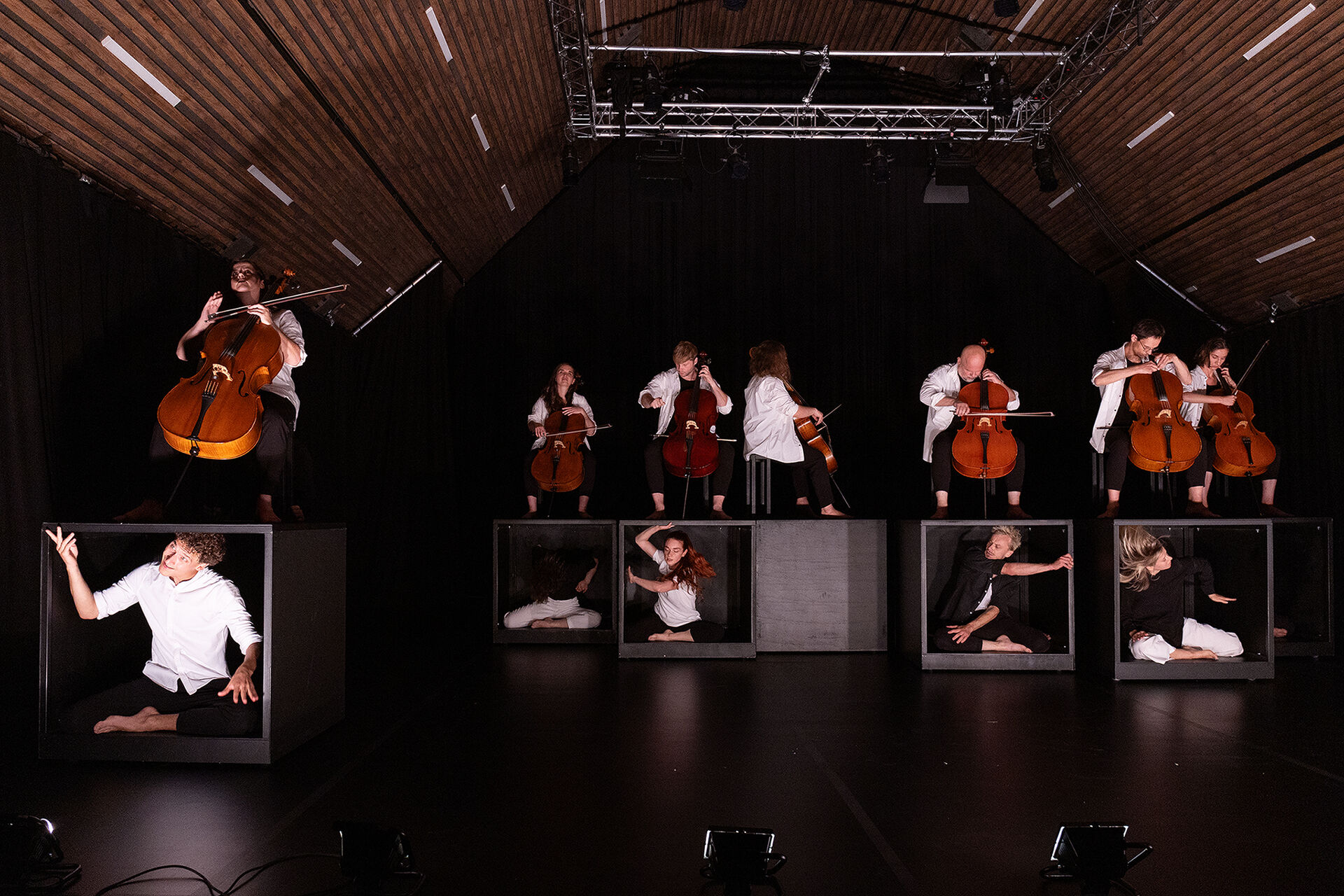 In the second part, Ravel’s entire composition is performed, and the cellists rightly command most of the attention. The performers appear on stage gradually, in keeping with the progression of the piece. They are brought in on black cubes, inside which – as the audience soon realises – dancers are concealed. The dancers repeat their movement patterns— —within the space defined by the cube. The cellists tap out the rhythm with their palms on the body of the instrument, play with the bow, pluck the strings, or even pick up a plectrum. An unassuming man in black – a mover – also plays a significant role, constantly shifting the cubes containing the performers closer to the audience, thereby helping to build the necessary tension in the piece. A thrilling finale that had the audience on their feet.
The young Greek artist Vasiliki Papapostolou (aka Tarantism) also works with constraints, limits and surveillance; her piece Panopticon was the final work I saw on the first evening of the festival. The artist draws on Michel Foucault’s concept of the disciplinary society, which creates obedient bodies subject to the system through self-censorship. In this solo performance, she moved like a puppet, driven solely by the impulses of her reddish hands. Her movements are characterised by isolation, abrupt stops, unexpected bends of the spine, dynamism and repetition. Despite her efforts to break free from the cycle, she succumbs to it.
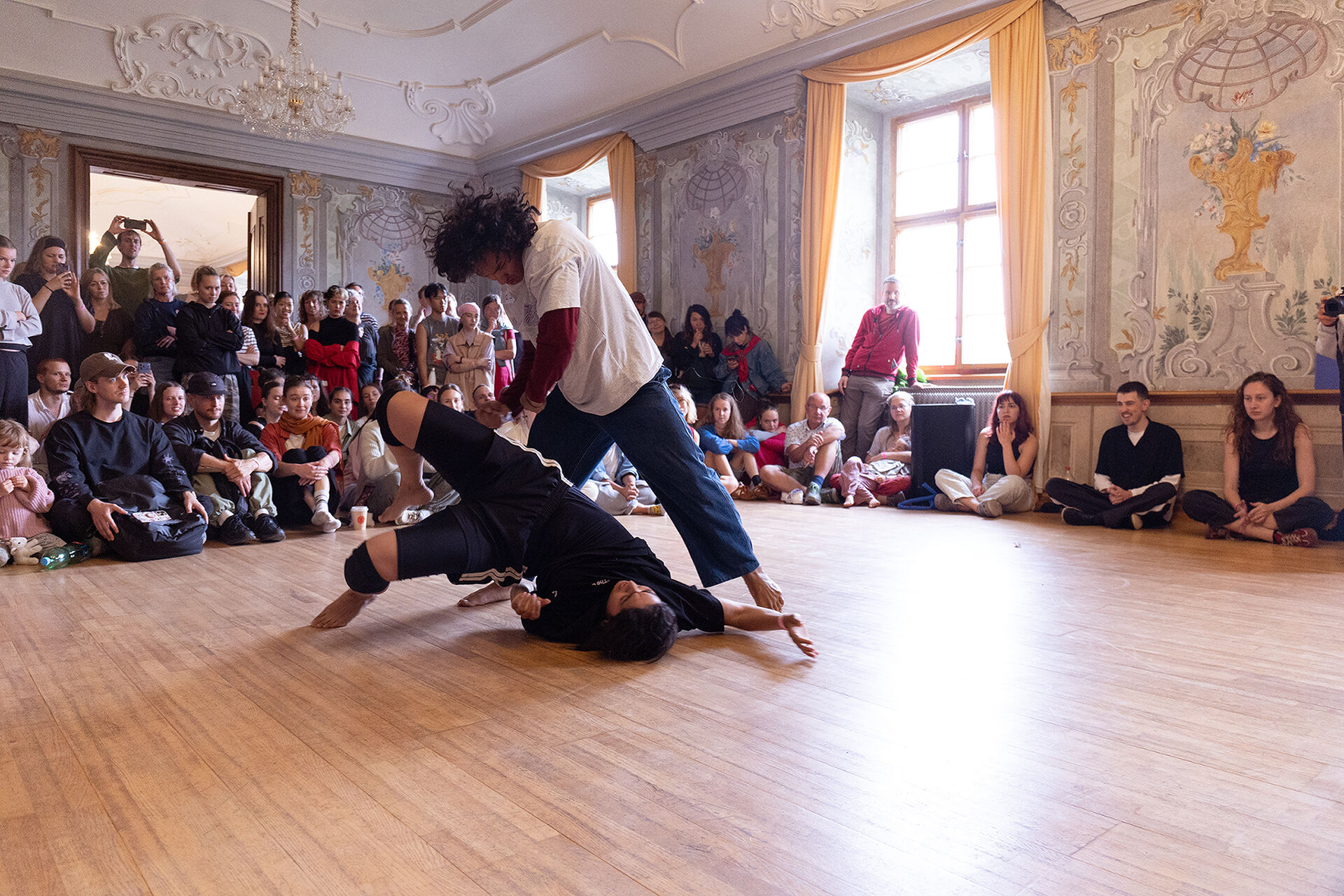
Vasiliki Papapostolou’s movement vocabulary brought so-called ‘experimental dance’ to the stage; the festival programme had in fact dedicated two whole afternoons to this genre, in the form of so-called ‘battles’ organised by Kristián Mensa (alias Mr Kriss), in which individuals and pairs – not only from the Czech Republic but also from abroad – compete against one another in dance to show what they’re made of. They dance to both recorded and live music, according to criteria set on the spot. The battles thus become a showcase of incredible talent, with participants able to improvise and react on the spot. I particularly enjoyed Sunday’s battles for pairs, where the element of couple dynamics also came into play. Due to the rain, the battle took place in the Fresco Hall; apart from creating a striking visual contrast between the past and the present, this also meant that performers and audience members had to be squeezed into a confined space, making the atmosphere of the event all the more lively and vibrant.
 KoresponDance is also a festival for young audiences – whether as performers (in shows featuring dance camp performances or the ‘Škola tančí’ project), workshop participants, or spectators. I picked out Roosa Halme’s ‘Block Theatre’ and an adapted version of Viktor Černický’s solo ‘PLI KIDS’ from the programme. In both cases, the quality of the pieces was evident from the spontaneous reactions of the young audience. The children got involved and shouted out what the structures built from blocks reminded them of; whilst the performer was building a tower out of chairs, they expressed not only loud laughter but also genuine concern that he might fall. Both performers won over the audience with their complete dedication to their craft.
The Taiwanese artist Chien Hung Kuo also focused on manipulating objects in his open-air solo performance Moving Zen. He moved a cubic metal structure with grace, balanced on a pole and played with fire. Most striking, however, were his experiments with a glass sphere in which the castle walls were reflected. Unfortunately, the overall impression was marred by music in the style of romantic songs and compositions, which came across as rather cheap. The song of the swallows, which began to flit over the courtyard at dusk, would have been more than enough.
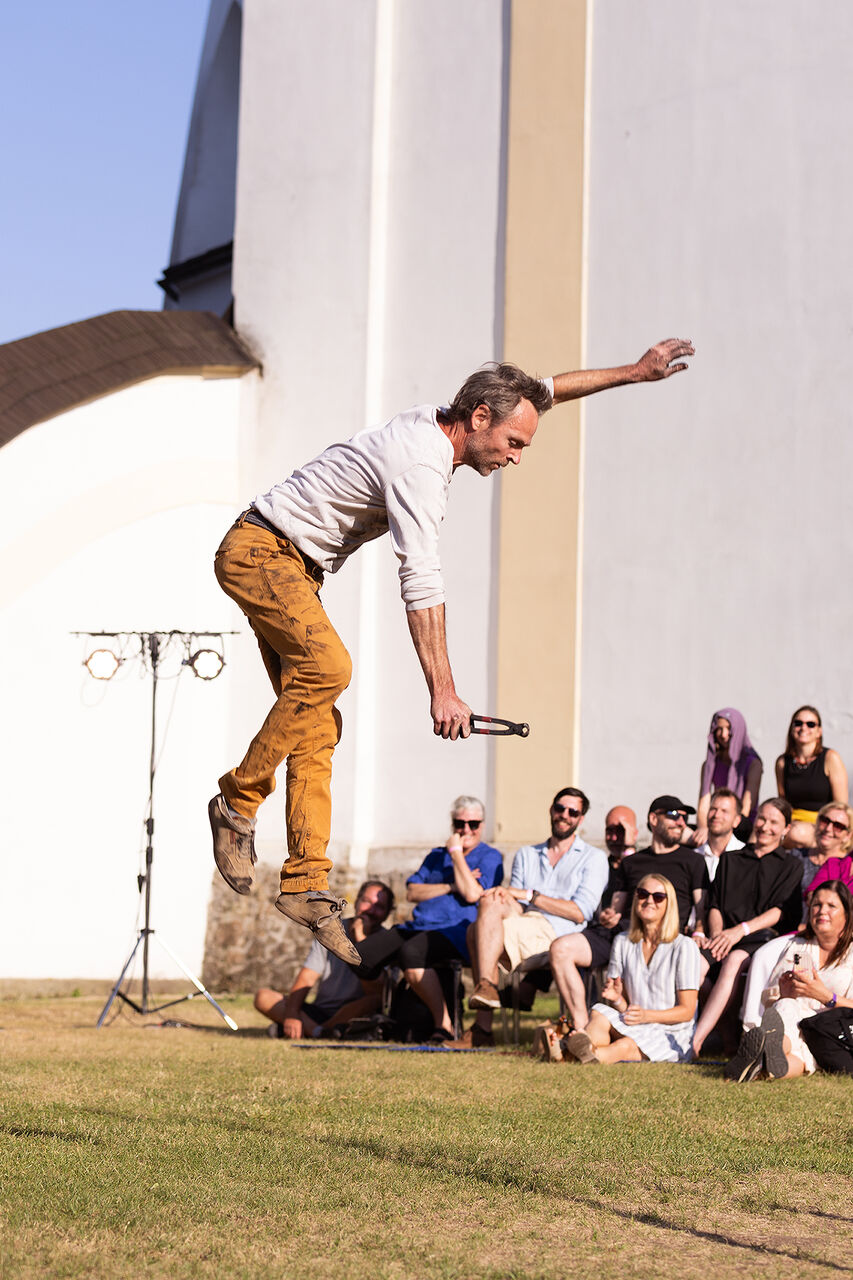
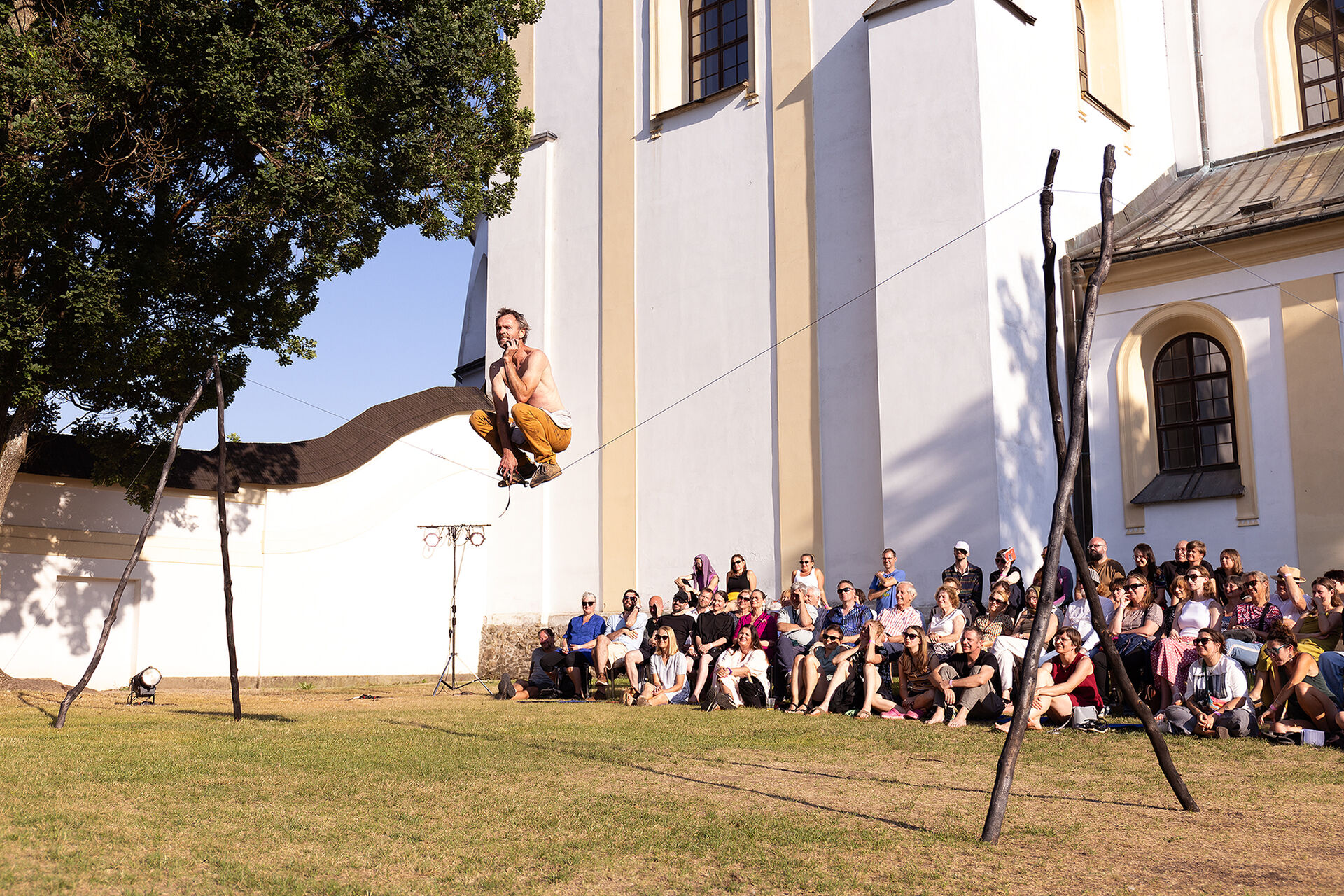 For me, the absolute highlight of the festival was Rémi Luchez’s solo piece – Miettes. Simple and poetic in concept, brilliant in execution. Four charred wooden branches and a coil of thick wire were transformed before the audience’s eyes into a rickety structure. Although it looked as though it might collapse at any moment, Rémi climbed onto it as if it were nothing. He balanced, glancing back at the audience scattered on either side. He threw himself off balance, though he remained fully in control. And then he pulled a pair of wire cutters from his pocket and literally cut the ground from under his feet. With genuine surprise at what had happened to him, he patiently and tirelessly set about joining the wire back together. And he climbed out again, cut the wire again… Just like in life, when we repeat the same mistakes and simply cannot learn from them, yet still have the strength to persevere. Rémi was a pensive, slightly naïve eccentric who completely won over the audience with his gentle humour.
This year’s KoresponDance festival offered a packed programme. You’d have to be at least two people to manage to see everything, and even then you’d need many times the mental capacity to take in all the impressions and experiences. Fortunately, the castle and its immediate surroundings offer plenty of peaceful havens where you can recharge your batteries, rest and relax. See you again next year.