For young audiences and the very youngest
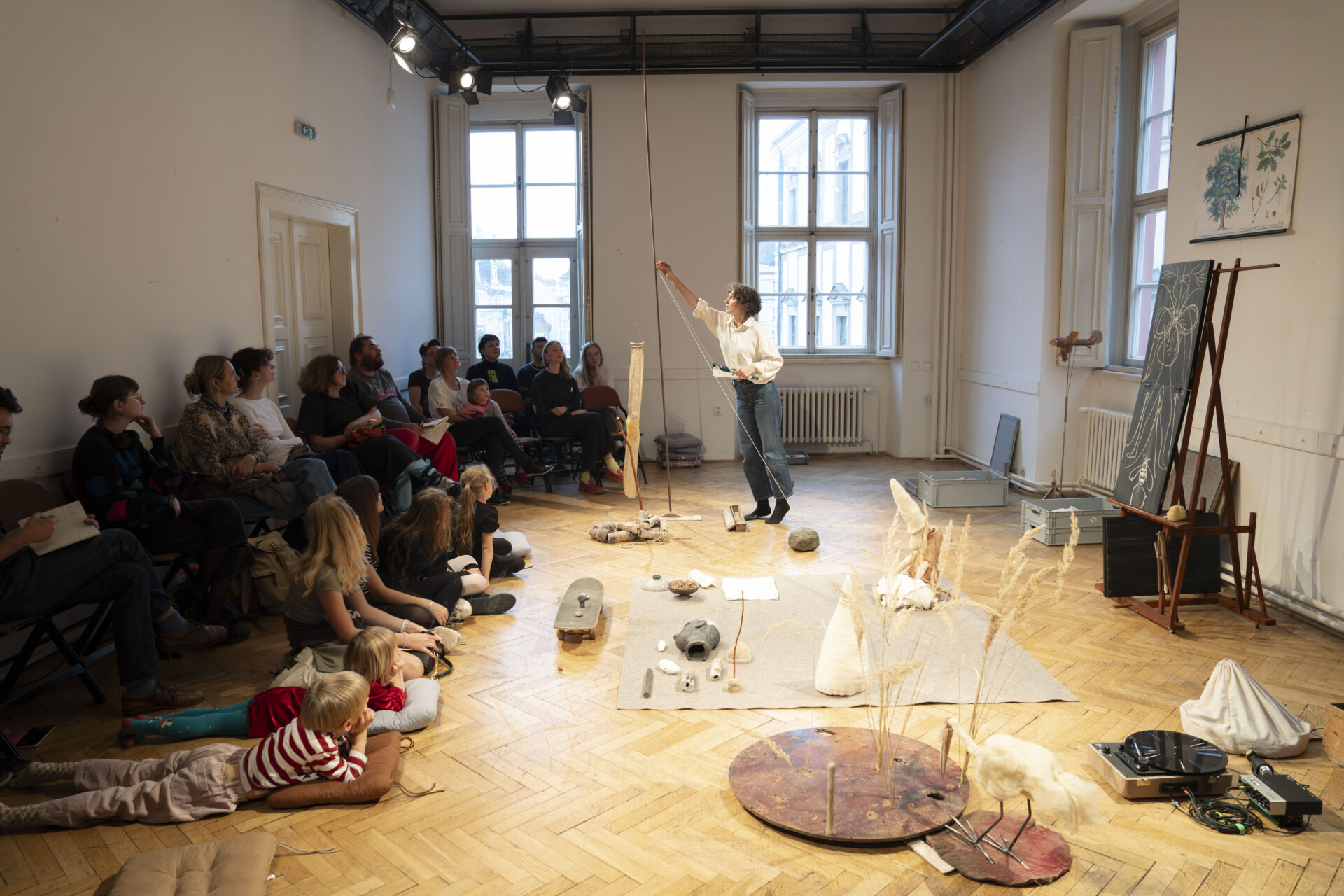
The festival’s programmers didn’t just think of young people, but also of the very youngest. Gracefully balancing on the border between performance and exhibition, V záři blesku (In the Glow of Lightning) offered a glimpse into the soul of artist, performer, educator, and art theorist Joseph Beuys. The creative duo Veronika Vlková and Robert Smolík set linen fabrics, wooden puppets, and chalk on a blackboard in motion in a completely unique performance, accompanied by the sound of silence. For, as is stated right at the beginning, some things are best experienced in silence. Under Vlková’s gentle touch, a log transforms into a hare; a man in a hat nods to the audience with his right hand—perhaps a reference to Beuys himself—and the wick of a candle smoulders with peaceful, purifying smoke. Perhaps it is the aesthetics of natural materials and soothing pastel colours, or perhaps it is precisely that silence that makes the performance more than object-and-movement theatre and more than an art exercise. A somewhat otherworldly ritual, a world that is both enchanting and magical.
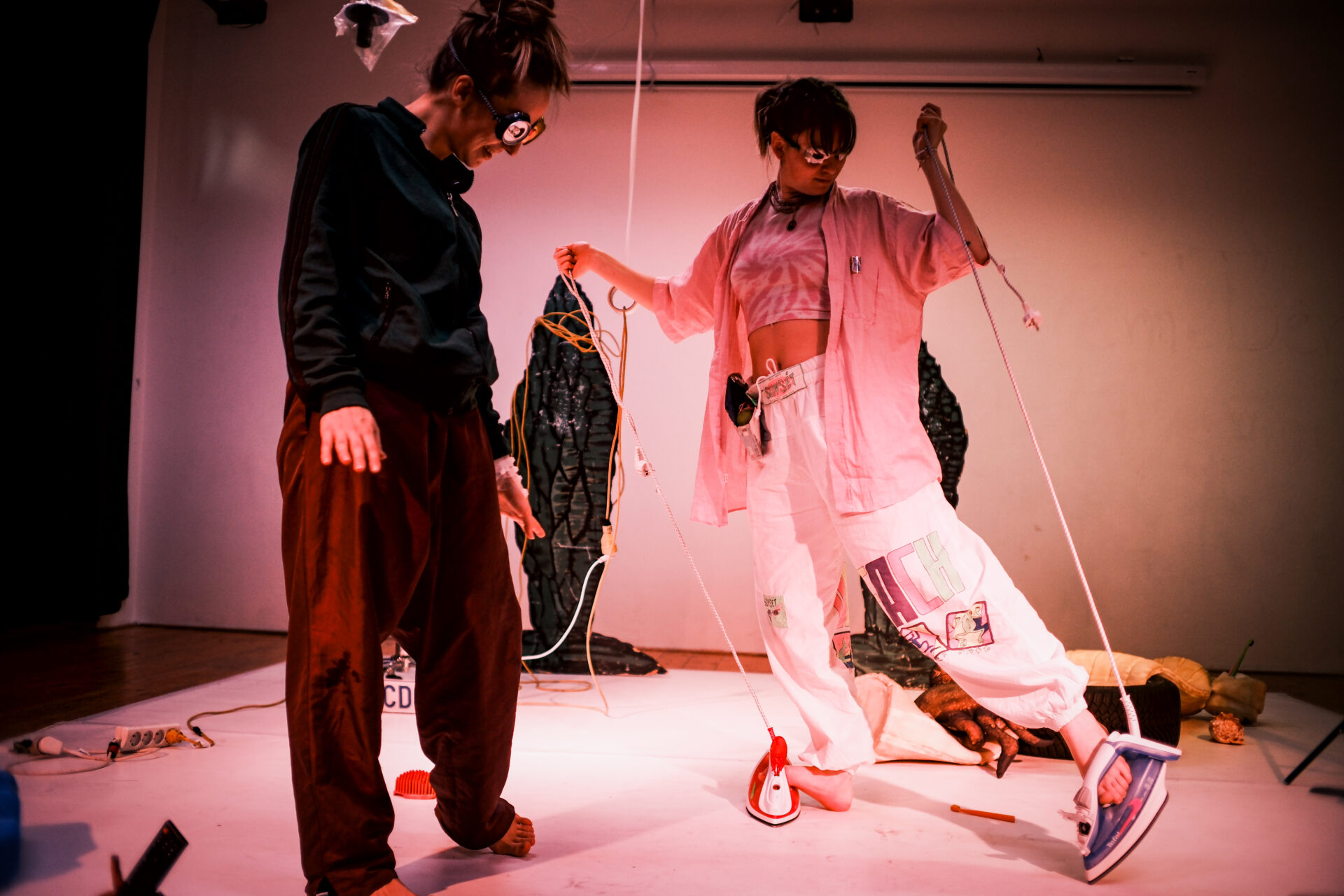
The collective Ghost Compost then introduced the familiar and unfamiliar underwater world to young audiences with their production Jsme, Chobotnice (We Are, Octopus). This wordless play about friendship and self-discovery, based on a book by Magdalena Rutová, tells the story of everyday things in extraordinary constellations. What, for example, can a toaster be used for? Whether it’s a French fry warmer, a VHS tape case, or a stylish handbag, the duo of performers extracts the maximum comedic potential from each of the everyday objects on display. Following the principle of “whatever fits where,” they explore—much like octopuses—an iron, an office chair, or wired headphones with their front and back tentacles, displaying naive curiosity, childlike fascination, and utterly serious concentration. The play is followed by… a game, this time the “real” one, without a script or rules, where the audience has the chance to become octopuses themselves for a moment and literally take the performance into their own hands (under the playful supervision of the performers, of course). After watching, the thought creeps into my mind of what a shame it is that after “adult” performances, interaction with the actors is usually limited to discussions. Rarely does the opportunity arise to “play around” right on the set afterward, uncover the secrets of stage tricks, or just try out a few props for fun. And yet, how many grown-up theatre kids secretly dream of exactly this!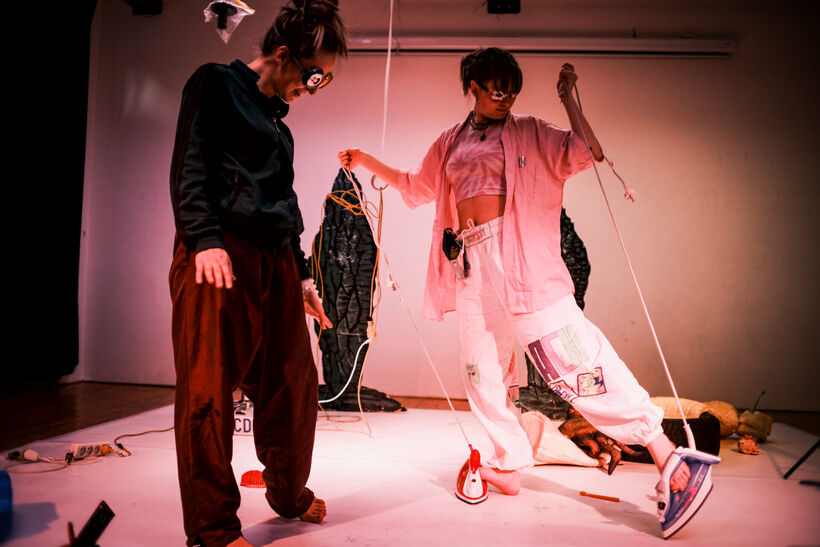
A unique work, or just “crazy”?
An attempt to return to childhood, even if not always the happiest years, was offered by the solo performance Iconic Program by the Czech-based performer Becky McFadden. The former competitive figure skater revisits the summers of her promising but not fully realized career on the ice. Through a playful series of accessible mini-lessons on figure skating tricks, she introduces the audience to the world of professional, often ruthless sport, which brings tears of pain and joy—very often both at once. Through archival footage of her favourite performances and intimate conversations with her family, she attempts—with humour and a healthy dose of self-irony—to literally skate her way out of the long-standing trauma of failure on the ice. And through inspiring music and the movement she loves so much, performed with the same elegance on ice as on land, she rediscovers her lost love for herself. With just enough girlish vulnerability to tug at the heartstrings a few times, the eternally young-at-heart McFadden is literally summoned before the audience onto a carpet—white, with long pile, measuring two square meters. It is precisely on this carpet that the otherwise bold and self-assured, yet now unusually fragile performance of this seasoned artist hones her own self-confidence. The performance is technically precise, expressive, and graceful—and truly unique in many ways.
A completely different approach to processing personal trauma and coming to terms with one’s own past was also evident in the original production LEMONADE (No Other Troy) by director and performer Tomáš Procházka. Years of inner exploration culminated in a profound, nearly six-hour dive into the twists and turns of the human psyche. In the dimness of the Venuše ve Švehlovce venue, the co-founder of the artistic collective PINKBUS Platform makes lemonade from nearly a dozen lemons—following the English saying that you should use what life serves you to your advantage. Here, this holds true without exception; Procházka’s scrutinized conscience is both form and content at once. To the sound of his own brutally honest audio commentary in English and Czech, he literally pours ashes (not only) on his head like a reborn phoenix. He lets the audience, which surrounds him on nearly all sides, judge for themselves the past inscribed in his present, completely exposed body, which wanders listlessly, slowly, as if soulless, through the corridor between the spectators. Alternately matter-of-factly and poignantly, he comments on the thorny path of his mental health—from overcoming addiction to intoxicating substances, through questions of sexuality and gender, to his professional transformation from director to performer. The result is a contemplative auto-ballad that is admirable for its openness, though its structure is perhaps too loose and its purpose at least obscure (even if Procházka’s revelation certainly has at least a partially therapeutic goal). As for the power of its message, however, it is, to my knowledge, unparalleled in our country.
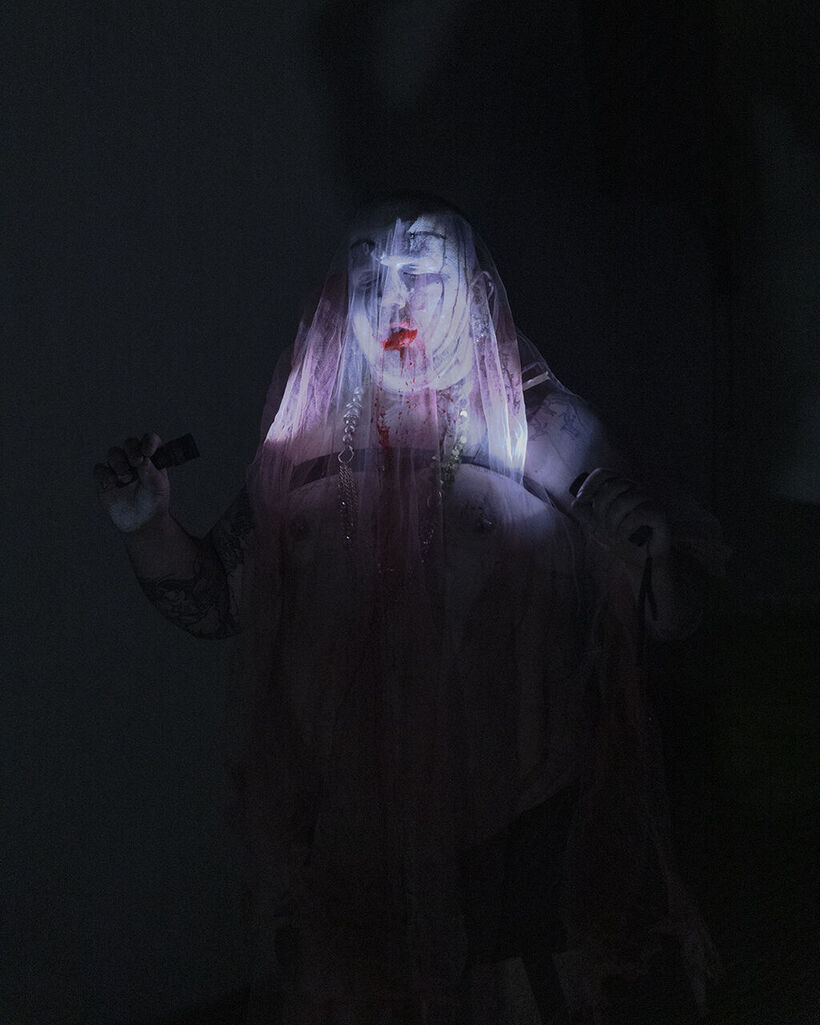 A truly sui generis project was the ambiguously classifiable theatrical piece Hodinka ošklivosti (An Hour of Ugliness). This final-year production by students of the Department of Alternative and Puppet Theatre at DAMU came across partly as an obscure séance and partly as a folkloric exorcism of stray theatrical spirits. A fragmentary text that indirectly alludes to immoral acts (exactly which ones is really hard to say) is complemented by a series of more or less interconnected actions. Cacophonous sounds and animal screeches, stares into the void, bodies alternately eerily rigid and maniacally possessed, with limbs hanging limply or, conversely, twisted at bizarre angles—in many ways, this evokes butoh dance. Unlike the emotive scenes of Japanese art, however, there is a lack of any order here, or a performance to which one can latch on. Or at least a central idea. Definitely an experiment through and through, but looking back, it stood out to me personally as a complete “flip-out.” On the other hand, independence takes many forms, and who am I to judge another’s independence?
A Look into the Future
As in previous years, the accompanying program was an integral part of this year’s festival. In addition to networking meetings for participating artists and a project exchange featuring works from the Czech Republic and abroad, the program also included a playroom for young audiences (and their parents), a discussion on pregnancy and motherhood in the cultural sphere, and, last but not least, a pair of moderated discussions on dramaturgy in the Czech Republic. The effort to bring together representatives of a profession that is not only difficult for many to define but also (and perhaps precisely for that reason) unjustly overlooked is certainly commendable. After all, the mere fact that nearly twenty active dramaturgs from across the country gathered at Husovka venue in Prague is proof of their interest in spending time together. One must, however, distinguish between professional decompression and depression—that is, the productive sharing of practice versus the self-serving venting of frustration. Often, the two go hand in hand, it is true. However, reaffirming a shared reality—despite the initial euphoria of mutual understanding—usually does not bring about change. This is all the more true when compared to the persistently unfavourable situation in the cultural sphere of neighbouring Slovakia. This is another reason why we need a vision for the future, which in this case was provided by a discussion with the emerging generation of dramaturgs about opportunities for professional networking, mentoring, and further systematic education through the Association of Theatre Dramaturgs (ADD). Because if there is a place to start, it is with a breath of fresh creative air.
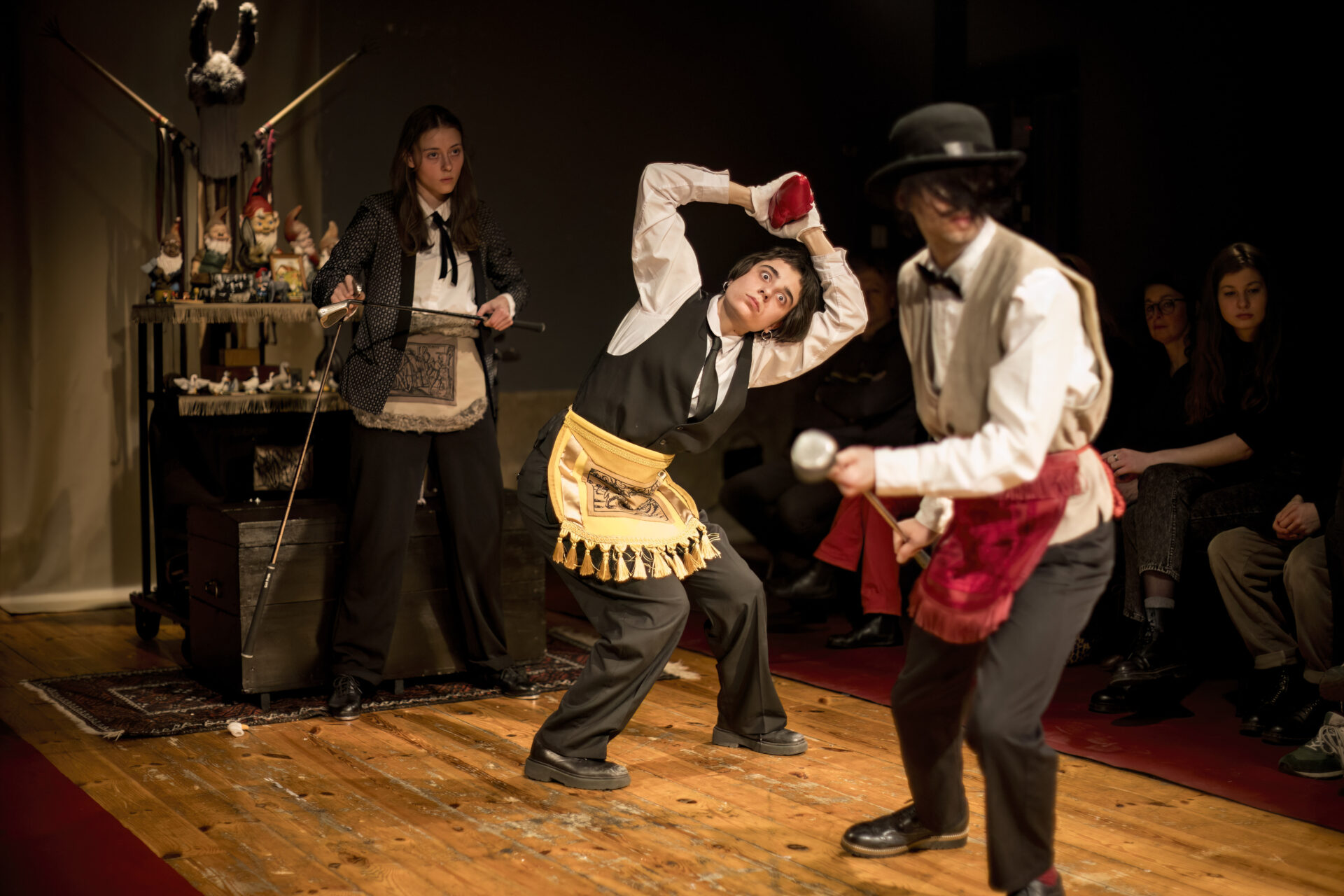
Last but not least, the Malá inventura festival also welcomed its very first audience to an original production—or rather, a work-in-progress—by Karol Fila titled Nenásilná těla (Non-Violent Bodies). The theme of the limits of political engagement, civic responsibility, and disobedience, a sense of (in)justice, and the seeds of violence slumbering within everyone—even the most self-contented human body—is exceptionally compelling. The subtle rebelliousness of the seemingly peaceful Filo stands in contrast to the documentary material—the words of a non-binary person detained and convicted for nonviolent protests. We can only wait to see what will sprout from this promisingly developed idea.
The greatest benefit of this year’s Malá inventura festival, however, was the extensive use of the Kulturní stanice Galaxie space. Once the largest multiplex in Central Europe, since last September it has hosted not only the Dejvické divadlo troupe but also performances by the Minor Theatre, the 4+4 Days in Motion festival, DAMU students, and events co-organized by the relatively new independent production collective DanceConnected. The unmistakably “cinematic” layout—with a spacious hall, a bar featuring an original, colourful installation by Krištof Kintera, and four independently functioning auditoriums—has all the makings of a hub (not only) for cultural gatherings. The question is what will happen at the final stop in the future. If it’s dance, so much the better.
Written from the Malá inventura festival, March 19–28, 2026.
V záři blesku
Creators: Robert Smolík, Veronika Vlková
Performer: Veronika Vlková
Dramaturgy: Anna Prstková
Jsme, Chobotnice
Creative collective: Yanina Arlova, Sviatlana Silich, Eliška Čadová, Barbora Chrpová
Dramaturgical collaboration: Michaela Čajkovičová
Iconic Program
Concept, performance, choreography, script: Becka McFadden
Dramaturgy, directing collaboration: Daniel Somerville
Video: Becka McFadden, Mariia Reshetova
Graphics: Mariia Reshetova
Technical collaboration: Filip Obermajer, Maxim Polluksov
Set design consultation: Anna Tichá
Translation: Eva V. Ullrichová
Sound collaboration: Lukáš Turza
Choreographic consultation: Sylvie Robaldo, Jára Šimůnek
Production: Kateřina Kubíková, Anna Kuřátková
PR: Michaela Sikorová and Kristýna Sudková (kujme pikli)
Social media, graphics: Adél Škvrna
Co-production: Beautiful Confusion, z. s., Industra Stage, Venuše ve Švehlovce
Hodinka ošklivosti
Director: Lukáš Horn
Dramaturgy: Johana Jurášová
Set Design: Adam Bohdal
Production: Markéta Křížová
Performers: Gagik Chilingaryan, Ema Brezinová, Ema Lovecká, Zbyněk Rohlík, Vilma Vojtíšková
LEMONADE (No Other Troy)
Concept, direction, and performance: Tomáš Procházka
Performance mentorship: Matthew Rogers
Costumes: Vojtěch Hanyš, Tomáš Procházka
Set design: Ľudmila Bubánová
Set design collaboration and masks: Zuzana Hudáková
Video: Tomáš Procházka, Michal Ďuriš
Production: PINKBUS Platform, Adriána Spišáková
Photographer: Josef Rabara
Graphic Design: Barbora Šajgalíková
Nenásilná těla (work-in-progress)
Author & Performer: Karol Filo
Dramaturgical Collaboration: Tobiáš Nevřiva, Orin Rodriguez
Consultants: Gosia Wdowik, Ira Brand, Robert Smolík