What can a body keep that an archive cannot? What can choreography still protect from disappearing? Across these works, darkness took many shapes: the night of the Wilis, an unconsoling ocean, a stage turned training ground. And in the dark, other questions surfaced, such as what the mouth remembers, who gets to be seen, and on whose terms.
Bodies against Disappearance
September is a quieter month for dance in Berlin. With the summer festivals over and the main season yet to begin, that which I saw happened beyond the theatre walls. Dance has never belonged solely to the stage, of course; this time, however, the city and its architecture became the choreographic frame, mostly around the Kulturforum, the modernist cluster of museums, libraries, and concert halls near Potsdamer Platz.
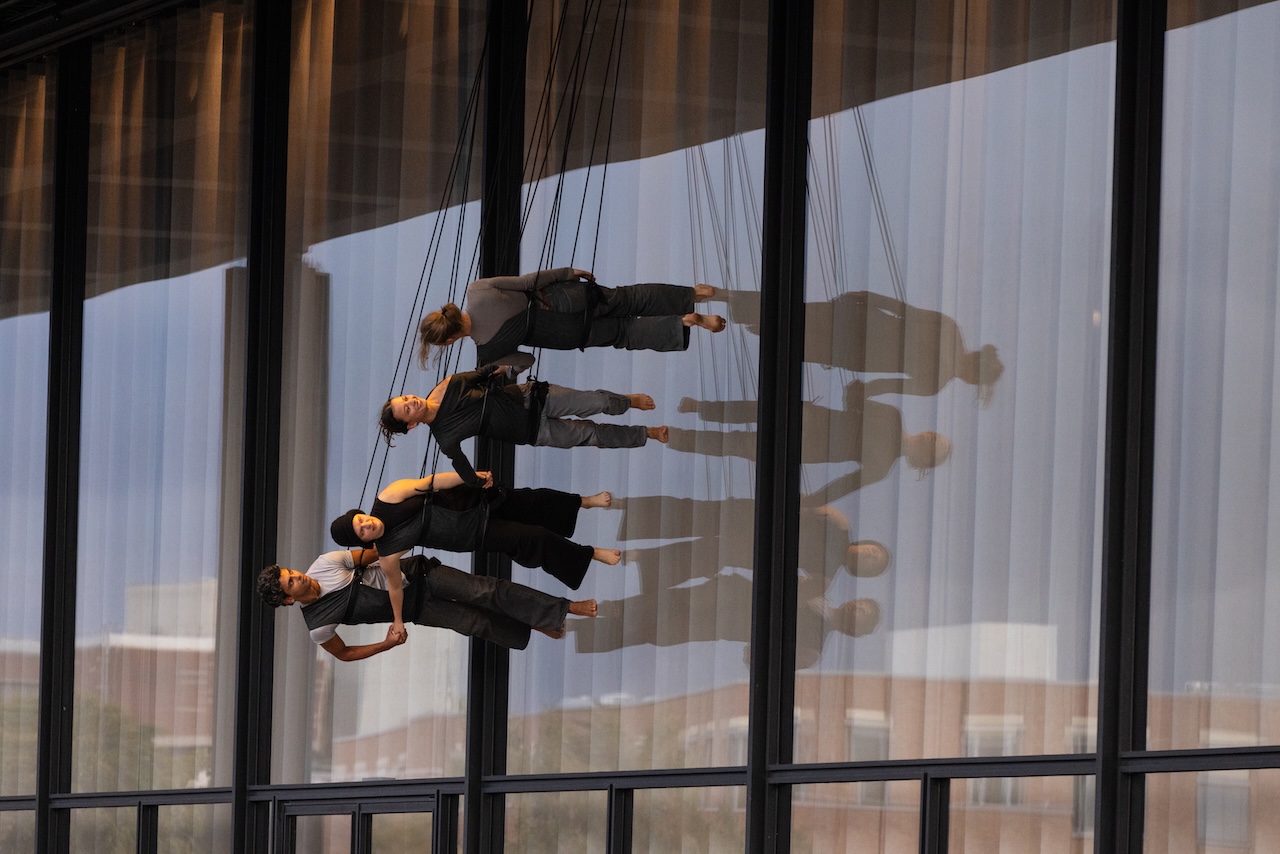
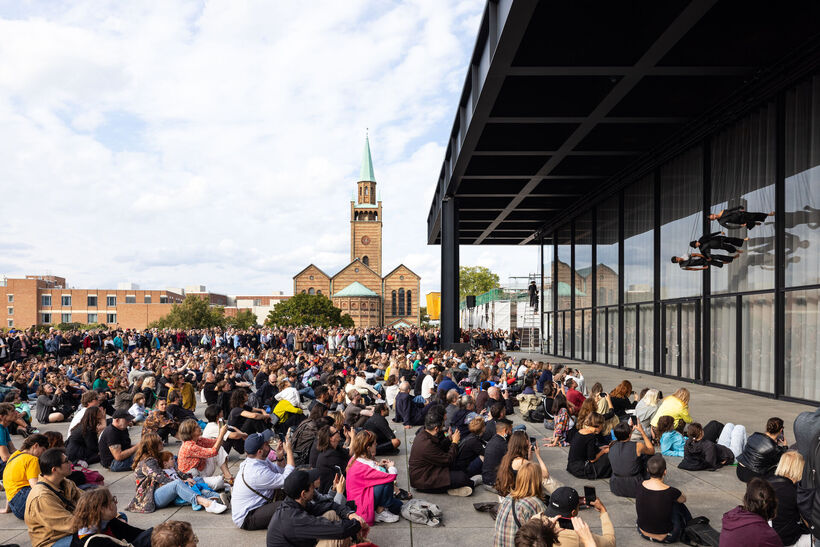
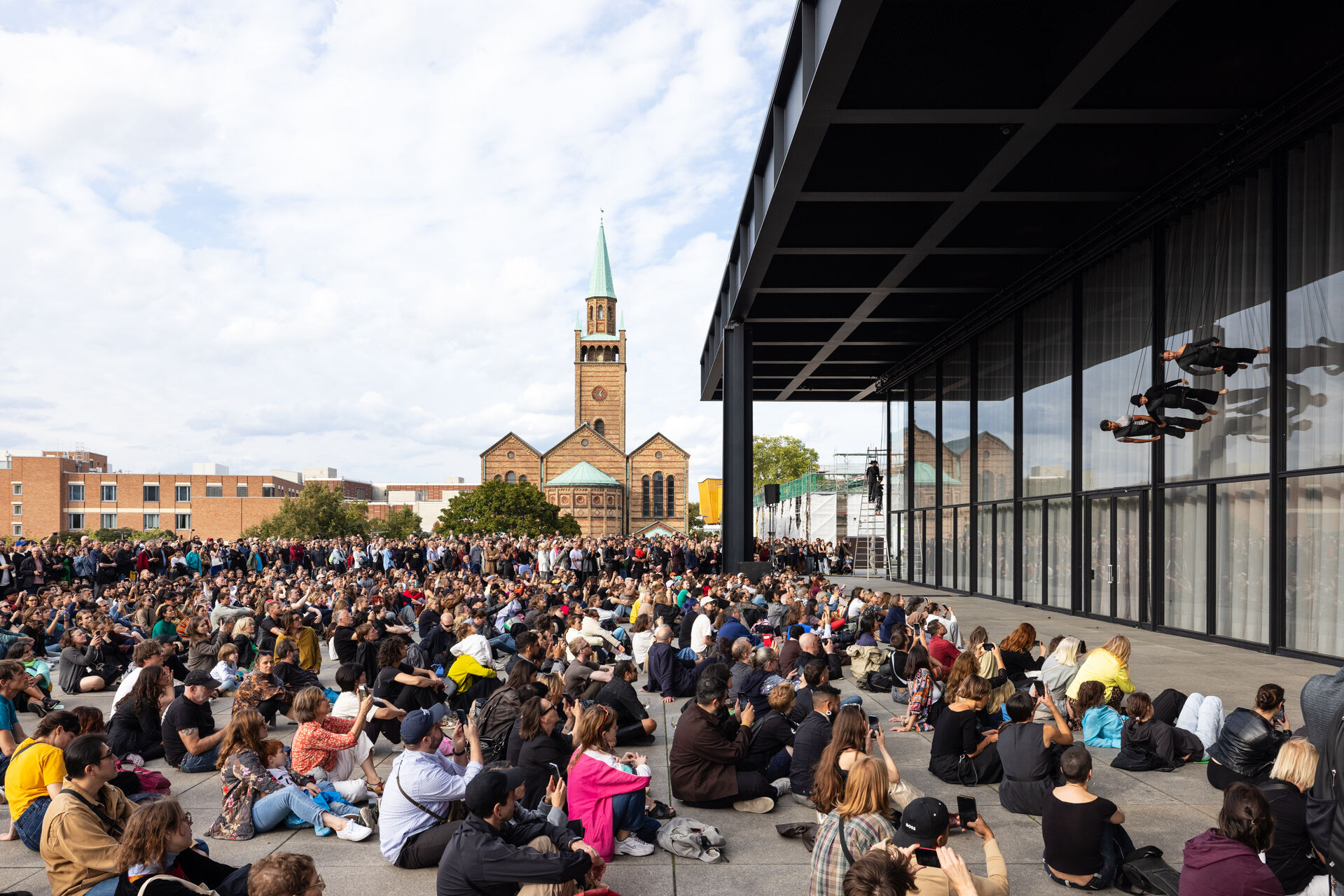
At the Neue Nationalgalerie, the highlight of the fifth edition of PERFORM!, held during Berlin Art Week, was Trisha Brown’s Walking on the Wall (1971), restaged by the Trisha Brown Dance Company on the vast glass panes of Mies van der Rohe’s building. Harnesses on, dancers of different ages climbed ladders and set off perpendicular to the façade, walking, running, hugging, and smiling in mid-air. By turning a vertical surface into a floor, the piece unsettles the perspective of mover and watcher alike. Kinaesthetic empathy did the rest: I caught myself bracing my core with every step, spellbound, and thinking, more prosaically, of all those feet leaving prints on the glass of an architectural masterpiece, as ours do on the pavement. Below, a huge crowd, there also for the opening of Maurizio Cattelan’sexhibition in the same building, watched in silence, while around it people drank and chatted as in a piazza. André Lepecki, who would later speak at the Volksbühne, has described the body as an archive that reopens a dance differently each time; here the reopening was literal – the same walk, on another wall and in other bodies, fifty-five years on.
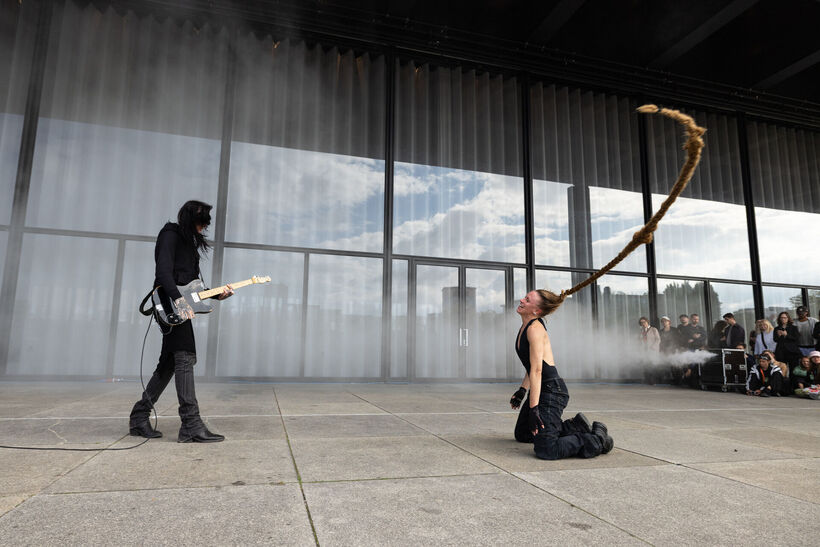
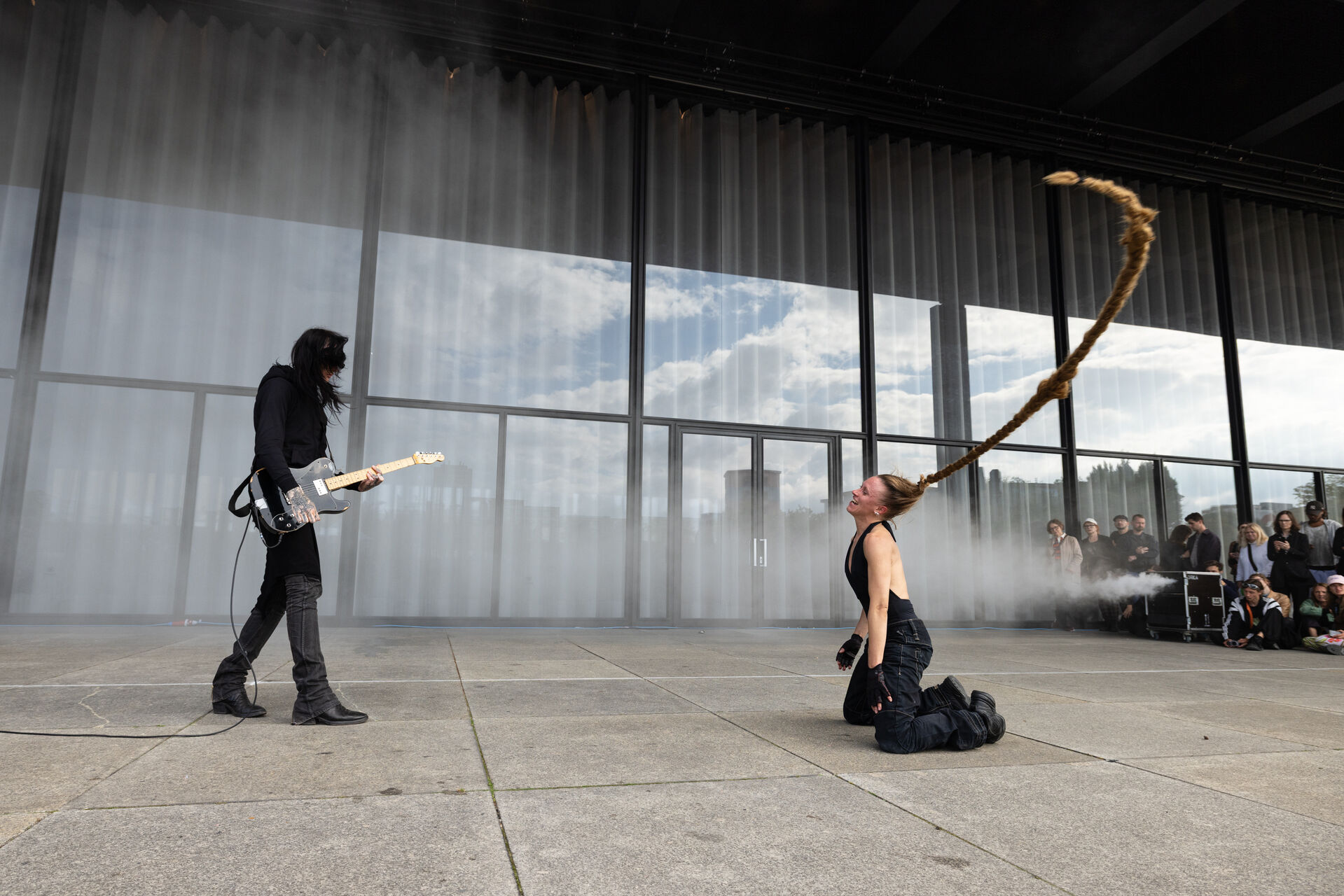
If Brown’s walkers defied gravity, Hard Play, by Danish artist Miriam Kongstad, drew us into a fairy tale gone full Grimm, probing how play teaches us gender and social norms from an early age. Dressed in black, cutting a kind of Rapunzel figure, with an impossibly long blonde braid of fake hair trailing behind her, she burst onto the museum’s terrace alongside Heva Vaupel on electric guitar and synthesizers, the braid both toy and leash, and threw herself into fierce, high-energy floor sequences while smoke built a world as powerful as it was unsettling. Fairy tales, after all, were never just for children: the dark has always been part of them, and Kongstad lets it in.
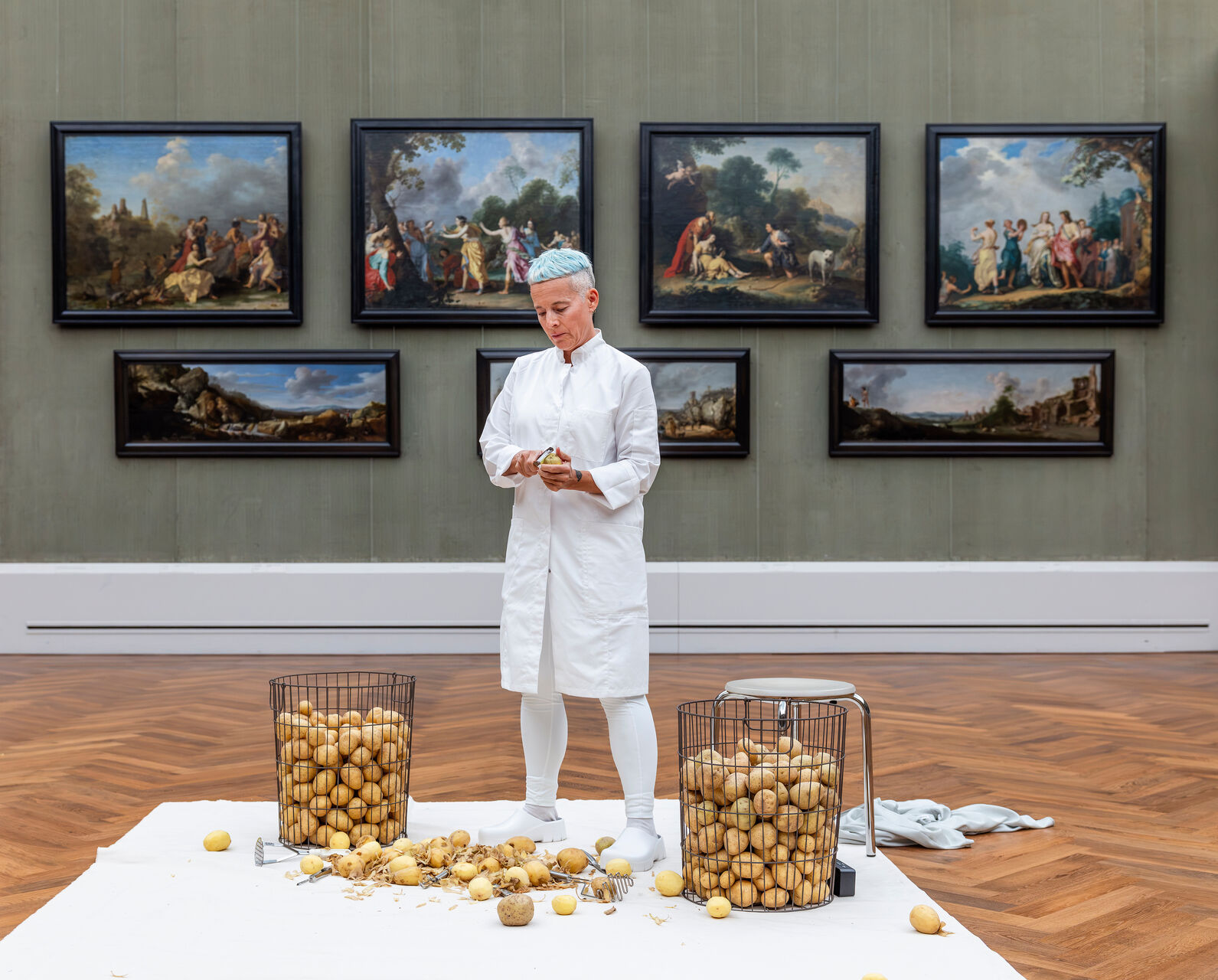
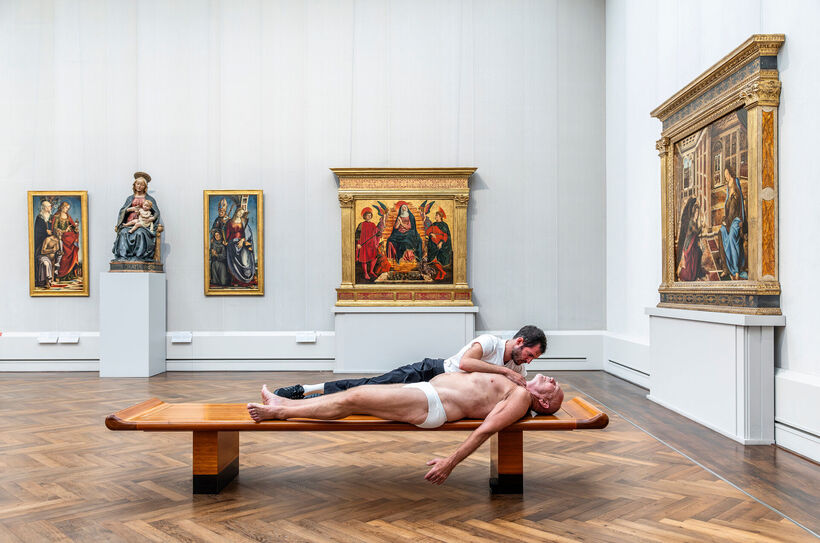
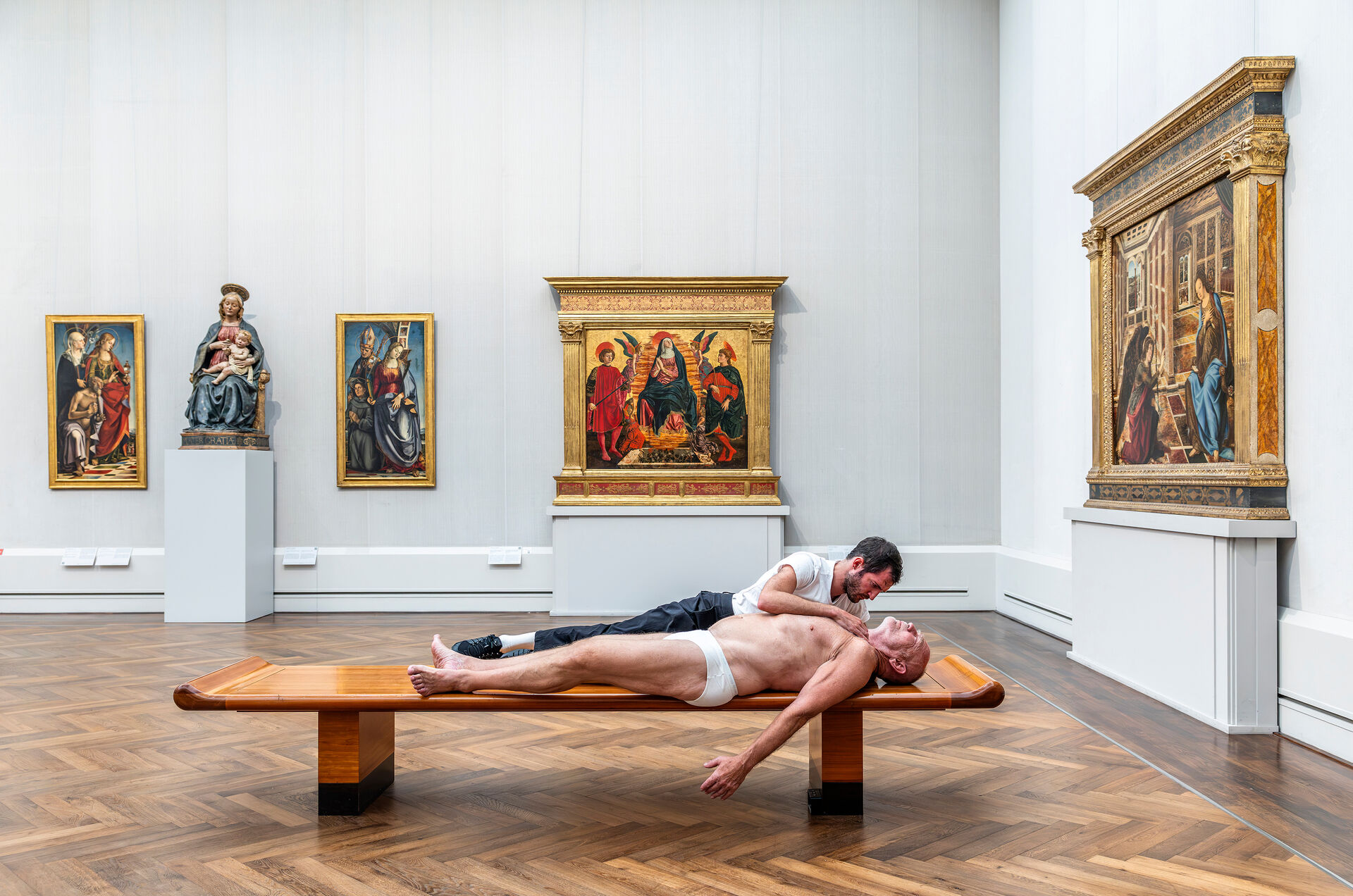
Next door, in the Gemäldegalerie, Ersan Mondtag and Nadim Samman’s Alternde Meister, a co-production with the Berliner Ensemble, started with a provocation: “On a painting, we call it patina; in a person, decay.” Twenty-five performers of different generations were scattered among paintings from the thirteenth to the eighteenth century, carrying out everyday actions. Among them, artist Candice Breitz peeling potatoes on a square white sheet, a pole dancer at work, elderly bodies motionless before canvases. Not dancers, strictly, but bodies in relation to the paintings and to us. Patina or decay, then, depending on who is looking: age is not the subject, but our way of looking is. And since looking meant moving, the choreography was also ours: by drifting from room to room, choosing whom to follow and for how long, we spectators traced our own paths through the collection.
Berlin Art Week also reached Kino International with the premiere of Eternity, Susanne Regina Meures’s film with Florentina Holzinger and her performers: friends fleeing climate collapse for the eternal ice, only to find eternity already melting. Glacier and female body appear side by side, both monumental and at risk, with the camera as another body among them; yet the parts of the Rhône Glacier where it was shot no longer exist. Back at the Kulturforum, the Staatsbibliothek, as part of Photo Book Summer, curated by musuku, was showing photographs of R.A.M.M., the 1990s lawless Berlin collective with their bodies hanging and exposed, not unlike Holzinger’s. That Berlin no longer exists either (rents saw to that). Film and photograph alike freeze what is already melting away.
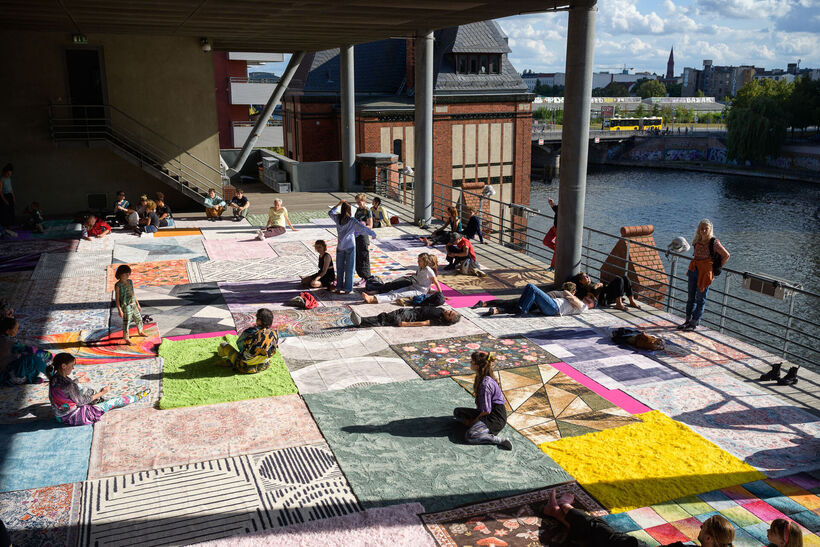
That weekend, Radialsystem – the former pumping station, now a cornerstone of the city’s dance ecosystem – celebrated its twentieth birthday (congratulations!) with a packed programme. On the deck, in bright sunshine and with the river behind, Xavier Le Roy opened a first rehearsal of Temporary Title, 2026 – In the Middle, Somewhat Rehearsed (a nod to Forsythe’s In the Middle, Somewhat Elevated) to the public, ahead of its premiere at the Palais de Tokyo for the Festival d’Automne. A durational piece of about three hours, we were able to come and go as we pleased. On a patchwork of carpets of different origins and textures (we could sit wherever we liked), fourteen performers, wrapped in fabrics of every colour and shape, moved alone, then together, always low and close to the ground, making bird or worm sounds, resulting less a performance to be watched and more an environmental choreography to inhabit. Towards the end, the performers formed small groups with the audience for quiet, personal conversations around displacement, inviting us to share the space where, as the programme note puts it, “simply being there would be sufficient”. I stayed for almost an hour.
In all these works, the audience’s bodies were set in motion too, finding their own, not always easy, ways of seeing, not least at PERFORM!, where the crowds at times outgrew the organization. Still, free and open, these formats allow strangers to gather briefly before dispersing back into the city.
Phil Dera.jpg)
By Mouth
Again at PERFORM!, Deva Schubert’s vocal collisions (variations on the mouth) took a piece I had first seen in February at Schinkel Pavillon outside. The first thing that reached me was its tremendous sound. Using their mouths and one another’s bodies as resonating surfaces, the performers turn a kiss into a transmission of sound, whilst a warped lullaby recalls the ancient lamenters, giving mourning back its political voice. Completely opaque, exposed to the elements, the bodies formed a dissonant choir where grief glitched rather than harmonized.
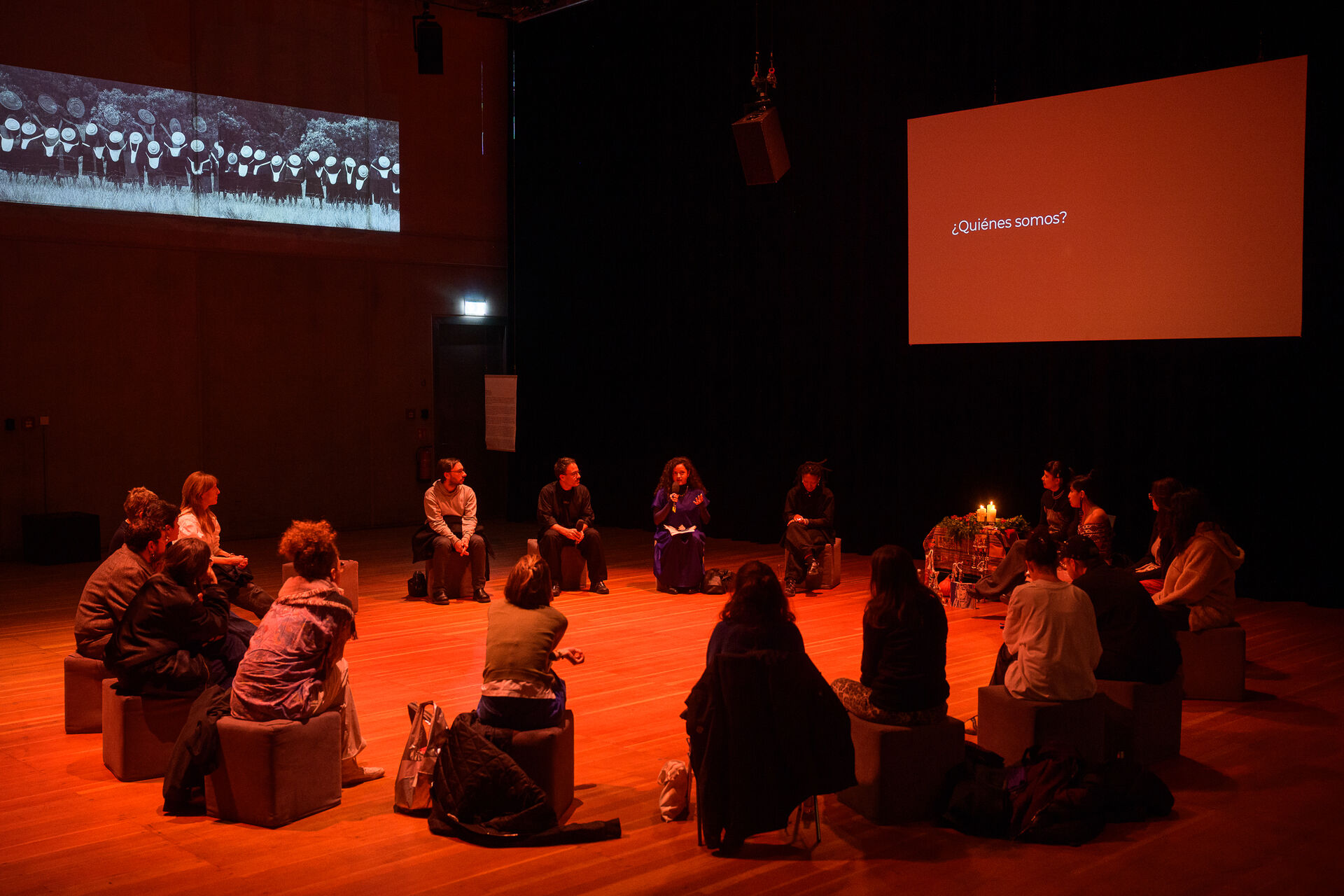
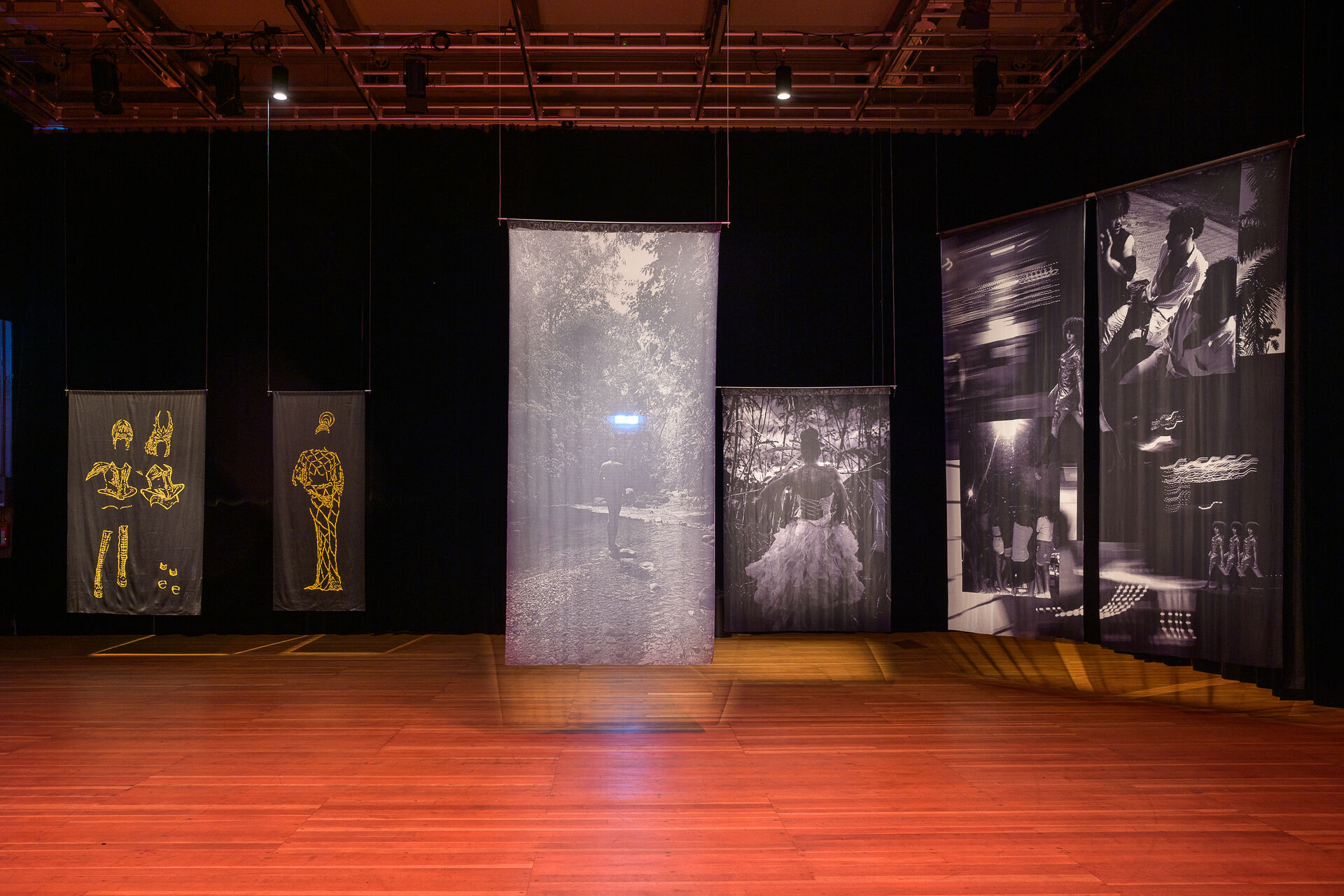
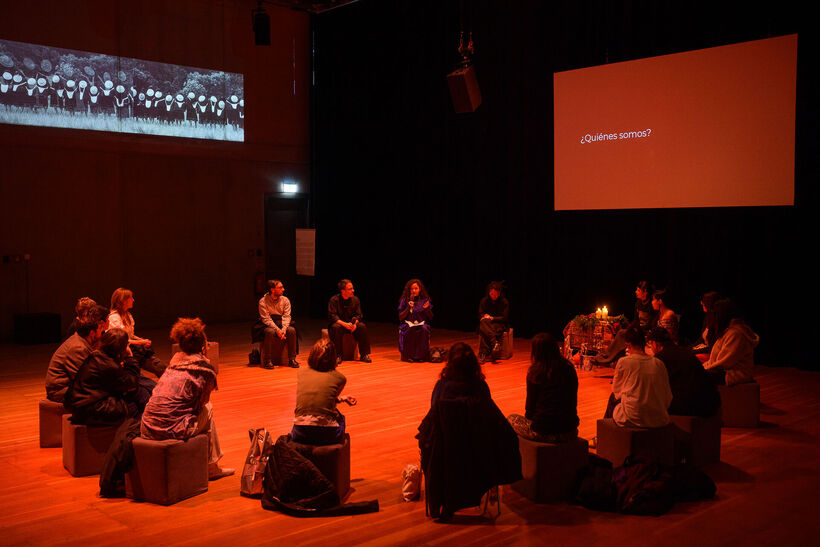
Radialsystem’s series Unexpected Lessons – Knowledges of Body and Sound listens to what the body and the voice know. Its fifth chapter, The Resonating Body – Writing and Orality, shared the house with Embodied Practices and its accompanying exhibition by Campaz and Morales, mentioned above. The talk on embodied knowledge brought the two artists together with curator Jenny M. Díaz Muñoz and performer Maque Pereyra: a conversation in Spanish, in a circle among candles, a healing drink passing from hand to hand. It touched on land, textile as a body, a photograph of feet from which small plants sprout. What stayed with me was the idea that change grows not from grand gestures but rather out of small, repeated acts of care and repair.
That same evening, I caught Melanie Jame Wolf’s Unruly Material (After Genet, after Mr. Punch), a formal experiment built on puppet gestures, and Alvin Tran’s first play, Strawberry, Arizona, in which a couple toys with murder and death. I missed emet ezell’s performative reading My Mouth Is a Resurrection Channel – but not what they said at the closing talk, hosted by Celina Baljeet Basra. There, Wolf described humour as a lubricant of trust that lets you dig deeper into the dark, while ezell spoke of the Catholicism of their upbringing as a first language and recalled how, visiting their family’s land, they chewed a flower and spat it out as a way of making contact with it, only later learning of its healing properties. Somatic transmission, by mouth: chewed, spat out, passed on.
Speaking Silence
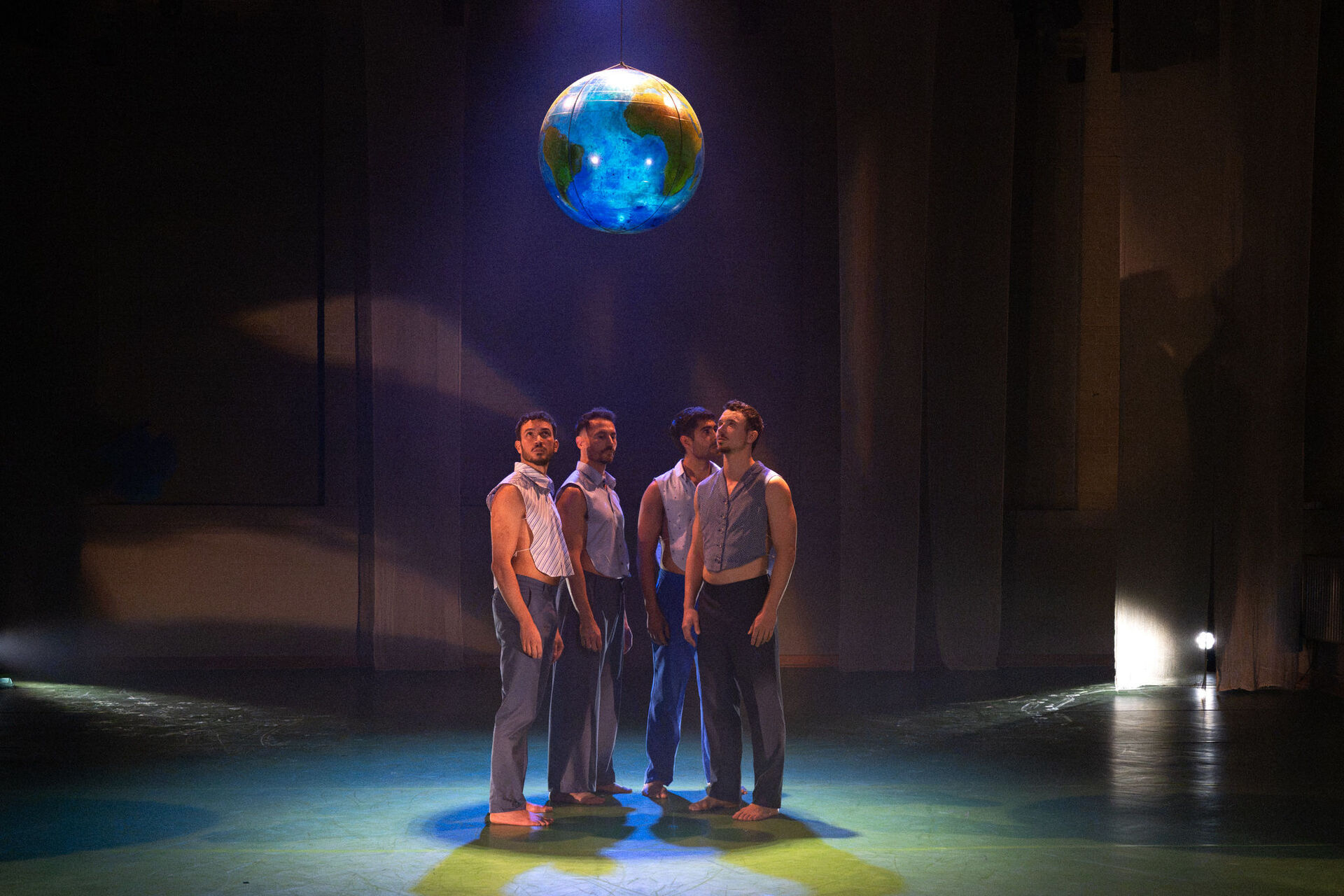
In early October, the season kicked off in earnest. Thirty years on and still going strong, cie. toula limnaios, premiered an elephant in the room in its own house, the HALLE, a cosy two-storey nest, with the stage below and, upstairs, a convivial bar lined with books and photographs. Prefaced by Nietzsche’s warning that truths kept silent become poisonous, the piece is conceived as a diptych on silence and the unspoken that makes silence speak through choreography of great precision. A green floor framed by small transparent white wings and soft blue forms; a balloon shaped like a globe hanging at its centre.
Two quartets – first the women, then the men – never sharing the stage, yet answering each other through similar costumes and recurring gestures. Whilst the women attack from the outset, sharp and confrontational, the men begin scattered, almost dispersed, only to lose all control towards the end. Although their choreographies differ, one image runs through both: knees, shins and arms assembled into a rifle, aimed straight at the audience, creating a punchy, almost cinematic effect. Both groups also hurl the balloon globe across the space, but it is tethered and cannot fly far: the world in our hands, but not just ours.
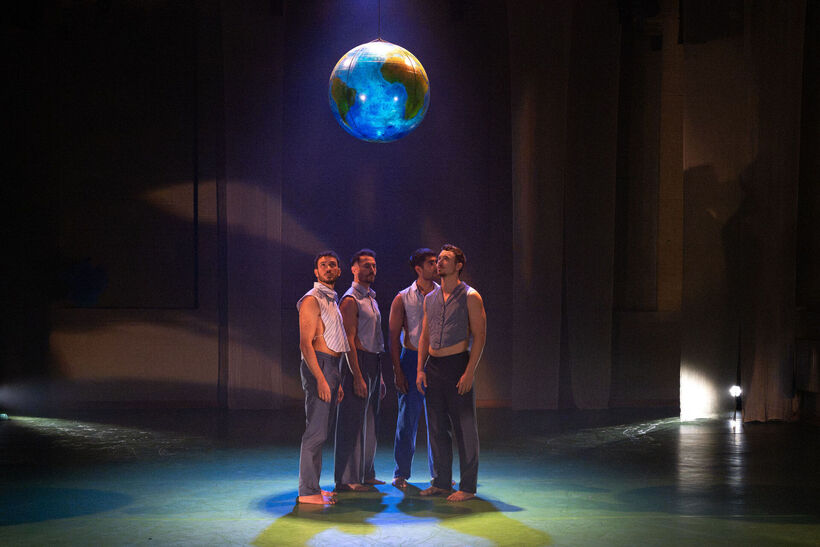
The cast is a joy to watch. The movement language rests on flow-work sequences, fluid and organic yet dynamic, that pour weight through the floor and back up the spine, grounded in touch and listening, woven into genuine choreographic writing and lightened by theatrical touches such as little skirts and coffee cups turned into musical instruments. Despite being divided into scenes, the piece avoids a rather familiar formula in contemporary dance – one task, five minutes, cut, next. In fact, the scenes flow into one another, and the whole breathes like a single body, closely tracked by Ralf R. Ollertz’s score.
A Love that Kills
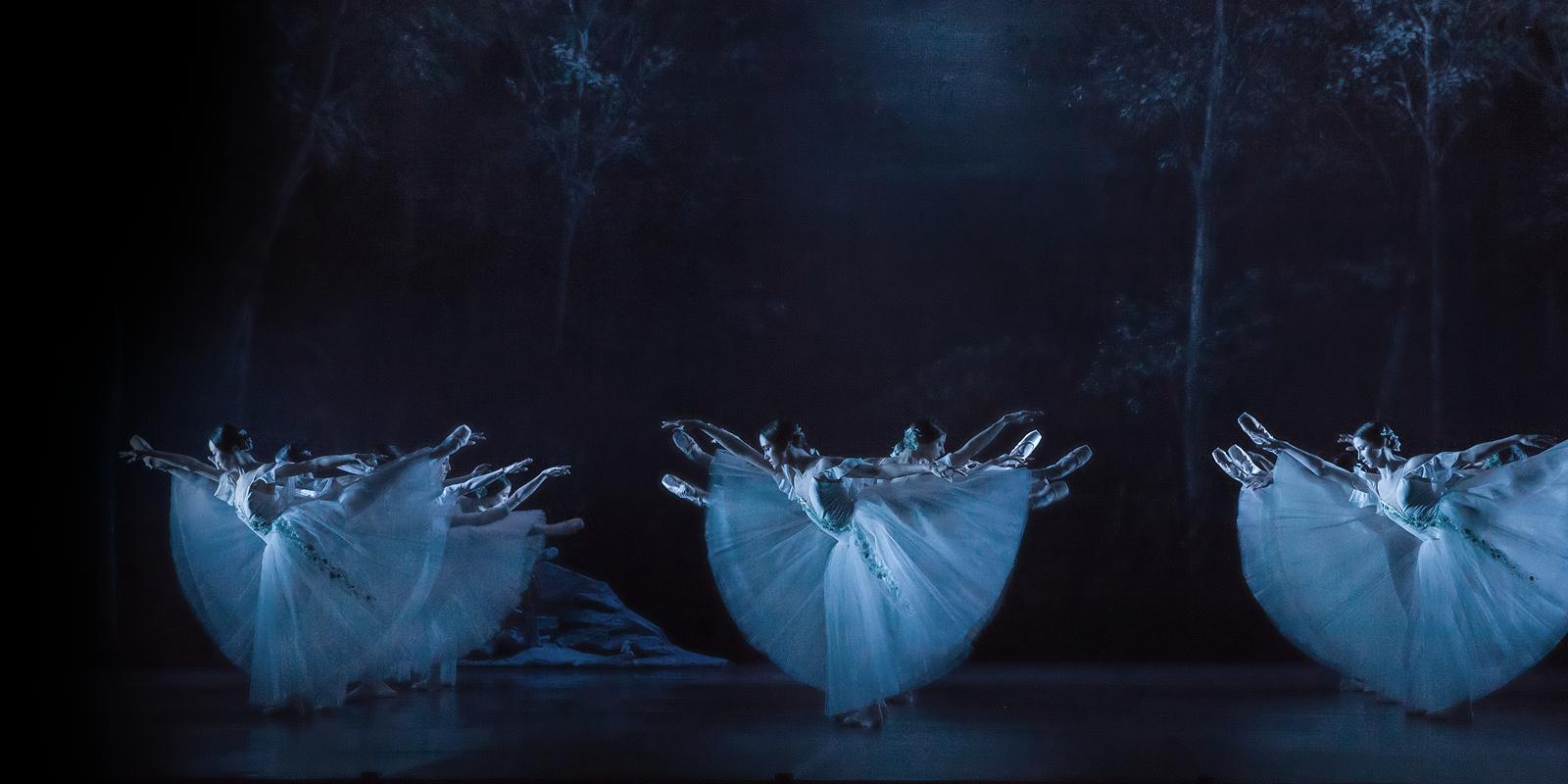
Where Limnaios keeps its violence unspoken, a great classic stages a love that kills. Marina Duarte was dancing Giselle for the first time on the night I saw Patrice Bart’s production at the Staatsoper Unter den Linden – and she was a revelation: light, with buoyant ballon, seemingly endless arabesques, quick, airy turns and exquisite pointe work. Beyond her impeccable technique, what struck me was her expressiveness. Her Giselle is a girl forced to become a woman in a matter of seconds, a teenager still seeking her mother’s warmth; by rooting the mad scene in that adolescent love, in all its nuances, Duarte keeps it from becoming a mere set piece. David Soares’s Albrecht is princely, immaculate in the turns and jumps, while Cohen Aitchison-Dugas’s Hilarion is cruel to the core.
In the white world of the Wilis, the ballet’s nocturnal logic takes over, and the dancing feels lived rather than executed. Leroy Mokgatle, a trans woman also making her debut as Myrtha, is formidable: martial in every movement and in the way she marshals the Wilis across the space, a queen whose authority fills the stage before the first jump. In that white night, Giselle turns a love that kills into an act of protection.
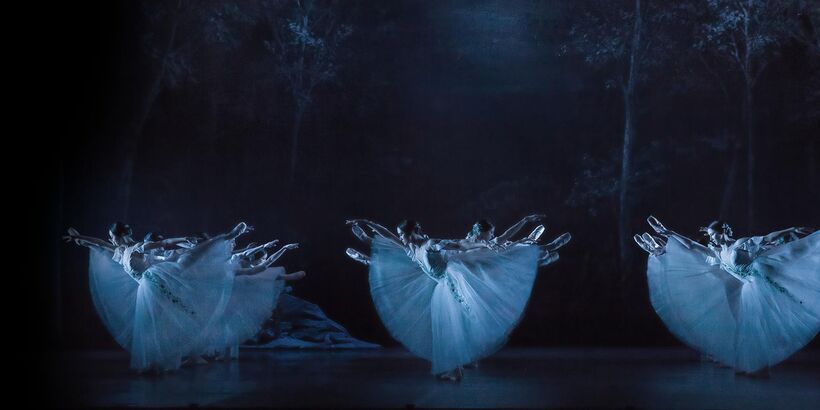
Bart’s production, following Coralli and Perrot, has been part of the company’s history since 2000, and the Staatskapelle was brilliantly conducted by Robert Reimer. A Brazilian Giselle and a South African Myrtha in a ballet born at the Paris Opéra in 1841: a reminder of the extent to which the canon travels, changing with the bodies that carry it.
Drastic Seas
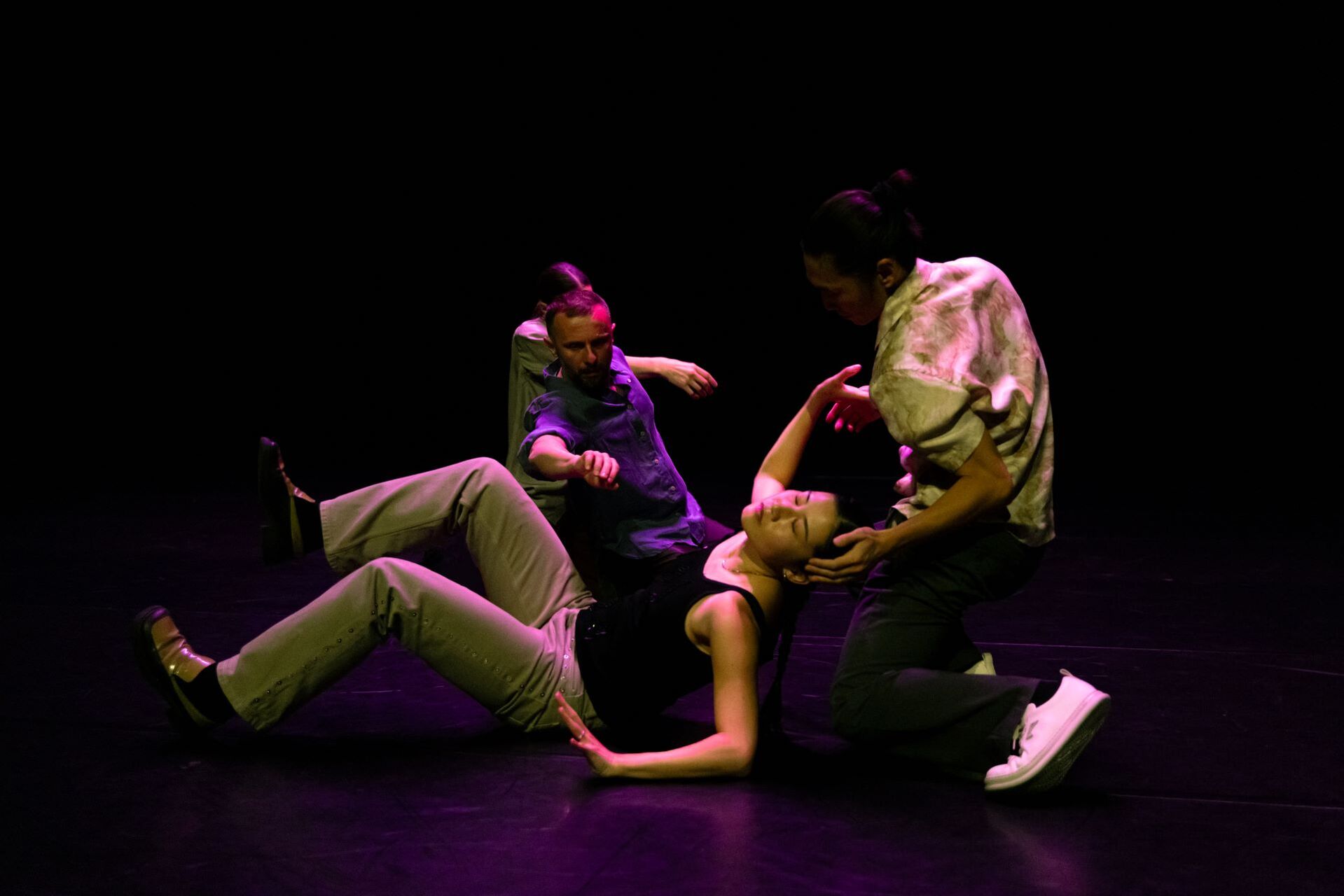
If the Wilis haunt a Romantic forest, the ghosts in Ocean Bound are coastlines. Back at Radialsystem, Berlin-based, Romanian choreographer Sergiu Matis premiered a work on ecological grief, created with Chihiro Araki, Lisa Densem, and Moo Kim, to music by Antye Greie-Ripatti (AGF), with adeptly judged sound design by Andrea Parolin. We enter directly onto the stage. Sheets of white paper hang at its centre; two dancers shake one like a breaking wave, then hang it among the others. For some twenty minutes, the audience and performers sit or walk side by side, watching videos shot in Indonesia, Chile, and Romania, where mangrove deforestation and erosion are redrawing the coastline. Nothing here is poetic; the images are concrete, almost tactile, at times brutal: plastic flip-flops among the ice, the sea eating into the forest. Ocean-bound, as the recycling industry calls plastic destined for the sea.
Then the curtain opens, we take our seats, and the dancers noisily tear down the paper, piling it on the floor like broken ice before dragging it away. On the bare stage, lighting does much of the choreography: the side and front lights rarely illuminate the whole space, slowly shifting from cold to warm. The piece is at its strongest when its fractured solos, all isolated wrists, elbows, and shoulders, condense into duets and shared forms, and when the canon returns: a broken canon of repeated elements, evoking waves without ever illustrating them. Only four dancers, yet they seem to fill the entire hall.
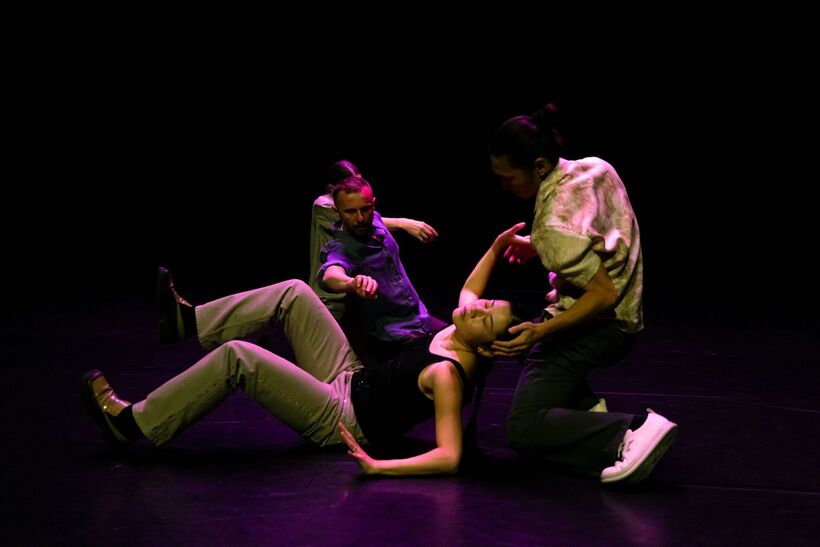
Matis is less interested in the ocean as nature, and more in what it means to us, climatically and affectively, and this is a work that we feel on our skin before it reaches our minds. In its most intense section, meticulously crafted, the bodies seem to vibrate, and I had the sensation of being out at sea, on an oil rig at the mercy of a storm. Not a divine or consoling ocean, but a violent one. What do you do with grief this large? Matis’s answer is to take his time: what at first seems long, turns out to be the work’s very engine. By refusing to hurry, Ocean Bound lets its density build until it becomes overwhelming. Physical, emotional, goosebump-inducing.
Seen in the Dark
On entering the Volksbühne for Mata Leão, by the Rio de Janeiro duo Davi Pontes and Wallace Ferreira, the first thing that strikes you is a structure of stacked platforms swallowing the centre of the stalls. Part of the audience has been seated on the stage itself, but from the stalls we see only the closed curtain, and for the first ten minutes or so we have no idea what is happening behind it. In jiu-jitsu, mata leão – “lion killer” – is a choke applied from behind, held until the opponent gives in or blacks out: a fitting title for a duo who have been developing self-defence choreographies since 2018. The piece is part of The School of Self-Defense, a wider programme of dance, theory, and ballroom that Pontes and Ferreira have devised for the Volksbühne.
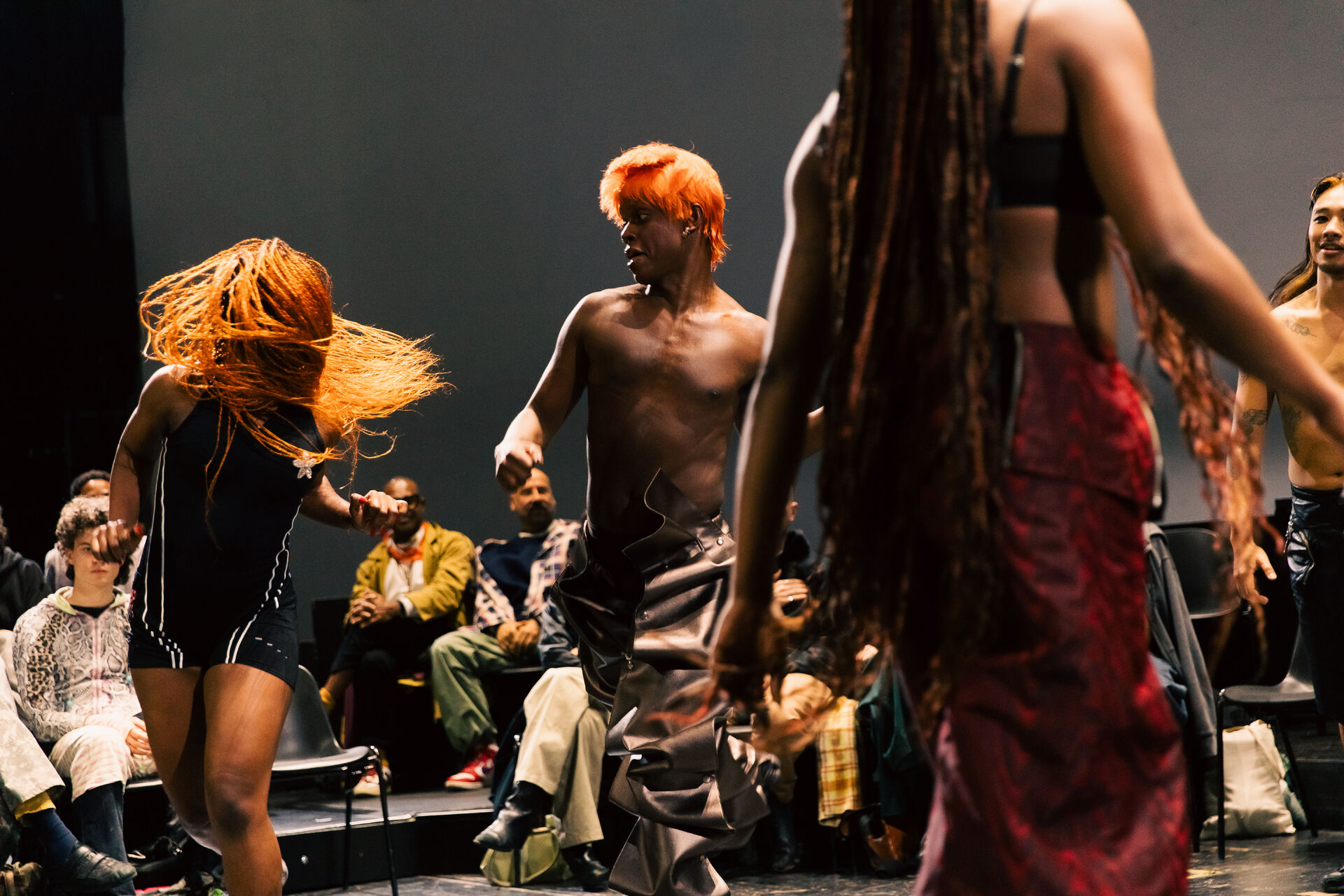
Before anything else happens, Pontes walks in alone, studies the audience from among the seats and borrows an audience member’s bag – a gorgeous cow-print design – then struts it down the aisle, turning the stalls into a runway. When the curtain finally opens, a voguing-inflected catwalk is already under way on stage: Ferreira leads the way, followed by the other six performers one by one, hailing from Berlin, elsewhere across Europe and Brazil, dressed in Djuna Reiner’s sharply styled clothes, pausing and posing like sculptures, the cow-print bag swapped between them and worn a different way each time, and something smaller passed from hand to hand, perhaps a sweet, a secret? I never worked out what it was, but I loved watching them, admiring their beautiful, immaculately manicured nails. Their arms begin to trace ballroom gestures; then come jumpstyle kicks, ballroom fused with boxing and martial arts, sometimes in unison, sometimes in two layers at once.
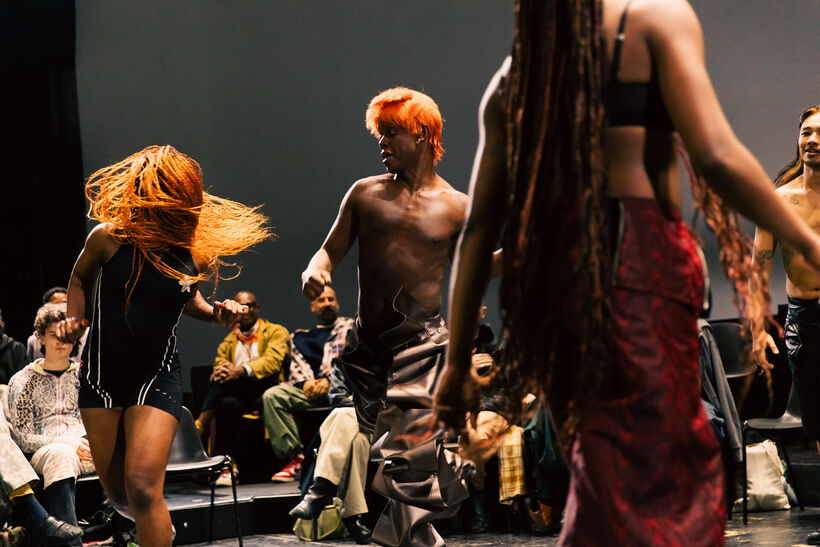
The performers look straight at us, each in turn, and we look back: for once the dark of the auditorium offers no hiding place, and we are not an anonymous audience but bodies being seen. Treating the vast Volksbühne as a challenge, the choreographers turn the usual order around, the dancers taking over the platforms right among us. No one sees everything, and no one is out of sight. The piece builds by moments rather than through a continuous phrase, and that is precisely its strength: these are not tasks ticked off one by one, but charges that build on each other, to Podeserdesligado’s mix of drums, horns, and machine beats. Towards the end, the movement grows repetitive, like a combat drill drained of its force, until everyone gathers on the steps in silence under a red light, before the dancing starts up once more.
In the post-show talk, the duo were joined by André Lepecki, one of the School’s guests and a dance studies legend. Lepecki spoke of the way the piece claims space through sheer persistence and asked to what extent a work like this can build a genuine relationship with an audience within a formal theatre space. Rather than dwelling on anti-Black violence, the choreographers choose to think from Black and queer affirmation: self-defence begins not with attack, but with the right to take up space. A state theatre needs its work to be visible, photographed and reviewed. Yet opacity is not invisibility: it is a light that does not let you look all the way through. Ballroom has always worked like this, being seen on one’s own terms, never fully read. As a spectator, it was a rare pleasure to be seen, not just to watch. As a dance writer, I am reminded that some things are meant to stay unlit.



Phil Dera.jpg)